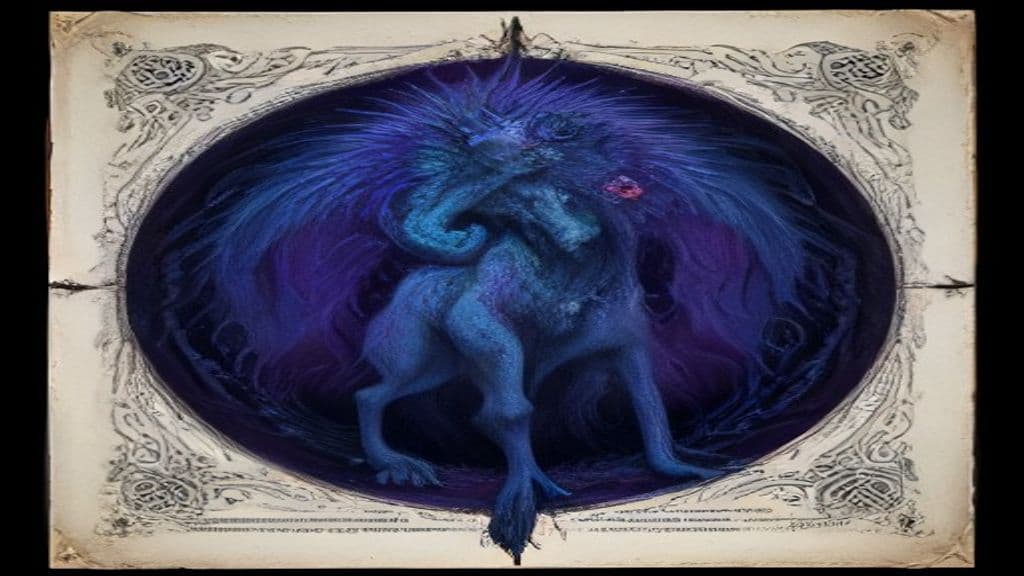
Within the grimoire corpus Aamon is not given a biographical origin narrative; he appears as an office-holder within a catalogued infernal hierarchy. Later commentators and modern summaries associate the goetic name with older theonyms — notably the Egyptian/Libyan Amun (Amoun) of Siwa and the Punic Baal Hammon — but the sources present those links as interpretive/etymological associations rather than as a direct, evidenced origin story.
Grimoire descriptions vary. In beast form Aamon is described as appearing like a wolf with a serpent's (or snake's) tail and as vomiting flames. In human guise the texts report variants: a man with doglike teeth and a large head variously likened to an owl, raven, or night-hawk; some summaries state simply 'a man with a raven's head' as an alternate reading. Manuscript traditions differ in emphasis across these elements.
The goetic texts attribute to Aamon knowledge of the past and the future and powers over human relationships — described in variant phrasings as reconciling friends and foes, procuring favor or love, or alternatively procuring feuds. He is consistently described as commanding forty legions of spirits. A manuscript variant (Harley MS 6483) reported in summaries adds that he can enable the magician to summon and interrogate the spirits of those drowned at sea; this appears as a specific manuscript reading rather than a universally attested function. The texts frame interactions as ritual: the Lesser Key indicates that at the magician's command Aamon may assume human form.
Weaknesses
- otherNo explicit vulnerability attested in supplied sources; control is effected through standard grimoire authority and the spirit's seal
Wards
- symbolSeal of Aamon (grimoire sigil) — described in the Ars Goetia tradition as 'His Seal is this which is to be worn as aforesaid' (specific image/instructions not supplied in the provided material)
A Elbereth Gilthoniel
An Elvish hymn in Sindarin addressed to Elbereth (Varda) from J. R. R. Tolkien's legendarium. Presented in The Lord of the Rings and later musical and dramatic adaptations, the hymn functions as devotional poetic language that evokes Elvish reverence for the star-kindler rather than an independent supernatural agent.
A Man Was Going Down the Road
Georgian tradition, possibly a reference to a novel title by Otar Chiladze (1973), lacking clear information on its supernatural nature or abilities. (Note: * Power tier should be set to Primordial, as there's no information on its supernatural nature or abilities; it simply appears to be a novel title without further context. * Summary: The summary is ac)
A ƭat Roog
A term attested in the vocabulary surrounding Roog within the Serer religious system; the provided sources do not supply a clear definitional account of an entity by this exact name. Material available situates the term in the wider context of Serer cosmology in which Roog is the universal supreme deity and ancestor cult (pangool) and priestly mediation (o yaal pangool) structure ritual life.
A'akuluujjusi
A'akuluujjusi is an Inuit primordial creator mother who fashioned the non-human animals and adjusted their physical traits so they could be hunted by people.
A'ra
No reliable sources in the supplied material establish A'ra as a distinct supernatural entity. The token "A'ra" appears in the dataset as (a) part of general references to pre-Islamic Arabian deities, (b) a modern Korean female given name (A-ra/아라), and (c) an Arabic toponym (A'ra, one village merged into Ar'ara).
A.R.G.U.S.
A.R.G.U.S. is a fictional clandestine United States government agency in the DC Comics universe that investigates, contains, and manages superhuman, meta-human, and supernatural incidents and assets. Introduced in The New 52 continuity, it functions as an institutional actor providing intelligence, logistical support, covert task forces (notably Task Force X / the Suicide Squad), and a dedicated magic division across comics and media adaptations.
Aani
Aani (ancient Egyptian jꜥnr) is the lexical term for the baboon in ancient Egyptian language and functions in religious contexts as an animal icon and theophoric epithet. Attested repeatedly in Egyptian texts and images, the baboon image is used to represent or denote aspects of gods such as Thoth, Hapy, Khonsu, and Osiris rather than implying the animal itself is an independent deity.
Aaron
Aaron is a central human figure in Israelite sacred literature: the elder brother of Moses, the first high priest (progenitor of the Aaronide priesthood), and a spokesman/prophet who mediates between Israel and God in Exodus–Deuteronomy narratives. His role in the texts establishes hereditary priestly authority, ritual functions (sacrifices, blessing, use of Urim and Thummim), and institutional norms for Israelite cultic life.
Aati
Aati (also rendered Ati) is one of the 42 judges of the dead in ancient Egyptian funerary literature, attested in the Book of the Dead tradition (notably the Papyrus of Nebsemy). Described as originating 'from Heliopolis', Aati's documented function is to question the deceased about a specific moral accusation during the Duat judgment; the funerary texts supply a formulaic denial the soul must recite.
Aatxe
In Basque folk mythology, Aatxe is a spirit that exists alongside humans and other entities, protecting the law-abiding and punishing malevolent individuals. (Note: 1. Power tier: The source material does not explicitly mention Aatxe as a deity-level entity, so Greater is plausible but could be clarified. 2. Abilities: While it's mentioned that Aatxe attacks male)
Ab-Zohr
Ab-Zohr is the culminating rite of the Zoroastrian Yasna service: a formal offering to the waters (Aban/Apas) that creates the consecrated liquid parahaoma and functions to purify, strengthen, and atone for damage done to waters. It is a ritual action rather than an independent supernatural being.
Aba (disambiguation / name-form)
Aba is a polyvalent name-form attested across many unrelated contexts (place names, personal names, animal names, and brief mythological listings). The provided sources do not support a single, coherent supernatural entity called "Aba" and offer no descriptive or ritual material for such a being.
Community Record
- [1]Aamon (Wikipedia). Wikipedia: 'Aamon' article summarizing Ars Goetia and Pseudomonarchia Daemonum descriptionswiki
- [2]Pseudomonarchia Daemonum (summary quoted). Summary quotation of Johann Weyer's Pseudomonarchia Daemonum as presented in the Wikipedia article on Aamonliterary
- [3]The Lesser Key of Solomon / Ars Goetia (summary quoted). Summary quotation of the Ars Goetia (The Lesser Key of Solomon) as presented in the Wikipedia article on Aamon, including mention of Harley MS 6483 variantliterary