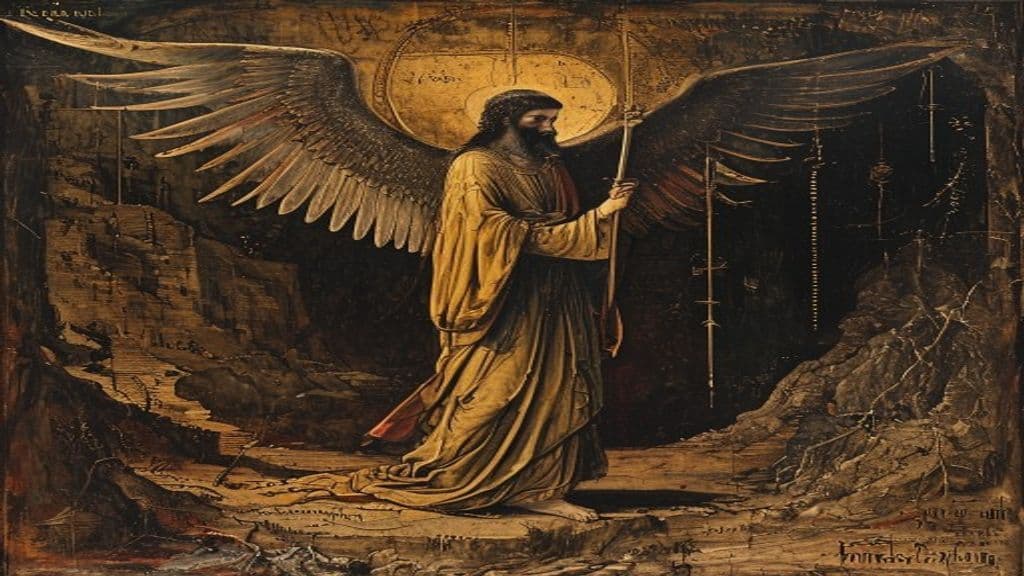
In Hebrew biblical usage the term אֲבַדּוֹן (’Ăḇaddōn) originates as a common noun meaning 'destruction' or 'doom' and designates a place or condition associated with ruin and the underworld, occurring in poetic and prophetic texts paired with Sheol (e.g., Job; Proverbs). This impersonal usage persists in Second Temple and Rabbinic contexts where 'the Sheol of Abaddon' or compartments of Gehenna are attested. The first clear literary personification of the term into an individual being appears in the Christian New Testament: Revelation 9 names an angel called Abaddon (Greek Ἀβαδδών) and gives a Greek translation Ἀπολλύων (Apollyon, 'Destroyer'), presenting the figure as the ruler of locust-like agents released from the abyss during an apocalyptic judgment sequence. Later medieval and theological literature further adapts and reinterprets the name—sometimes allegorically or polemically—so that Abaddon functions variably as an emblem of destruction, a hostile figure in epic poetry, or a subject of exegetical identification with other adversarial figures.
As a place or realm Abaddon is described in biblical poetry only as part of the underworld/abyssal geography—bottomless pit, a domain paired with Sheol and Gehenna—without a physical form. As an individual in Revelation 9:1–11 Abaddon is named as the angel or king of an army of locusts; the text itself does not give a detailed anthropomorphic portrait of Abaddon beyond his title and rulership. The associated locusts are vividly described in Revelation as resembling horses and possessing crowned human faces, women's hair, lions' teeth, wings, iron breast-plates, and tails like scorpions' stingers.
When treated as a realm, Abaddon functions metaphorically and ontologically as destruction itself—a devouring or insatiable domain that, in poetic passages, cannot be satisfied (e.g., Proverbs). In Revelation Abaddon is depicted as an agent with authority over an infernal host: he is called the king of locusts released from the abyss and thus commands a tormenting plague that afflicts people for a limited period (five months) and targets those without God's seal. Exegetical traditions diverge on Abaddon's ultimate alignment: some commentators treat him as an instrument acting at God's bidding, while others equate or associate him interpretively with Satan or Antichrist; these are theological readings rather than uniform scriptural assertions.
Weaknesses
- conditionThose who bear the seal of God on their foreheads are not tormented by the locusts (protective condition in Revelation 9:4)
Wards
- conditionThe 'seal of God' on the forehead as described in Revelation functions in the scripture as the protective state that spares persons from the locust-torment

Aatxe
In Basque folk mythology, Aatxe is a spirit that exists alongside humans and other entities, protecting the law-abiding and punishing malevolent individuals. (Note: 1. Power tier: The source material does not explicitly mention Aatxe as a deity-level entity, so Greater is plausible but could be clarified. 2. Abilities: While it's mentioned that Aatxe attacks male)
Ab-Zohr
Ab-Zohr is the culminating rite of the Zoroastrian Yasna service: a formal offering to the waters (Aban/Apas) that creates the consecrated liquid parahaoma and functions to purify, strengthen, and atone for damage done to waters. It is a ritual action rather than an independent supernatural being.
Aba (disambiguation / name-form)
Aba is a polyvalent name-form attested across many unrelated contexts (place names, personal names, animal names, and brief mythological listings). The provided sources do not support a single, coherent supernatural entity called "Aba" and offer no descriptive or ritual material for such a being.
Abaasy
Abaasy (Abaahy, Abasy; Yakut: Абаасы, Abaası) are beings of the Sakha (Yakut) underworld, depicted in sources as destructive underworld spirits or demons associated with the long deceased. They inhabit the lower cosmic layer, serve an underworld ruler, are blamed for disease and madness, and may be appeased by blood sacrifice.
Ababil
Ababil (Arabic: أبابيل, romanized abābīl) are miraculous birds mentioned in the Qur'anic account of Surah Al‑Fil. In Islamic tradition they appear as a divinely sent avian host that defended the Kaaba by pelting an invading army with small clay stones; tradition places the event in the year traditionally given as 570 CE.
Abada (unicorn)
Mythical creature in Central African tradition with two crooked horns, possessing healing properties. (Note: 1. Power tier: Primordial (Abada has cosmic, deity-level healing properties) 2. Sensory cues: physical presence and possibly an aura or energy emanating from the horns 3. Weaknesses: should be mention)
Abadir
Abadir is a polysemous name attested in distinct cultural contexts: a legendary founding saint and clan ancestor in eastern Ethiopia (Sheikh Abadir Umar Al‑Rida / Aw Abadir), a term applied to cone‑shaped cult stones in Phoenician religious description, and a personal name of a martyr (Abadir/Apater) in the Coptic Synaxarium. The attestations are independent usages of the same name rather than a single supernatural being.
Abadiu of Antinoe
Abadiu of Antinoe was a fourth‑century bishop of Antinoe (Antinoopolis, in Roman Egypt) commemorated as a martyr and saint in the Coptic Orthodox Church, with a feast day on 26 December. Sources record that he was killed during a theological dispute with Arian opponents and reference him in collections of Egyptian martyrs.
Abagtha
Abagtha (Hebrew: אבגתא, ’Ǎḇaḡṯā) is a named human court official in the Hebrew Bible’s Book of Esther, listed among seven chamberlains who ministered before King Ahasuerus and were commanded to bring Queen Vashti before the king. He is attested only in Esther 1:10 and is presented as an institutional palace attendant rather than a supernatural being.
Abaia
Abaia is a singular, enormous freshwater eel spirit from Melanesian tradition (notably Fiji, the Solomon Islands, and Vanuatu) that dwells in lake depths and protects all aquatic life; when humans harm lake creatures it responds by creating waves, storms, or floods that drown transgressors.
Aban (Āb/Ābān)
Aban (Avestan apas; Middle Persian āb/ābān) is the collective, sacred principle of the waters in Zoroastrian cosmology — both the element water and its personified hypostases (the Apas/Ahuranis). Aban functions as a primordial, life-giving creation, a calendrical and liturgical focus (day-name, month-name, Abanagan feast), and a ritual object of veneration (ape zaothra, Aban Yasht) rather than a malign force to be expelled.
Aban Yasht
The Aban Yasht is a hymn from the Persian tradition that praises Anahita, a goddess associated with water, fertility, and wisdom. It consists of 132 stanzas and is part of the 21 Yashts collection. (Note: - Power tier should be "Primordial" or possibly "Cosmic", given that it's a hymn of great spiritual significance and associated with a goddess. - The article incorrectly states that Anahita is associa)
Community Record
- [1]Abaddon - Wikipedia. Wikipedia, 'Abaddon' article (summarizing biblical usage, Revelation 9, etymology, and medieval literary uses).wiki
- [2]Wikidata entry: Abaddon. Wikidata item summarizing identifiers and linked descriptions for Abaddon/Apollyon.other
- [3]Archive item (modern cultural references). Archive.org item cited in source list noting modern cultural usages of the name 'Abaddon' (cultural afterlife rather than primary traditional data).other
- [4]Archive item (modern cultural references). Archive.org item cited in source list noting modern cultural usages of the name 'Abaddon' (cultural afterlife rather than primary traditional data).other