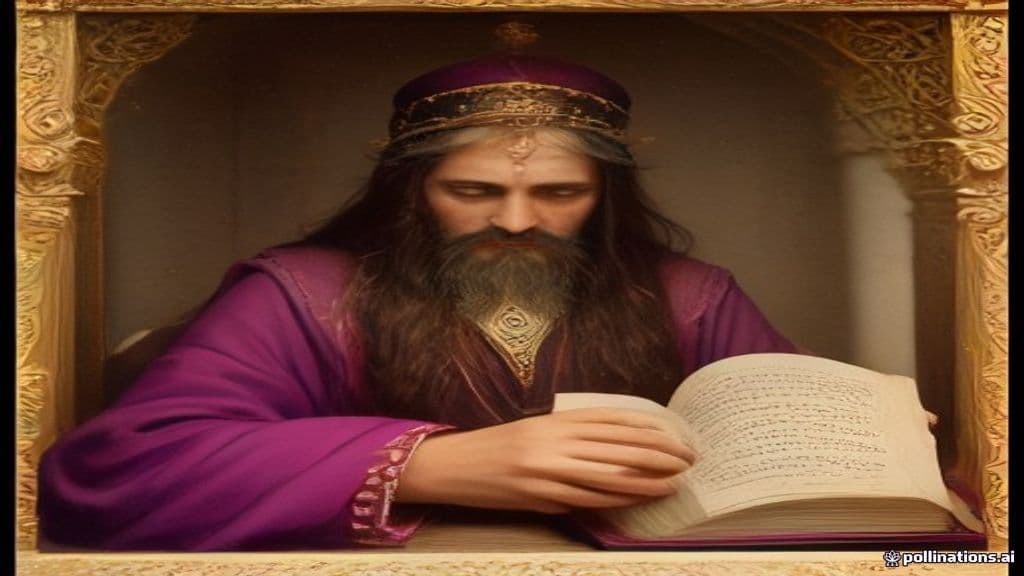
Abagtha has no mythological origin narrative in the sources provided. He appears as a named individual in the single biblical attestation of Esther 1:10, which situates him among the seven chamberlains attending King Ahasuerus during the events of the royal banquets in the third year of the king’s reign. Modern scholarship records etymological proposals for the name: one proposal equates the form with Old Persian Bagadāta (rendered in some discussions as 'Bigtha'), meaning roughly 'god-given' or 'law received from god'; an alternative proposal derives it from Avestan gabata, 'fortunate one'. These etymologies are scholarly suggestions about the name’s linguistic origin rather than narrative origins within the biblical text.
The biblical text and the supplied secondary sources give no physical description of Abagtha. He is identified by title as a סָרִיס (sarīs) — a term used in Hebrew to denote a palace officer or attendant and which can, in different contexts, mean a eunuch or more broadly a high-ranking court official. Apart from his listing among the seven chamberlains named in Esther 1:10, no details of clothing, bodily features, or distinguishing marks are provided in the sources.
Sources attribute no supernatural powers to Abagtha. His described role is administrative and functional: as one of the seven chamberlains who 'ministered in the presence of Ahasuerus the king,' he carries out royal commands such as being ordered, along with the other chamberlains, to bring Queen Vashti before the king wearing the crown royal. The narrative frames him as an instrument of palace authority and protocol rather than as a bearer of magical or extraordinary abilities.
Community Record
- [1]Abagtha (Wikipedia). Wikipedia contributors, 'Abagtha,' Wikipedia, The Free Encyclopediawiki
- [2]Wikidata: Abagtha (Q304781). Wikidata entry Q304781 for Abagthaother
- [3]Esther Chapter 1 (American Standard Version) — Archive. American Standard Version, Esther 1:10 (archive transcription)literary
- [4]Esther Chapter 1 (Textbibel) — Archive. Textbibel transcription of Esther 1 (archive)literary