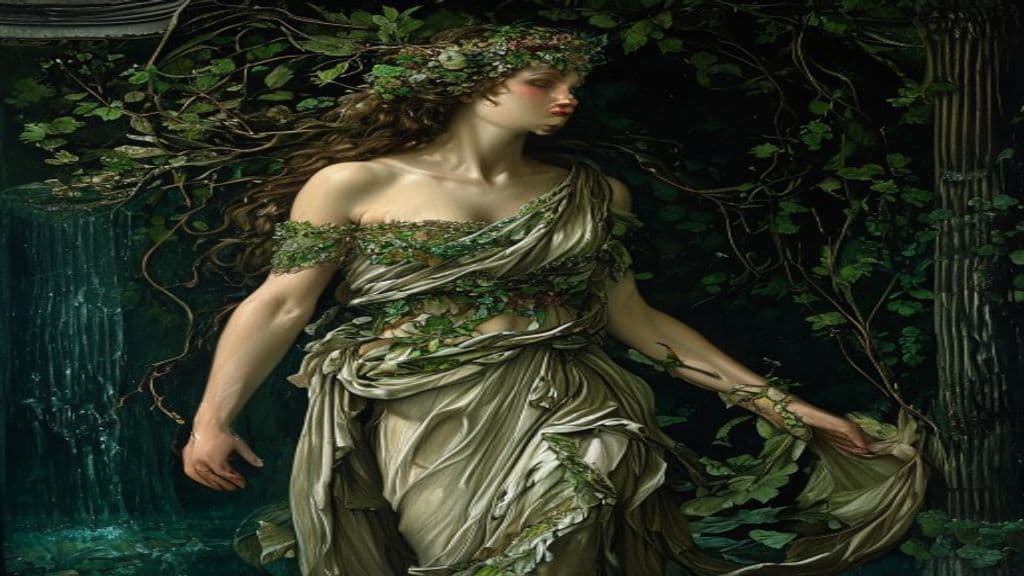
The sources provide no full origin narrative for Abarbarea. Classical authors present Abarbarea as a naiad — a freshwater nymph — and the name is attached to at least two mythic personages: one identified as the naiad wife of Bucolion (attested in the Homeric/Iliadic tradition cited by modern summaries) and another cited as a naiad ancestress of the Tyrians (attested in later mythographic tradition such as Nonnus as summarized in the available references). Hesychius records plural lexical forms (Ἀβαρβαρέαι / Ἀβαρβαλαια), which the lexicographer lists as names, indicating that the term also occurs in plural in ancient lexical tradition.
The provided sources do not supply descriptive physical details for Abarbarea. She is categorized as a naiad, and therefore, within Greek mythic taxonomy, would be regarded as a freshwater nymph associated with springs or rivers; however, no specific attributes (form, clothing, coloration, or distinguishing features) are described in the cited material.
No explicit powers, deeds, or behaviors are recorded for Abarbarea in the supplied sources. The attestations only identify her as a naiad — a class of semi-divine nature-spirits tied to fresh water — and attach her to genealogical roles (wife of Bucolion; ancestress of the Tyrians). Beyond that generic cultural association with freshwater, the sources do not enumerate particular abilities, interactions with humans, or mythic exploits.
Cinyras
Cinyras is a mythic human king and eponymous founder-figure in Greek and Roman literary traditions, chiefly associated with Cyprus (notably Paphos). He functions as a legendary ancestor, founder of priestly lines connected to the cult of Aphrodite Paphia, and the tragic protagonist of the Myrrha–Adonis cycle; classical authors also link him with musical skill and eastern (Phoenician/Cilician/Byblian) cultural connections.
Erichthonius of Athens
Erichthonius is a legendary early ruler and culture-hero of Athens in Greek tradition, credited with civic innovations (notably the quadriga/chariot) and serving as an ancestral figure in Athenian royal genealogies; he is linked to Hephaestus and to Athena and figures in festival memory and art rather than as a malignant supernatural being.
Polyphemus
Polyphemus is the Homeric Cyclops — a one‑eyed giant shepherd who lives outside Greek civic norms, notorious for refusing hospitality and for blinding and being blinded by Odysseus. Later literature reframes him variously as comic, rhetorical, or lovesick, but the core tradition presents him as a liminal, semi‑divine monstrous figure (son of Poseidon).
Abaia
Abaia is a singular, enormous freshwater eel spirit from Melanesian tradition (notably Fiji, the Solomon Islands, and Vanuatu) that dwells in lake depths and protects all aquatic life; when humans harm lake creatures it responds by creating waves, storms, or floods that drown transgressors.
Aban (Āb/Ābān)
Aban (Avestan apas; Middle Persian āb/ābān) is the collective, sacred principle of the waters in Zoroastrian cosmology — both the element water and its personified hypostases (the Apas/Ahuranis). Aban functions as a primordial, life-giving creation, a calendrical and liturgical focus (day-name, month-name, Abanagan feast), and a ritual object of veneration (ape zaothra, Aban Yasht) rather than a malign force to be expelled.
Aban Yasht
The Aban Yasht is a hymn from the Persian tradition that praises Anahita, a goddess associated with water, fertility, and wisdom. It consists of 132 stanzas and is part of the 21 Yashts collection. (Note: - Power tier should be "Primordial" or possibly "Cosmic", given that it's a hymn of great spiritual significance and associated with a goddess. - The article incorrectly states that Anahita is associa)
Abandinus
Abandinus is a locally attested Romano‑Celtic theonym known from a single inscribed bronze feather (votive object) dedicated at Godmanchester (the Roman fort Durovigutum) in Cambridgeshire. Scholars interpret him as a local god or male spirit tied to a specific place and possibly associated with a nearby spring or stream; this association is tentative and based on etymological readings of the name.
Abanoub
Abanoub is a 4th‑century Egyptian Christian child martyr venerated in the Coptic tradition. Remembered for his public confession of Christ, miraculous healings associated with his passion, and the translation and veneration of his relics, his feast is observed on July 31 (Epip 24) and his cult centers include Nehisa and Samanoud.
Abarta (Ábartach)
Abarta (also Ábartach) is a figure of Irish myth who, in surviving accounts, tricks Fionn mac Cumhaill's warriors by giving them a supernatural grey horse that bears them into the Otherworld. Sources variably identify him as a member of the Tuatha Dé Danann or as a Fomorian; after the incident he is compelled to release the captured warriors and is refused entry to the Fianna.
Abas
Abas (Ancient Greek: Ἄβας, gen.: Ἄβαντος) is not a single mythic being but a recurring personal name borne by multiple mortals and minor mythic figures in Greek epic and genealogical traditions — kings, founders, seers, warriors, attendants, a centaur, and a youth transformed by a goddess. The name is glossed in the sources as 'guileless' or 'good-hearted' and appears across Argive, Theban, Trojan, Euboean, and other local cycles.
Abaset
Abaset is a localized ancient Egyptian goddess attested in tomb decoration at El‑Bawiti in the Bahariya Oasis during the 26th Dynasty. She is depicted anthropomorphically with a hedgehog motif incorporated into her headdress and appears on the walls of Qarat Qasr Salim, including twice in the Tomb of Bannentiu. No cult texts, myth narratives, or ritual prescriptions for her are recorded in the cited corpus.
Abaskhiron the Soldier
A Coptic Orthodox martyr venerated for refusing imperial idolatry during the Diocletian persecution; reputedly healed by the Archangel Michael, preserved in monastery relics, and commemorated on 14 June (7 Paoni).
Community Record
- [1]Abarbarea — Wikipedia. Wikipedia, entry 'Abarbarea' (online)wiki
- [2]Abarbarea — Wikidata. Wikidata entry Q279782 (classification: naiad)other