
The term 'Abas' functions as an anthroponym in Greek myth rather than denoting a single origin. Individual bearers include: (1) Abas, king of Argos (a royal figure in the Argive genealogical cycle); (2) Abas, son of Poseidon and Arethusa, a Thracian-born founder who gave his name to the Abantians/Abantes and migrated to rule in Euboea; (3) Abas, son of Metaneira (in one version), a boy who mocked the wandering Demeter and was changed into a lizard (this metamorphosis narrative is alternatively told of a boy named Ascalabus with mother Misme in other traditions); (4) Abas, son of Melampus, an Argive seer in the prophetic lineage of Melampus; (5) various martial and attendant figures called Abas who serve as defenders of Thebes, companions of heroes such as Perseus, Diomedes, and Aeneas, a centaur present at the wedding of Pirithous and Hippodamia, and a servant/watchman of King Lycomedes on Scyros. These disparate genealogies and episodes derive from a range of classical authors and scholiasts summarized in the available sources.
No single physical description unites all bearers of the name. Descriptions follow the individual's narrative role: the metamorphosed boy is explicitly transformed into a lizard in the Demeter episode; one Abas is a centaur (implying the conventional half-man, half-horse form); royal, seer, attendant, and warrior Abases are described only by their social roles and actions in the surviving summaries rather than by distinctive corporeal traits.
Bearer-specific, generally mortal capacities consistent with their narrative roles. Abas son of Poseidon functions as a dynastic founder and king who leads migrations and rules (founding the Abantians/Abantes in Euboea). Abas son of Melampus is placed in the prophetic tradition (a seer), though no discrete prophetic acts are preserved in the provided summaries. Several Abases act as warriors and defenders who engage in battle and may be slain by named opponents; others serve as attendants or watchkeepers (e.g., the servant of Lycomedes who reports approaching ships). The metamorphosed youth exhibits the outcome of divine transformation rather than an innate supernatural ability.
Weaknesses
- otherNot applicable (name-bearers are mortal figures; no collective weaknesses are attested)
Wards
- otherNot applicable (no warding practices associated with the name are recorded)

Kitsune
Fox spirits of Japanese mythology — intelligent, long-lived beings who gain additional tails (up to nine) as they age and grow in power. They serve as messengers of the god Inari and as powerful tricksters.
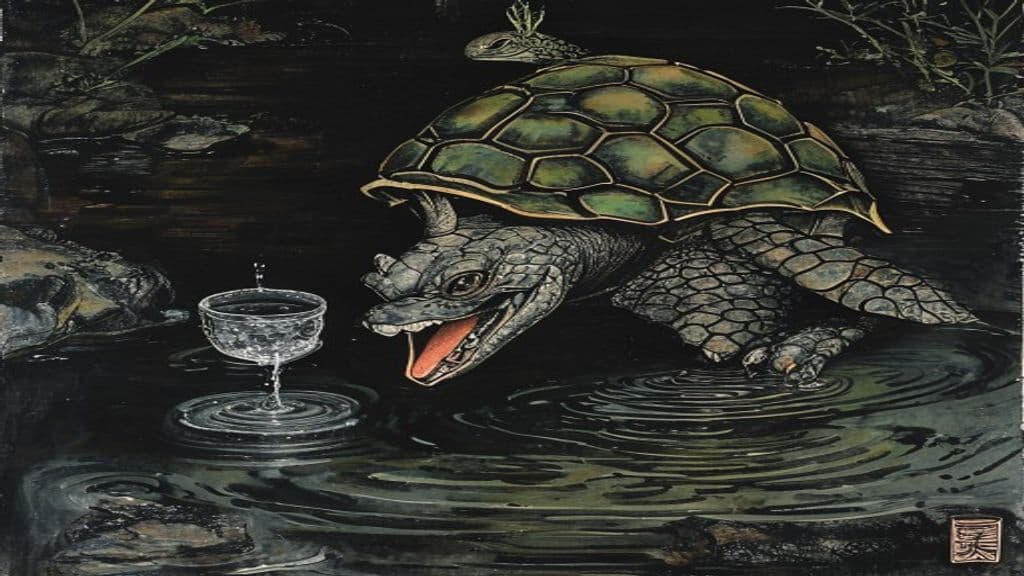
Kappa
A water-dwelling imp of Japanese folklore with a bowl of water on its head. Mischievous but bound by strict codes of politeness; dangerous near rivers.

Iblis
The primordial deceiver in Islamic theology; a jinn who refused God's command to bow before Adam and was expelled from heaven. The source of all temptation and whispered suggestion.
Acheilus
Acheilus (also spelled Akheilos/Achilleus in some sources) is a minor figure of Greek myth described as a mortal son of Zeus who was transformed into a shark and thereafter called a 'shark-formed sea daimon.' Surviving summaries frame his story as a hubris metamorphosis: boasting about his beauty led a goddess to change him into a marine monster.
Achelois
Achelois (Ancient Greek: Ἀχελωίς, 'she who drives away pain') is an attributive name or epithet used in ancient Greek mythic contexts rather than a single, consistently characterized being. The term appears applied to several different figures — a surname of the Sirens, a general name for certain water-nymphs (Acheloides), and as the name of a daughter of Pierus — and functions within Greek naming practice as a descriptive label rather than a fixed ontological office.
Achilles (son of Zeus)
A minor figure in Greek myth named Akhilleus (Ancient Greek: Ἀχιλλεύς), presented in some traditions as a son of Zeus and the Lamia who was famed for irresistible beauty, won a beauty contest judged by Pan, and was transformed into ugliness by Aphrodite. This Akhilleus is distinct from the Homeric hero of the Trojan War.
Achiroe
Achiroe (variants Anchirrhoë, Anchinoë/Ankhinoe) is a minor Greek mythological figure: a Naiad associated with the river Nile, daughter of the river-god Nilus, who becomes the wife of the Egyptian king Belus and mother of mythic progenitors such as Aegyptus and Danaus (with some accounts also naming Cepheus and Phineus). She functions primarily as a genealogical link between river-divinity and royal lineages rather than as an active agent in surviving myths.
Acontes
Acontes (Ancient Greek: Ἀκόντην) is an Arcadian prince in Greek mythology, counted among the fifty sons of the impious King Lycaon. He appears in the Lycaon narrative as a participant in a sacrilegious meal prepared for Zeus (disguised as a peasant) and is destroyed by the god's lightning as punishment.
Actaea
Actaea is a named sea‑nymph in Greek mythic lists, identified in the provided sources as the personification or eponym of the seashore. She appears primarily in onomastic and catalogue contexts (lists of nymphs/Nereids) and has no surviving independent narrative or cultic rites attested in the cited material.
Acte (Akte)
Acte (Ancient Greek Akte, sometimes rendered Acme) is a divine personification in Greek myth: one of the Horae who embodies a particular hour of the day — specifically the hour of eating and pleasure, a designated afternoon work-hour — and functions chiefly as a temporal marker rather than an active mythic agent.
Adonia
The Adonia festival is a ritual mourning celebration for Adonis, the consort of Aphrodite in ancient Greek mythology. (Note: 1. The draft claims that the article is about a "ritual mourning celebration", but the source only mentions the festival as a mourning celebration. 2. Power tier should be Primordial or Ancient since )
Adrastus
Adrastus (Ancient Greek: Ἄδραστος or Ἄδρηστος) is a legendary king of Argos in the Greek mythic-historical tradition, best known as the leader of the expedition of the Seven against Thebes and as a figure tied to oracular counsel, dynastic marriages, and local hero cults.
Aega
Aega is attested in modern reference works as a mythological name from the Greek tradition; the string 'Aega' is used for more than one minor figure or entry in Greek mythic catalogs. Surviving provided sources give no coherent myth, iconography, or rituals tied to a single, identifiable deity or spirit named Aega.
Aegaeus
Aegaeus (Ancient Greek: Αἰγαῖος) appears in Greek myth as (1) a local river-god associated with the island called Scheria (traditionally associated with Corfu) and father of the nymphs Aigaiides and of Melite (who in some sources bore Heracles a son, Hyllus), and (2) as a toponymic surname/epithet of the sea-god Poseidon derived from the town of Aegae in Euboea.
Aegesta
Aegesta is an ancient place-name and eponym recorded in Greek and Roman sources as an alternate form of Segesta, an Elymian city in northwestern Sicily, and as a mythic personal name (Aegestus/Aegesta) tied to Trojan foundation legends rather than a supernatural being.
Community Record
- [1]Abas (mythology) — Wikipedia. Wikipedia, 'Abas (mythology)' (summary of classical sources including Apollodorus, Ovid, Homer, Pausanias, Hyginus, Statius, Antoninus Liberalis).wiki
- [2]LP0047 Labors End (archive). Archive item referenced in research notes (contextual collection).other
- [3]For The Record #249 - Bush-Whacked (archive). Archive item referenced in research notes (included in supplied material list).other
- [4]Lecture Series #9 - What Does the 'W' in George W. Bush Stand For? (archive). Archive item referenced in research notes (included in supplied material list).other
- [5]Abas (disambiguation). Wikipedia, 'Abas' (disambiguation) — lists multiple uses of the name including mythological persons.wiki
- [6]Abas (son of Lynceus). Wikipedia, 'Abas (son of Lynceus)' — identifies Abas as the twelfth king of Argos, great-grandfather of Perseus, founder of Abae and Argos Pelasgikon, and notes Hera's favour and a blessed shield (excerpt truncated in source).wiki
- [7]Abas (mythology). Wikipedia, 'Abas (mythology)' — gives the Ancient Greek name Ἄβας (gen.: Ἄβαντος), glosses the name as 'guileless' or 'good-hearted', and notes the name belongs to multiple figures including two companions of Aeneas.wiki
- [8]Abas (Wikidata). Wikidata entry for 'Abas' (aggregated identifiers for name uses and persons).wiki