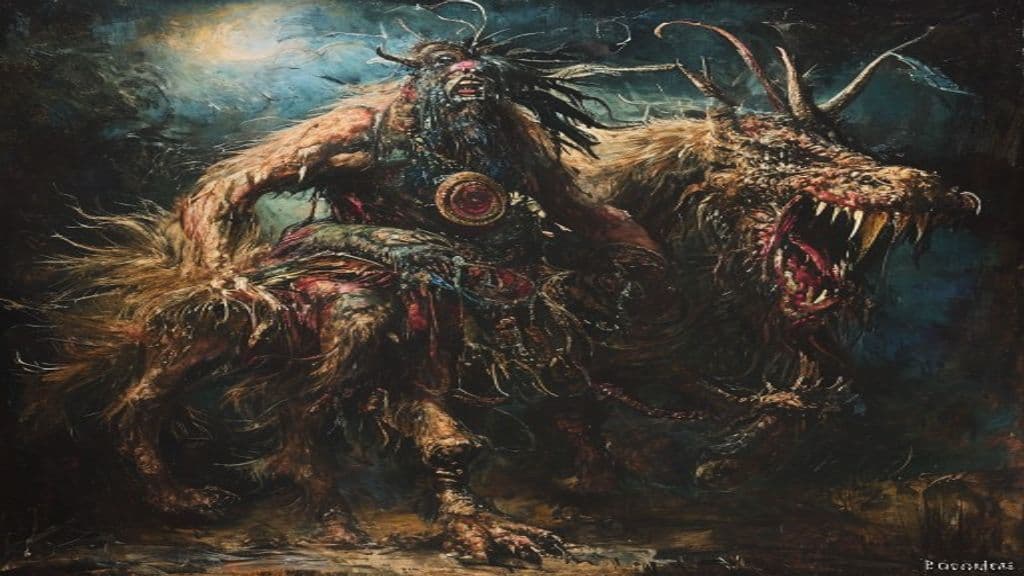
Sources present the abaasy as inhabitants of the lower world or 'kingdom of darkness' in Sakha cosmology. They are alleged to be spirits of the long deceased who dwell near graves or in deserted places and to serve the underworld ruler Arson-Duolai, who is said to swallow people's souls and give diseases. The concept is embedded in Sakha thought and language (the verb абааһы көр- 'to see abaasy' is used idiomatically for 'to hate' or 'to dislike').
Abaasy are described in sources as ugly, horrible, man-eating beings; individually they are portrayed as monstrous (one-eyed, one-armed, one-legged). They are sometimes shown mounted on monstrous steeds described as two-headed, eight-legged, two-tailed dragons. In Olonkho epic poems a named chief (Alyp Khara Aat Mogoidoon) appears as a three-headed, six-armed, six-legged giant with an iron body.
The abaasy are alleged to dwell in the underworld and near graves or deserted places and to travel about causing destruction. They are associated with causing disease, sexual manifestations, and madness, and in epic narratives are man-eaters. They serve Arson-Duolai, who is said to swallow souls and give disease. The sources note that abaasy can be appeased by blood sacrifices.
Weaknesses
None recorded.
Wards
- ritualblood sacrifice (appeasement)
Aani
Aani (ancient Egyptian jꜥnr) is the lexical term for the baboon in ancient Egyptian language and functions in religious contexts as an animal icon and theophoric epithet. Attested repeatedly in Egyptian texts and images, the baboon image is used to represent or denote aspects of gods such as Thoth, Hapy, Khonsu, and Osiris rather than implying the animal itself is an independent deity.
Aaron
Aaron is a central human figure in Israelite sacred literature: the elder brother of Moses, the first high priest (progenitor of the Aaronide priesthood), and a spokesman/prophet who mediates between Israel and God in Exodus–Deuteronomy narratives. His role in the texts establishes hereditary priestly authority, ritual functions (sacrifices, blessing, use of Urim and Thummim), and institutional norms for Israelite cultic life.
Aati
Aati (also rendered Ati) is one of the 42 judges of the dead in ancient Egyptian funerary literature, attested in the Book of the Dead tradition (notably the Papyrus of Nebsemy). Described as originating 'from Heliopolis', Aati's documented function is to question the deceased about a specific moral accusation during the Duat judgment; the funerary texts supply a formulaic denial the soul must recite.
Aatxe
In Basque folk mythology, Aatxe is a spirit that exists alongside humans and other entities, protecting the law-abiding and punishing malevolent individuals. (Note: 1. Power tier: The source material does not explicitly mention Aatxe as a deity-level entity, so Greater is plausible but could be clarified. 2. Abilities: While it's mentioned that Aatxe attacks male)
Ab-Zohr
Ab-Zohr is the culminating rite of the Zoroastrian Yasna service: a formal offering to the waters (Aban/Apas) that creates the consecrated liquid parahaoma and functions to purify, strengthen, and atone for damage done to waters. It is a ritual action rather than an independent supernatural being.
Aba (disambiguation / name-form)
Aba is a polyvalent name-form attested across many unrelated contexts (place names, personal names, animal names, and brief mythological listings). The provided sources do not support a single, coherent supernatural entity called "Aba" and offer no descriptive or ritual material for such a being.
Ababil
Ababil (Arabic: أبابيل, romanized abābīl) are miraculous birds mentioned in the Qur'anic account of Surah Al‑Fil. In Islamic tradition they appear as a divinely sent avian host that defended the Kaaba by pelting an invading army with small clay stones; tradition places the event in the year traditionally given as 570 CE.
Abada (unicorn)
Mythical creature in Central African tradition with two crooked horns, possessing healing properties. (Note: 1. Power tier: Primordial (Abada has cosmic, deity-level healing properties) 2. Sensory cues: physical presence and possibly an aura or energy emanating from the horns 3. Weaknesses: should be mention)
Abaddon
In Hebrew scripture Abaddon is primarily a noun meaning 'destruction' or a section/condition of the underworld paired with Sheol; in the New Testament Book of Revelation Abaddon is personified as an angelic figure (Greek Apollyon) described as the king of an army of locusts released from the abyss during the apocalypse.
Abadir
Abadir is a polysemous name attested in distinct cultural contexts: a legendary founding saint and clan ancestor in eastern Ethiopia (Sheikh Abadir Umar Al‑Rida / Aw Abadir), a term applied to cone‑shaped cult stones in Phoenician religious description, and a personal name of a martyr (Abadir/Apater) in the Coptic Synaxarium. The attestations are independent usages of the same name rather than a single supernatural being.
Abadiu of Antinoe
Abadiu of Antinoe was a fourth‑century bishop of Antinoe (Antinoopolis, in Roman Egypt) commemorated as a martyr and saint in the Coptic Orthodox Church, with a feast day on 26 December. Sources record that he was killed during a theological dispute with Arian opponents and reference him in collections of Egyptian martyrs.
Abagtha
Abagtha (Hebrew: אבגתא, ’Ǎḇaḡṯā) is a named human court official in the Hebrew Bible’s Book of Esther, listed among seven chamberlains who ministered before King Ahasuerus and were commanded to bring Queen Vashti before the king. He is attested only in Esther 1:10 and is presented as an institutional palace attendant rather than a supernatural being.
Community Record
- [1]Abasy. Wikipedia contributors, 'Abasy,' Wikipedia, The Free Encyclopedia, https://en.wikipedia.org/wiki/Abasywiki