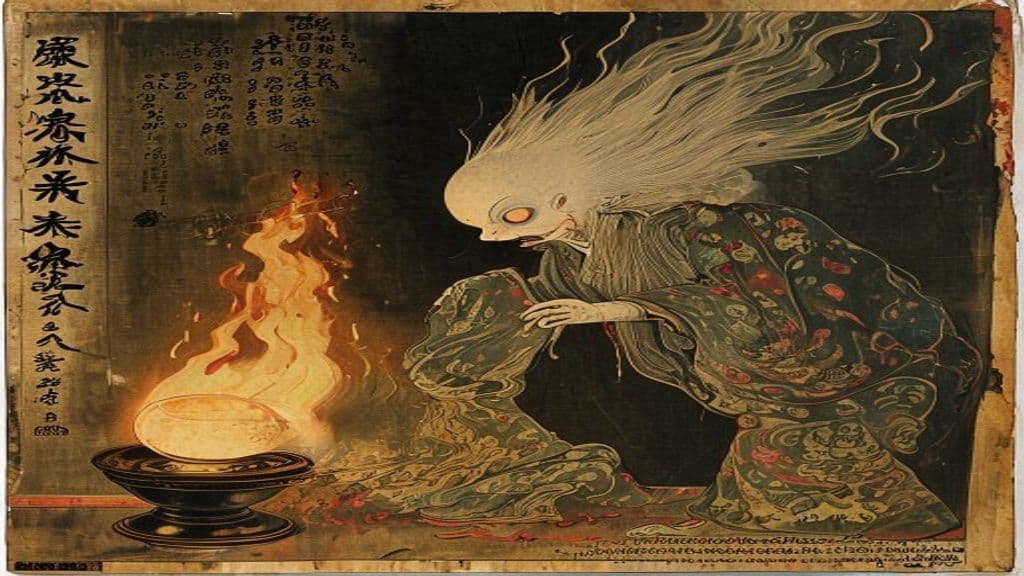
Toriyama Sekien's Konjaku Gazu Zoku Hyakki records a local tale from Ōtsu in Ōmi Province that long ago an oil merchant stole oil nightly from the Jizō at the Ōtsu crossroads; when he died his soul became a flame. Sekien presents a note linking that flame‑story (abura‑nusumi no hi) to an infant figure that laps oil from lamps and suggests the baby‑figure may be the reborn soul of the oil‑stealer. Later yōkai compendia and commentators treat this as a folkloric etiological account and as part of a cluster of oil‑related yōkai narrative motifs rather than as a demonstrable historical fact.
Sekien's illustration shows an infant spirit lapping oil from an andon lamp; his accompanying note describes a flying ball‑like fire in Hatchō, Ōtsu. Later yōkai literature summarizes the creature as alternating between a ball of flame (mysterious fire/abura‑nusumi no hi) and a baby that briefly shapeshifts to lick andon lanterns before returning to flame and departing.
Primary behavior recorded in Sekien and later sources is the licking or sucking of oil from lamps. Sources describe a duality or alternation: a flying, ball‑like fire that at times assumes the appearance of a baby to take oil, then reverts to flame and leaves. Sekien frames this behavior as the postmortem repetition of an oil merchant's theft of a roadside Jizō's oil. Modern commentators note mundane explanations (for example, animals such as cats licking fish‑oil lamps) as possible rationalizations for the sightings and imagery.
Weaknesses
- otherNo specific weaknesses recorded in Sekien or the provided sources; treated in the material as an etiological/cautionary motif rather than a combatant spirit.
Wards
- otherNo specific warding rituals, charms, or prescriptions are recorded in the supplied sources; prevention is presented primarily as moral caution (avoid stealing or wasting oil).

Absyrtus
Absyrtus (Ancient Greek: Ἄψυρτος) is a Colchian prince in the Greek Argonautic cycle, son of King Aeëtes and brother or half-brother of Medea. He appears in variant traditions either as a companion taken by Medea during her flight with Jason and murdered/dismembered to delay pursuit, or as a pursuer sent by Aeëtes who is overtaken and slain by Jason; his death functions as a key narrative device in the escape from Colchis.
Abtin
Abtin (Persian: آبتین), attested also as Athwya, is a mythic ancestral figure in Iranian tradition described in Avestan and later epic literature as one of a small set of formative human-like figures involved in preparing the corporeal world and as the father of the epic hero-king Fereydun in the Shahnama.
Abu
Abu is a poorly understood Mesopotamian god attested in modern reference summaries. Secondary literature tentatively links him with vegetation and snakes and records that he was often paired with a deity written gu2-la2, but primary details about his cult, iconography, and myths are lacking in the cited sources.
Abumi-guchi
A Japanese yōkai classed as a tsukumogami: an animated stirrup (abumi) depicted in Sekien Toriyama's Gazu Hyakki Tsurezure Bukuro. Traditional accounts say it is formed from a stirrup that belonged to a soldier who fell in battle and that it waits where the stirrup lies for its dead owner to return.
Abundantia
Abundantia is the Roman divine personification of abundance and material plenty, used primarily in imperial propaganda and public iconography to signify secure grain supplies, wealth, and the promise of a 'Golden Age' under the emperor. She also appears in later medieval European folklore as Domina Abundia / Dame Habonde, a household benefactor in accounts condemned by ecclesiastical writers.
Abundia
Abundia is a sparsely attested name found in modern secondary sources as a beneficent, abundance-associated female supernatural figure; the name occurs in a Wikidata gloss as a "beneficent fairy who brings abundance" and is listed among goddesses in a modern Dutch lecture about historical witchcraft. No primary medieval or early-modern texts documenting her lore were provided in the sampled material.
Abura-sumashi
A yōkai spirit from the Amakusa region of Kumamoto Prefecture, Japan, said to inhabit mountain passes. Traditionally explained as the ghost of a person who stole oil, it appears to surprise travelers and is represented in modern media with a straw-coat body and a potato- or stone-like head.
Abyzou
Abyzou is a female malignant supernatural figure in Near Eastern and medieval European magico-medical and demonological traditions, blamed especially for miscarriages, stillbirths, and infant mortality. She appears in literary sources (notably the Testament of Solomon) and on Byzantine and medieval amulets where her flight or subjugation is commanded by names, images, and saints/archangels.
Abzar İyesi
A Turkic iyesi (possessive/guardian spirit) of the courtyard, outbuildings, and farmstead grounds; ambivalent in nature, it protects its domain but may harm livestock and cause mischief, often appearing in animal forms.
Abzû
Abzû (Sumerian abzû; Akkadian Apsû) is the primordial freshwater abyss in Sumerian–Akkadian cosmology: the deep fresh waters that underlie and surround the earth, source of springs, rivers and ritual holy waters, and a creative principle whose mingling with the salt sea (Tiamat) figures in Mesopotamian cosmogony.
Abāmūn of Tarnūt
A fourth‑century Coptic Christian presented in later hagiography as a martyr from the city of Tarnūt (Therenuti). Known primarily from a single late medieval Synaxarion notice, he is commemorated liturgically for his voluntary confession and violent martyrdom.
Abī-simtī
Abī-simtī (also rendered Abi-simti, Abisimti) is a named woman attested in third-millennium BCE Mesopotamian documentary and literary texts. She appears in administrative account records as a provider of animals and donor to temple cults and in Sumerian love-song literature as the named beloved/consort addressed by a royal speaker.
Community Record
- [1]Abura‑akago (Wikipedia summary). Wikipedia: Abura‑akago (summary of Sekien and later yōkai literature)wiki
- [2]Konjaku Gazu Zoku Hyakki (Toriyama Sekien) — entry note as summarized. Toriyama Sekien, Konjaku Gazu Zoku Hyakki (entry and accompanying note summarized in secondary sources)literary
- [3]Mythlok: Abura‑akago : The Oil Thief (popular summary). Modern popular retelling/summarization drawing on Sekien and later yōkai compilationsother
- [4]Yokai.com: Aburaakago (glossary/compendium). Contemporary yōkai compendium summarizing Sekien's depiction and later interpretationsother
- [5]Prints of Japan: Glossary / Sekien references. Glossary and referenced material on Sekien's yokai illustrations and motifsother