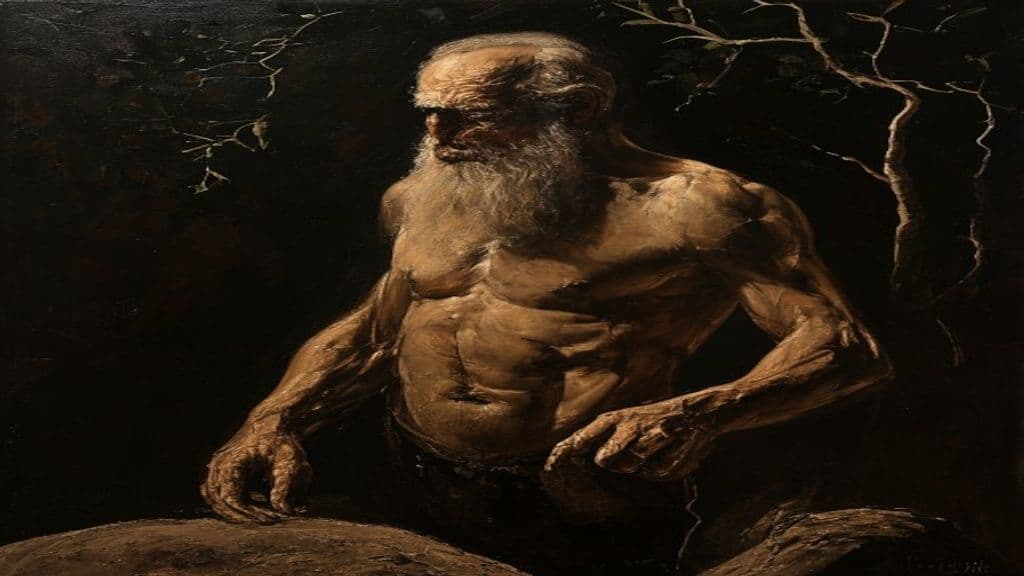
According to Genesis as presented in the cited sources, God forms Adam from 'the dust of the ground' and makes him a living being by breathing into his nostrils 'the breath of life.' In Genesis 1 the term adam appears in the collective sense for humankind; Genesis 2 presents a focused account in which God forms a single male human, places him in the Garden of Eden, and later forms a woman, Eve, as his companion. The narrative situates Adam at the origin of humanity and genealogy, with Genesis 4–5 recounting his named offspring and descendants.
The biblical material cited emphasizes Adam's origin as an earthly, bodily being formed from dust and animated by God's breath rather than providing detailed physiognomy. He is presented as male and as a living human made from the ground; no elaborate physical description beyond this created-from-dust bodily origin and nakedness (noted after the Fall) is given in the cited summaries.
The sources portray Adam exercising human capacities within the narrative framework: he names the animals when God brings them to him (an act indicating a role in classification and caretaking in the garden), receives and responds to divine commands (moral agency shown most notably in the episode of disobedience), and procreates to continue the human line (Cain, Abel, Seth, and unnamed sons and daughters listed after Seth). These are presented as narrative roles and human faculties rather than supernatural powers.
Weaknesses
- conditionmortality (subject to death)
- conditionsusceptibility to temptation/disobedience (narrative moral vulnerability)
Wards
None recorded.
Abigail
Abigail is a female figure in the Hebrew Bible portrayed in 1 Samuel 25 as the intelligent and beautiful wife of Nabal who intervenes to prevent David from committing violence; later tradition regards her as one of the Tanakh's seven female prophets and as a model of beauty and wisdom.
Agag
Agag (Hebrew אֲגָג, ʾĂḡāḡ) is presented in the Hebrew Bible and later Jewish exegetical tradition as a royal personal name or dynastic title applied to the kings of Amalek. Treated as a human foreign king and eponymous ancestor of Amalekite hostility, Agag functions in scripture and rabbinic literature as a political antagonist whose fate embodies themes of memory, justice, and the consequences of royal failure.
Deborah
Deborah (Hebrew: דְּבוֹרָה, Dəḇōrā) is a human religious and civic figure in the Hebrew Bible: a prophetess, the fourth judge of pre‑monarchic Israel, and the only female judge mentioned in the Hebrew Bible. She functions as an intermediary who conveys divine command, renders judgment, and participates in liturgical celebration (the Song of Deborah).
Eheieh (Ehyeh Asher Ehyeh)
Eheieh (Hebrew: אֶהְיֶה אֲשֶׁר אֶהְיֶה, Ehyeh Asher Ehyeh) is a biblical divine self-designation rendered in English as variants of "I Am that I Am" or "I will be what I will be." In later Jewish esoteric (Kabbalistic) discourse the name is associated with the highest Sephirah, Keter, and denotes the primal self-manifestation or mode of being from which emanation and sustenance proceed.
El Shaddai
El Shaddai (Hebrew: אֵל שַׁדַּי, ʾĒl Šadday) is a theonym used in the Hebrew Bible for the God worshipped by the patriarchs and Israel. The compound name is attested across Genesis, Exodus, Job and prophetic texts and has a contested etymology variously read as mountain‑, wilderness‑, destructive, or fertility‑related imagery rather than a single fixed English equivalent.
Eldad and Medad
Eldad and Medad are Israelite men named in Numbers 11 who prophesied within the Israelite camp while the seventy elders went to the tabernacle to receive prophetic spirit. The episode is used in biblical and later traditions to discuss the distribution of prophecy and is elaborated in rabbinic and early Christian apocryphal literature with varied prophetic attributions.
Eve
In the Genesis tradition Eve (Hebrew Ḥawwāh) is the first woman created by God and the companion of Adam; as the progenitor of humankind she participates in the origin story that explains expulsion from the Garden of Eden and certain human conditions such as mortality and pain in childbirth.
Heavenly host
A collective category in Abrahamic and Near Eastern texts naming an ordered assembly associated with the divine realm. The term can refer to the stars and other celestial bodies, to organized spiritual beings (angels) serving God, and is often described with military vocabulary (hosts, armies, commanders) that places the group within divine governance and occasional cosmic or earthly conflicts.
Ishmael
Ishmael (Heb. Yishmaʿeʾl) is a human patriarch in the Hebrew Bible, described as Abraham's firstborn son by Hagar; in later reception (notably Islamic tradition) he is also regarded as a prophetic ancestor of certain Arab lineages. The biblical narrative situates him as the progenitor of twelve sons who become tribal chiefs and as a figure who lives and survives in the wilderness.
Jacob
Jacob (Hebrew: יעקב, Yaʿaqōv) is a central human figure in the Book of Genesis, portrayed as the third Hebrew patriarch and the progenitor of the Twelve Tribes of Israel. The supplied sources treat him as a legendary/historical ancestor within the Abrahamic family line rather than as a supernatural being.
Jah (Yah)
Jah or Yah (Hebrew: יָהּ, Yāh) is the short form of the Tetragrammaton (יהוה, YHWH), the personal name of the God of Israel (commonly vocalized as Yahweh). It functions as an abbreviated theonym appearing in Hebrew scripture and liturgical formulas (notably hallelujah) and is used in prayer, praise, and religious study rather than as an independent folkloric being.
Melchizedek
A brief biblical royal‑priest figure described in Genesis as 'king of Salem' and 'priest of El Elyon' (the Most High). He blesses Abraham, brings out bread and wine, and is later invoked in Jewish and Christian traditions as a typological precedent for legitimate priesthood and tithing.
Community Record
- [1]Adam — Wikipedia. Wikipedia, entry 'Adam'wiki
- [2]Adam — Wikidata Q347181. Wikidata entry Q347181other