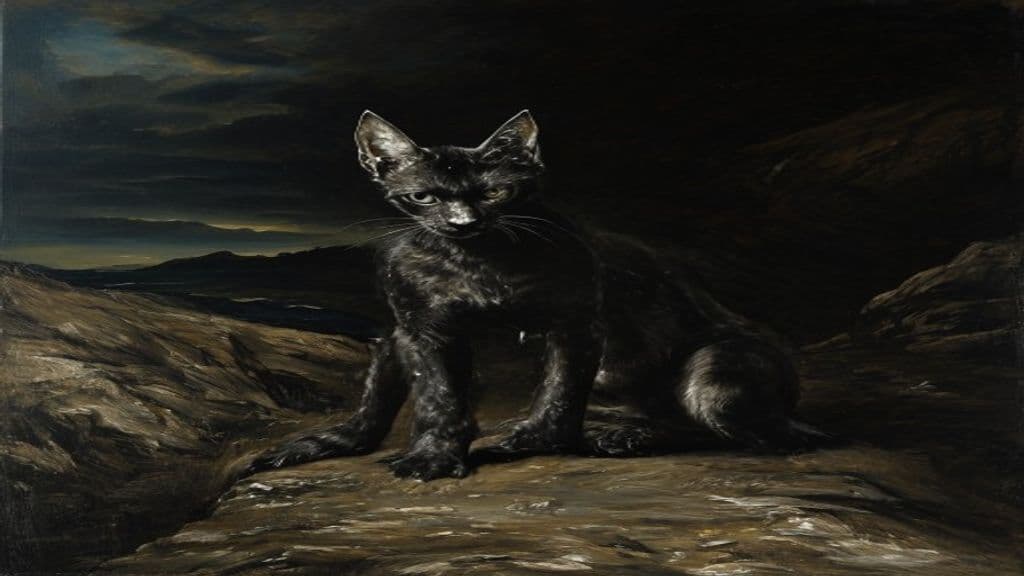
Manx tradition frames the Adhene as Cloan ny moyrn, literally "the Children of Pride/Ambition," and records an origin legend describing them as "fallen angels cast from heaven but too good for hell." This places them in a liminal moral category within local cosmology: not fully angelic nor damned, and accountable to a distinctive set of customs and behaviors in relation to humans.
When visible they are described in the recorded accounts as being about the size of a small child. Other specific physical details are not supplied in the cited Manx sources; much later popular and gaming material reimagines their appearance but those reuses are distinct from the traditional descriptions.
Traditional accounts attribute to the Adhene a range of social and economic behaviors that parallel human livelihoods: they fish at sea, herd cattle on the hills, and were said to work in caves making storage barrels — the sound of this work being taken by people as an omen of good fishing or harvests. They could be benevolent but were mostly mischievous in dealings with humans and were reputed to take babies or wives when they wished. Folklore also records a moral limitation on their power: their powers were not effective over any human "on an errand of mercy."
Weaknesses
- conditionHuman on an errand of mercy (their powers ineffective)
Wards
- conditionBeing engaged in merciful action (traditionally recorded protection)
Cailleach
A Gaelic 'veiled old woman' figure who personifies winter and its elemental forces; credited in tradition with shaping the landscape (mountains, hills, valleys) and with controlling storms and seasonal turnover. Treated both as a singular mythic sovereign (e.g., the Hag of Beara / Beira) and as a type (plural cailleachan or 'storm hags') in regional lore across Ireland, Scotland and the Isle of Man.
Selkie
A seal-being from northern Atlantic coastal folklore said to shift between seal and human forms by removing or donning a seal skin. Tales focus on intimate relations with humans, the selkie's longing for the sea, and the narrative motif of a hidden skin that prevents return to the ocean.
Sleih beggey
An umbrella term in Manx tradition for the island's 'little people' or fair folk, covering a range of domestic and wild fairy types who interact with human communities — sometimes helpful or neutral, sometimes hostile, notably in accounts of hunting, music, hearth-occupation, and infant abduction.
Adbar
Adbar is an Ethiopian belief concerning spirit possession that is discussed in scholarship and contemporary art alongside the wider regional phenomenon known as zār. These spirits are held to possess individuals (reported mostly among women), causing discomfort or illness; ritual practice aims to reconcile the spirit and the person rather than to eliminate the spirit.
Adder Stone (Egyptian Tradition)
A type of stone with specific physical characteristics, typically glassy and containing a naturally occurring hole, primarily made of flint. Not considered supernatural in Egyptian tradition. (Note: - Remove "primarily made of flint" from Appearance section, as it is not a characteristic unique to Adder stones. - Power tier should be "None" based on the source material, but clarify that this refe)
Adekagagwaa
Adekagagwaa is a Haudenosaunee sun deity associated with summer who is described as exercising authority over other weather spirits and participating in an annual cycle of departure and return tied to the seasons.
Aderyn y Corff
Aderyn y Corff (literally 'bird of the corpse') is a bird-like death-porter in Welsh folklore said to call outside the door of a person about to die. Described as an avian portent that may lack feathers or wings and as existing on another plane when not manifesting, it is treated in Welsh ghost lore and sometimes naturalized as a screech owl in modern accounts.
Adgilis Deda
Protective spirit and deity of fertility in pre-Christian Georgian pantheon, revered by mountaineers of northeast Georgia. (Note: 1. Power tier should be Ancient (deity-level) instead of Primordial. 2. Add sensory_cues that reflect Adgilis Deda's association with fertility, such as blooming flowers or lush vegetation. 3. List Wa)
Adi (asura)
Adi is attested in modern reference works as the name of an Asura who 'appears in the Matsya Purāṇa.' Beyond this single-line citation in secondary sources, no descriptive material about the figure is provided in the supplied research notes.
Adi Shakti
Adi Shakti (also Adi Parashakti, Mahadevi, Adya Shakti) is the primordial feminine power in Hindu/Shakta theology, regarded as the ultimate reality (Para Brahman) and the source from which all goddesses and gods manifest. She is both an impersonal cosmic principle (Mulaprakriti) and a focus of devotional invocation in temples, mantras, and pilgrimage sites such as Shakti Peethas.
Adi Vinayaka
Adi Vinayaka (Ādi Vināyaka; also called Nara Mukha Vinayaka) is a named iconographic and devotional form of the Hindu god Ganesha portraying the deity with a human head, described in sources as the form before the episode of decapitation by Shiva. It is rarely worshipped and appears in a small number of South Indian shrines and in devotional/musical repertoires.
Adikia
Adikia (Ancient Greek: Ἀδικία) is the personification and embodiment of injustice and wrongdoing in ancient Greek religious and visual culture, typically portrayed as the opposite and vanquished counterpart of the goddess Dike (Justice). She appears chiefly in archaic vase-paintings and emblematic visual programs where Justice punishes or restrains her.
Community Record
- [1]Adhene. Wikipedia, 'Adhene' article (summary and quotations drawn from Manx tradition as recorded there).wiki
- [2]Adhene (Wikidata). Wikidata entry for Adhene (metadata linked to available references).wiki
- [3]Adhene | White Wolf Wiki | Fandom. Modern role-playing / fandom reuse noted as derivative and distinct from Manx tradition.other
- [4]Denizen | White Wolf Wiki | Fandom. Context for modern reuses of the term 'Adhene' in gaming material.other
- [5]A Shakespeare Quote? That Can Only Mean… – Onyx Path Publishing. Example of modern creative reuse referencing the term 'Adhene.'other
- [6]DragonsFaeriesElves&theUnseen : Adhene Fairies (blog). Blog reference using the name and summarizing traditional attributes; treated as secondary/derivative in the dossier.other
- [7]Manx Music: Success at Pan-Celtic for Adhene. Modern cultural use of the name by a Manx musical group, cited as contemporary reuse rather than folkloric source.other