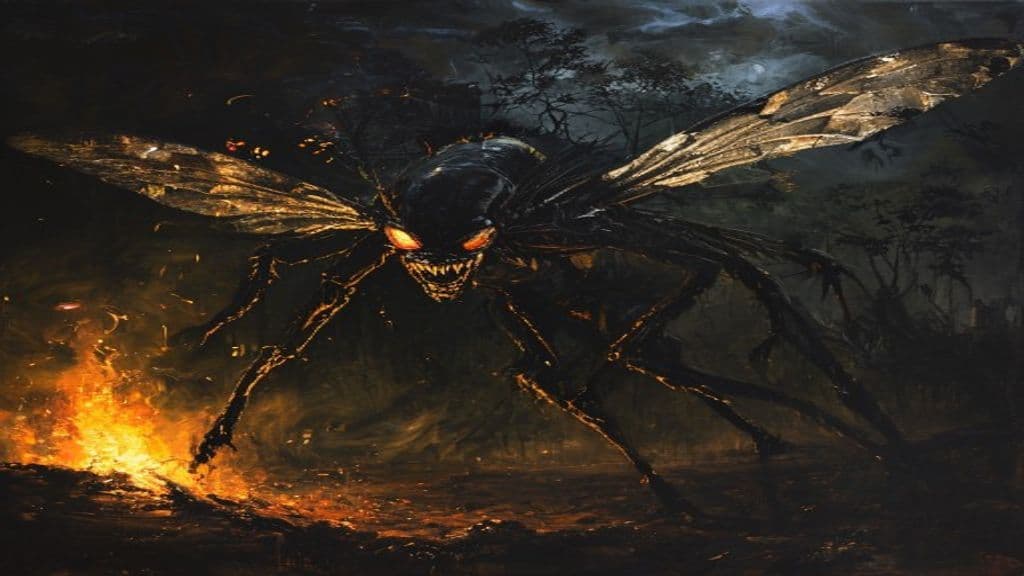
The Adze is associated with witchcraft among the Ewe. A witch may host an Adze willingly, sending it forth to harm enemies, but an uninvited Adze also wanders the night looking for victims on its own. When captured, the Adze takes a horrific humanoid form.
By night, a firefly that slips through the tiniest gaps — keyholes, cracks, woven walls — to reach sleeping victims. When captured or exposed to sufficient magical force, it reverts to a hunchbacked humanoid with hollow eyes and pitch-black skin.
Squeezes through impossibly small openings in firefly form. Drinks blood, coconut water, and palm oil — preferred prey is young children, especially the beautiful. Possesses humans, causing illness, madness, and misfortune in communities.
Weaknesses
- ritualExposure to strong daylight — it cannot hold firefly form
- ritualTrokosi priests' ritual purification
Wards
- ritualProtective charms (gris-gris) placed at children's bedsides
Adrestia (Adrasteia)
Adrasteia (also Adrestia and multiple orthographic variants) is a figure in classical Greek tradition whose roles shift from a Phrygian mountain/mother-goddess probably associated with Cybele, to a Cretan nymph entrusted with nursing the infant Zeus, and by the fifth century BC identified with Nemesis as a deity/personification of divine retribution and balance.
Adriel the Meholathite
A named human figure in the Hebrew Bible (2 Samuel), identified as Adriel son of Barzillai the Meholathite and cited in genealogical and narrative material connected to events in the reign of David. He appears as a social/lineage marker in the account concerning the Gibeonites and the execution and burial of members of Saul's house.
Adsullata
Adsullata is attested as a Continental Celtic river goddess associated with the River Savus (modern Sava) in the Roman province of Noricum. Later traditions record her presence in Brittany as a goddess of hot springs and present her as an antecedent or origin-form of the Anglo‑Celtic sun goddess Sul.
Adur Burzen-Mihr
Adur Burzen-Mihr is a consecrated Atash Behram — one of the three Great Fires of late antique Sasanian Zoroastrianism — historically associated with the farmer social estate and with a cultic location in northeastern Iran. Medieval texts (e.g., the Bundahishn) and later summaries record it as a major pilgrimage fire with legendary associations of protection and miraculous efficacy; its documentary history after the early Islamic period is unclear.
Adur Farnbag
Adur Farnbag is one of the three Great or Royal fires in the Zoroastrian ritual/topographical system of pre‑Islamic Iran. Presented in the sources as a continuously tended sacred fire housed in a temple, it is attested in secondary accounts as a focus of cultic activity, miracle stories, and association with elite ritual geography in the Parthian–Sasanian eras.
Adur Gushnasp
Adur Gushnasp (Middle Persian: Ādur ī Gušnasp; New Persian: Āzargušnasp) is a pre-Islamic Zoroastrian Great Fire — one of the three highest grade sacred temple fires (Atash Behram) of Sasanian-era Iran. Housed at the temple-site historically called Shiz (modern Takht-e Soleymān, Adurbadagan), it functioned as a continuously tended cultic fire, a pilgrimage destination, and a focal point of royal patronage and warrior-class identity.
Adze (Folklore)
Vampiric being in Ewe folklore, transforming into human shape upon capture. (Note: 1. Power tier should be Greater, as "deity-level" powers are implied by the ability to possess humans. 2. Add sensory cues (e.g., glowing lights) based on its firefly form. 3. Add weaknesses and wards)
Adže / Adze
No folkloric entity named 'Adže' is documented in the provided sources. The string appears in heterogeneous, non-folkloric contexts (a Bosnian village name, an English woodworking tool entry, a performer pen name, a CIA document fragment) and one modern podcast episode list that mentions 'the Adze' among other vampire-like beings; none of these supply an ethnographic description of a supernatural being called 'Adže'.
Aea
No evidence in the provided sources supports Aea as a supernatural being. The corpus shows Aea/AEA used as modern acronyms, product names, file extensions, conference labels, and certifications rather than a folkloric or cosmological entity.
Aeacidae
The Aeacidae are a dynastic lineage in Greek myth and historiography descended from the hero Aeacus, son of Zeus and the nymph Aegina. The name functions as a patronymic designation for those 'of Aeacus' and is used to claim genealogical legitimacy and political prestige in regions such as Aegina and Molossian Epirus.
Aeacus
Aeacus is a mythic king of the island of Aegina in Greek tradition, famed for his justice and piety. After death he is accorded a permanent office in Hades as one of the three judges of the dead alongside Minos and Rhadamanthus, and he is the eponymous ancestor of the Aeacidae.
Aeanes
Aeanes is attested in classical sources as an ancient personal name preserved in epic indices and as a local toponym (a sacred precinct, Aeaneium, and a spring, Aeanis) said to be named after a man slain by Patroclus. The name also appears in modern contexts as a taxonomic genus and in placename continuity, but the provided sources do not support a coherent supernatural identity for Aeanes.
Community Record
- [1]West African Religion. Parrinder, Geoffrey. 1949. West African Religion. Epworth Press.academic
- [2]Vampires of the World. Bunson, Matthew. 1993. The Vampire Encyclopedia. Crown Publishers.folk