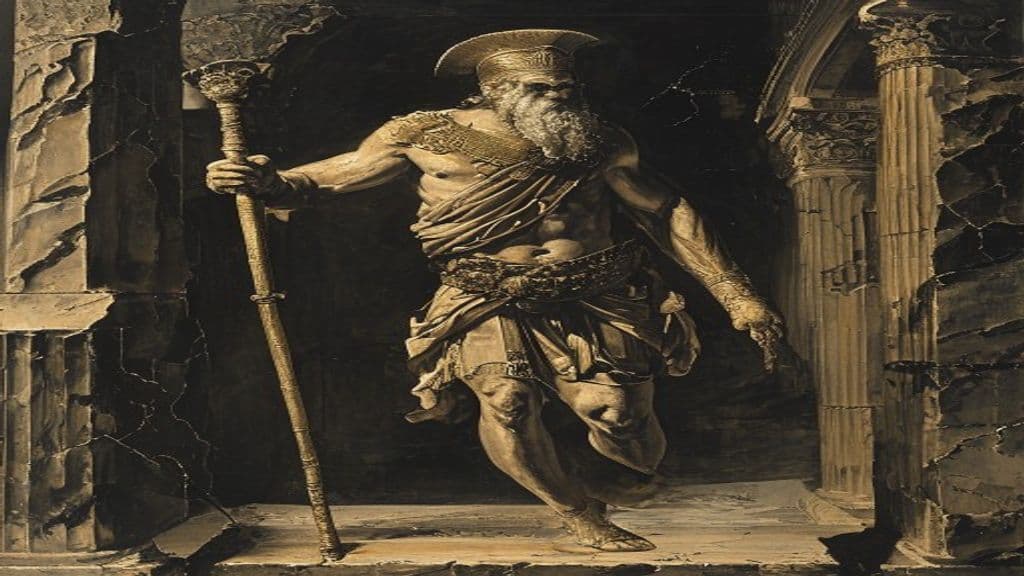
Aeacus is presented in the mythic genealogies as the son of Zeus and the nymph Aegina and as king of the island of Aegina. He is the ancestor and eponym of the Aeacidae, the line including Peleus and Telamon and the grandchildren Achilles and Ajax. Tradition preserves variant foundation-legends for his reign: in one account Zeus transforms ants (μύρμηκες) into men (the Myrmidons) to repopulate Aegina during Aeacus’s kingship; other versions describe men springing from the earth. Aeacus also features in etiologies tied to local cult (his supposed burial beneath the altar of the Aeaceum) and in narratives of exile and family violence—Peleus and Telamon are said to have fled Aegina after killing their brother Phocus.
Surviving summaries do not supply detailed physical descriptions of Aeacus as a living king. Later artistic and literary references note a specific underworld iconography in which he is depicted bearing a sceptre and the keys of Hades; sources state this attribute appears in some works of art and literary description. Cult tradition recorded in later summaries also locates his tomb or hero-shrine beneath the altar of a square marble enclosure (the Aeaceum) on Aegina.
Ancient sources and later summaries emphasize Aeacus's reputation for exemplary justice and piety: he is repeatedly invoked as an adjudicator in disputes among mortals and, in mythic anecdotes, even among gods. The Delphic oracle is said to have required his prayer to end a drought, which he offered successfully. After death he assumes a permanent judicial office in Hades as one of the three judges who pass sentence on arriving shades; Plato is reported to describe Aeacus as especially concerned with the souls of Europeans on arrival. Tradition also credits Aeacus with civilizing deeds—he is linked to the building of Troy's walls in a Pindar-related legend in which Apollo and Poseidon take part—and with the dynastic legitimation of his descendants (the Aeacidae).

Community Record
- [1]Aeacus - Wikipedia. Wikipedia, 'Aeacus' article (summary of ancient traditions and cultic references).wiki
- [2]Aristophanes, The Frogs (dramatic appearance recorded in archive cast listing). LibriVox recording listing and archive entry for Aristophanes' The Frogs (cast includes 'Aeacus'); corroborates Aeacus's dramatic role as underworld judge in that play.literary
- [3]Aeacus - in ancient sources (Attalus index). Attalus: compilation and references to ancient authors concerning Aeacus (genealogy, myths, variant traditions).other
- [4]Wikidata: Aeacus. Wikidata item summarizing identifiers and cross-references for Aeacus.other