
Two alternative, partially conflicting traditions are preserved. In one set of accounts Aed is recorded as the eldest son of Lir and Aoibh (daughter of Bodb Dearg) and thus one of the four Children of Lir who, after the death or displacement of Aoibh, are cursed by Aoife to live as swans. In a separate tradition Aed is counted among the children of the Dagda and thus sibling to figures such as Aengus and Cermait; in that narrative his life ends when he is slain by Corrgend (Corrchenn/Corggend) of Cruach for seducing Corrgend's wife. These variant placements reflect multiple genealogical strands in the Tuatha Dé Danann material rather than a single unified origin.
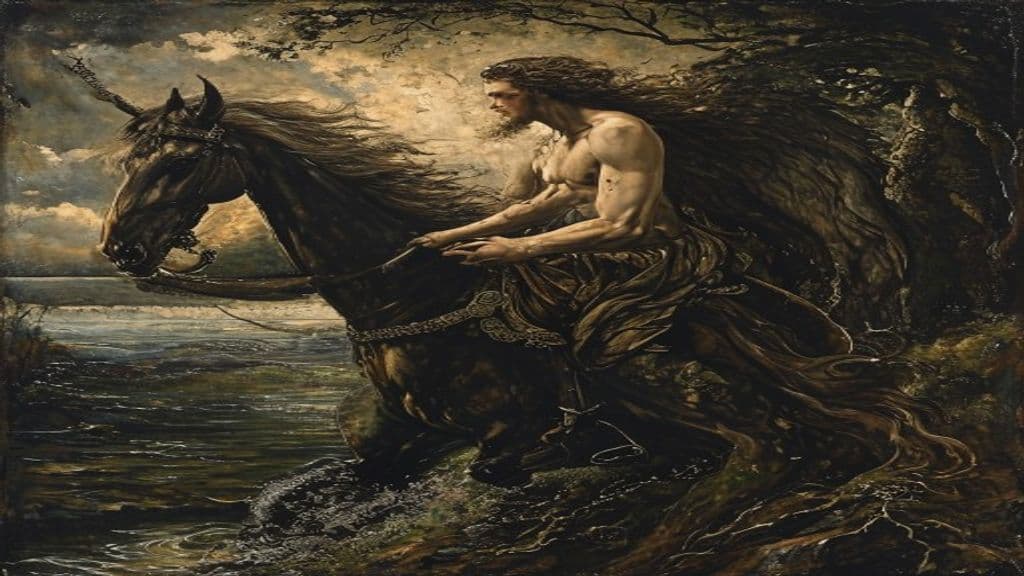
Direct descriptive statements in the sources are limited. In the Dagda-son tradition Aed is called a 'faultless' and 'bright-faced youth.' In Dindsenchas verse he is given the epithet 'of the wind-swift horses' and the byname 'Aed Luirgnech' (glossed as 'big-shins'). As one of the Children of Lir he is transformed into a swan as part of Aoife's curse, and in that form he shares the collective physical description of the swan-children in the tale.
The supplied accounts do not ascribe a catalogue of explicit magical powers to Aed beyond those implied by his membership in the Tuatha Dé Danann/Daoine Sidhe and the etymological association of his name with 'fire.' In the Children of Lir tradition the transformation into a swan is performed by Aoife's curse rather than by Aed, and the narrative stresses that the swan-children retained their voices and knowledge of songs and tales. In the Dagda tradition Aed's role is chiefly genealogical and narrative (his seduction, death, and the Dagda's pursuit of his killer); no specific personal magical acts are recorded in the provided material.
Abarta (Ábartach)
Abarta (also Ábartach) is a figure of Irish myth who, in surviving accounts, tricks Fionn mac Cumhaill's warriors by giving them a supernatural grey horse that bears them into the Otherworld. Sources variably identify him as a member of the Tuatha Dé Danann or as a Fomorian; after the incident he is compelled to release the captured warriors and is refused entry to the Fianna.
Abcán (Abhcán)
Abcán (modern spelling Abhcán) is a named dwarf poet and musician of the Tuatha Dé Danann in Irish myth. He appears in a small number of narratives as a musician whose art has soporific power and as the ferryman who brings the goddess Ruad from the Otherworld to the human world.
Abhean
Abhean is a named poet of the Tuatha Dé Danann in medieval Irish literature, described as a poet in particular of Lugh and recorded as having been killed by Óengus before Midir in a poem by Fland Mainistreach preserved in the Lebor Gabála Érenn.
Achtland
Achtland is a figure from Irish tradition who, according to the surviving account, was a mortal woman famed for rejecting mortal suitors who married a member of the Tuatha Dé Danann and crossed into the síde to become immortal as his wife.
Aengus
Aengus (Óengus, Aonghus) is a member of the Tuatha Dé Danann in Irish myth, portrayed as a youthful, attractive figure associated with love, youth, poetic inspiration and seasonal/solar symbolism; he is linked to Brú na Bóinne (Newgrange) and appears as fosterer, protector, enchanter and avenger in multiple tales.
Ailill Angubae
Ailill Angubae is a human figure in the Irish tale The Wooing of Étaín, presented as the brother of High King Eochaid Feidlech who falls desperately in love with his brother's wife, Étaín. His unrequited passion leads to a wasting illness and a failed rendezvous when the Tuatha Dé Danann figure Midir casts him into an enchanted sleep.
Airmed
Airmed (Airmid) is a healer and keeper of herbal knowledge among the Tuatha Dé Danann in Irish myth. Daughter of Díán Cécht and sister of Miach, she preserves the lore of healing plants, gathers herbs at Miach's grave, and is named among enchanters who sang over the well of Sláine to restore the wounded.
Aos Sí
Aos Sí are a broad class of supernatural beings in Gaelic (Irish and Scottish) folklore associated with the mounds and liminal places of the landscape. They are variously described as descendants or later forms of the Tuatha Dé Danann, ancestral or nature spirits, or otherworldly folk who coexist with humans and can be helpful or dangerous when offended.
Badb
Badb is an Irish supernatural female figure associated with warfare, death, and prophecy. She commonly appears as a crow or raven and as a wailing omen, acts on battlefields to sow confusion and foretell slaughter, and is often treated as one member of the triadic Morrígna.
Banba
Banba (modern spelling Banbha) is a matron goddess of Ireland in Irish mythology, daughter of Delbáeth and Ernmas of the Tuatha Dé Danann. She forms a triad of matronal personifications of the island with her sisters Ériu and Fódla, is associated with sovereignty and the land, and appears in origin and heroic narratives linked to specific Irish landscapes.
Bodb Derg
Bodb Derg is a kingly figure of the Tuatha Dé Danann in Irish myth, attested as ruler of the Munster síd and later elected king of the Tuatha Dé Danann after their defeat and withdrawal into the sídhe. His name is etymologically linked to the war-crow figure Badb and is glossed in sources as 'Red Crow.'
Celtic Mythological Beings
A pantheon of supernatural entities from ancient Celtic mythology, associated with various aspects of nature and the cosmos. (Note: - Power tier: Reduce to Lesser (some Greater entities are mentioned, but overall Celtic mythological beings are more regional or local spirits) - Weaknesses: Add "Disruption of natural cycles" as a we)
Community Record
- [1]Aed (god) — Wikipedia. Wikipedia contributors. "Aed (god)." Wikipedia, The Free Encyclopedia.wiki