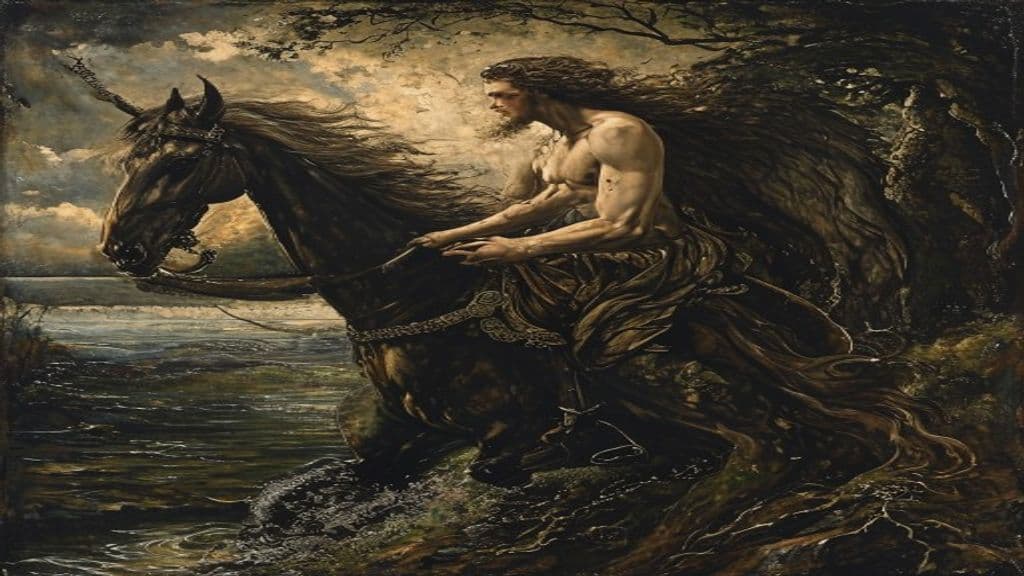
In the mythic corpus Aengus is presented as a son of the Dagda and Boann and a member of the Tuatha Dé Danann. Medieval narratives record Boann's conception of Aengus occurring when the Dagda caused the sun's path to 'stand still' so that Boann's pregnancy could be concealed; this episode is told in connection with Aengus's later securing of Brú na Bóinne (named Brug maic ind Óig after him). The medieval Dindsenchas offers an etymological tale in which his name is linked to 'one desire' relating to his mother's longing; modern Celticists have also proposed a Proto-Celtic name meaning 'true vigour.' Scholars have suggested (on the basis of these mythic motifs) that the conception/claiming of the Brú dramatizes winter-solstice/solar-rebirth themes, an interpretation attributed to commentators rather than presented as a plain fact in the medieval texts.
The traditionally attested portrait of Aengus in Irish myth is of a beautiful, youthful noble: epithets emphasize perpetual youth (Óc/Óg) and texts describe him as a skilled horseman, warrior and sailor, 'red-armed', 'mighty and stern' and famed for exploits in battle-squadrons alongside figures such as Aed and Cermait. A later Scottish folktale provides a picturesque late rendering in which 'Angus mounted his white steed...clad in raiment of shining gold' with a crimson royal robe spread by the wind; that description is a late folkloric image and not presented as authoritative across all medieval sources.
Across the tales Aengus manifests poetic and enchantment power (linked to poetic inspiration and spells), cunning linguistic ownership (he secures Brú na Bóinne by asking for it for 'láa ocus aidche'—a phrase interpreted ambiguously as 'a day and a night' or 'day and night'), fosterage and protective agency (he is the foster-father and protector of Diarmuid Ua Duibhne and rescues Diarmuid and Gráinne), and lethal martial action (he kills a poet who slandered his brother and in various accounts slays Elcmar or other foes in reprisals). In one narrative context he takes Diarmuid's body to Brú na Bóinne and breathes life into it when he wishes to speak with him, indicating a mythic capacity to revive or animate a corpse for communication. Manannán mac Lir aids Aengus in at least one tale by reciting a poem ('Luck and Prosperity') that functions as an incantation to force Elcmar from the Brú; such episodes show magical speech acts enacted by allied figures in the narratives.
Community Record
- [1]Aengus (Wikipedia). Wikipedia contributors. 'Aengus.' Wikipedia, The Free Encyclopedia. https://en.wikipedia.org/wiki/Aenguswiki
- [2]Out of the Woods - Show #412 - 3-3-18 (archive audio playlist mentioning Aengus in titles). Out of the Woods, Show #412 (3 March 2018), archive.org item referencing Aengus in tracklisting. https://archive.org/details/OOTW20180303other
- [3]March 17th, 2023 (archive playlist mentioning Aengus titles). Archive playlist (17 March 2023) including references to Aengus in track titles. https://archive.org/details/lotd-3-17-2023other
- [4]The little big book of chills and thrills (archive listing referencing 'Song of Wandering Aengus'). The little big book of chills and thrills (archive.org listing includes modern artistic references to Aengus). https://archive.org/details/littlebigbookofc0000unse_b8o6other