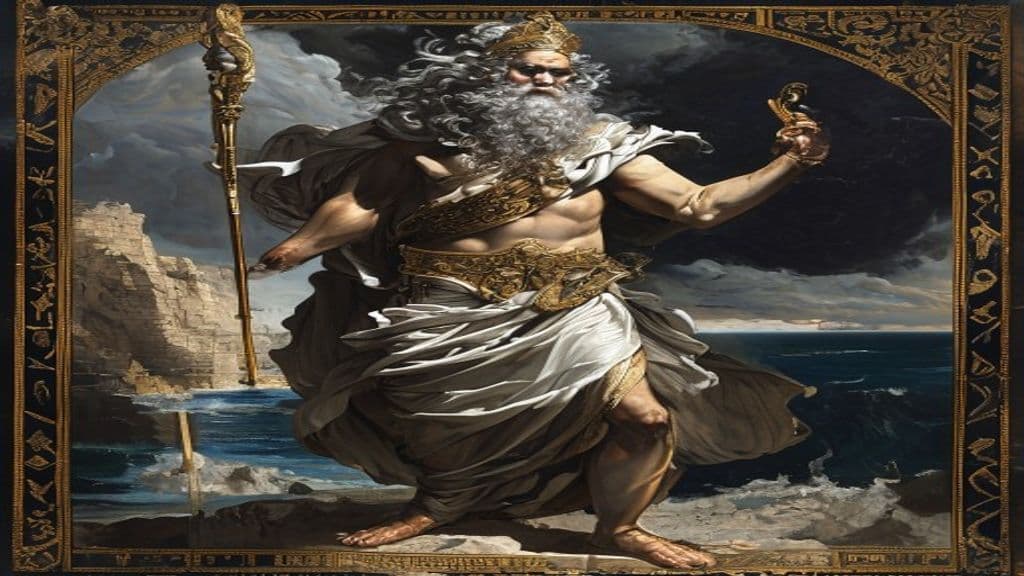
In the classical Greek mythographic tradition the name Aeolus designates at least three distinct personages. One is a son of Hellen presented as the eponymous ancestor of the Aeolian race, locating a people within Greek ethnogenesis. Another is given as a son of Poseidon who led a colony to islands in the Tyrrhenian Sea and functions as a heroic/semi-divine founder in colonizing narratives. A third, attested in Homer (Odyssey) and Vergil (Aeneid) and later mythographic summaries, is described as son of Hippotes and as a kingly keeper or ruler of the winds, resident on an island-kingdom (Aeolia) who can contain and release winds within epic episodes. Ancient compilers and mythographers—cited in classical summaries—recognized difficulty in keeping these traditions distinct and offered divergent genealogies and identifications.
Primary summaries and the provided sources do not record a consistent, detailed physical description for any Aeolus figure. Classical epic presents the wind-ruler Aeolus in a kingly social role (resident in an island-kingdom), but the supplied materials give no standardized iconography or bodily description. Later artistic and literary representations vary, and the extant summary data explicitly lacks a unified portrait.
According to the Homeric and Vergilian epic tradition summarized in the sources, the Aeolus who is son of Hippotes functions as ruler or keeper of the winds and in narrative episodes is shown able to restrain, contain, and release winds (Odyssey; Aeneid). The son of Poseidon is credited in genealogical tradition with leading a maritime colony to islands in the Tyrrhenian Sea (founder/leader behavior). The eponymous son of Hellen functions as an ancestral progenitor for the Aeolian people. The supplied materials do not attribute broader meteorological creation or systematic cosmic powers beyond the wind-steward role found in epic, nor do they provide mechanics or limits for the wind-control beyond the narrative attestations.
Community Record
- [1]Aeolus — Wikipedia (summary of classical tradition). Wikipedia contributors, 'Aeolus', Wikipedia, The Free Encyclopedia.wiki
- [2]Wikidata entry for Aeolus. Wikidata: Q1856707 (Aeolus).other