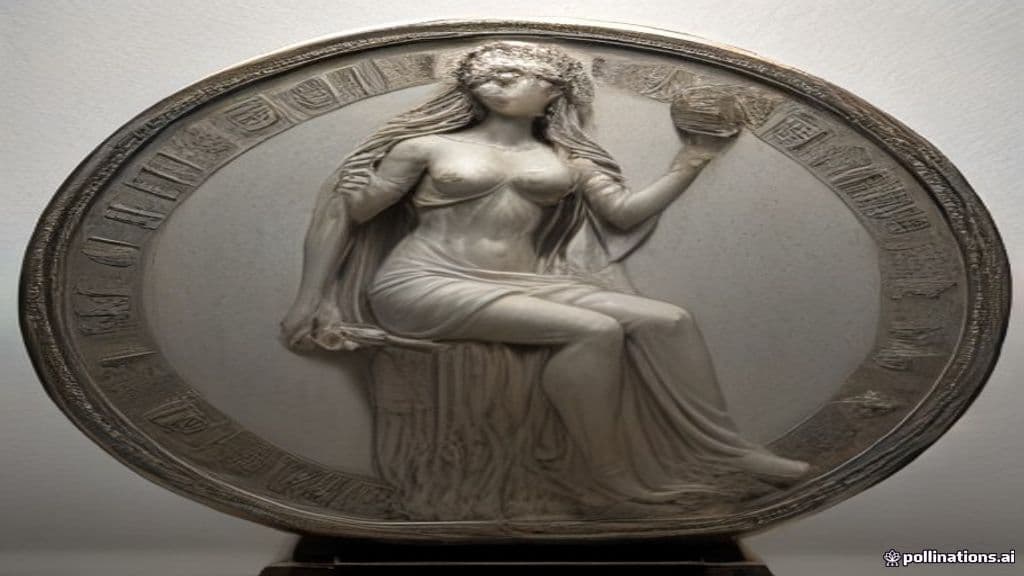
Linguistically a Latin noun (Aequitas, genitive aequitatis), the term functions in Roman thought as both an ethical-legal principle and, in certain contexts, a divine personification. In Republican and Imperial literature and imagery the concept is attested in rhetorical and legal discourse (notably Cicero's tripartite definition) and visually as a female personification used in imperial propaganda and on coinage under the epithet Aequitas Augusti.
As an abstract concept Aequitas has no intrinsic bodily form. In Roman imperial iconography she is depicted as a woman on coinage, commonly shown holding a cornucopia (horn of plenty) and a balance scale (libra). In Roman usage the libra on coins frequently signified 'honest measure'—an emphasis on correct measure and fair exchange—alongside the broader meanings of justice and equity.
Aequitas does not possess supernatural 'powers' in the folkloric sense in the cited material; rather, she operates as a normative standard and rhetorical-religious category. Functionally, aequitas serves as (1) a juridical/moral ideal of equity or tempering of law, (2) a religious-moral norm governing correct relations toward gods and Manes (per Cicero's scheme), and (3) a claim employed in imperial propaganda to assert that an emperor's rule embodies fair measure and honest administration (Aequitas Augusti).
Community Record
- [1]Aequitas (Wikipedia). Wikipedia, 'Aequitas' article (summary and iconographic notes).wiki
- [2]Aequitas (Wikidata). Wikidata entry for Aequitas.other
- [3]Aequitas — Wiki archive. Archived Miraheze wiki entry on Aequitas.other