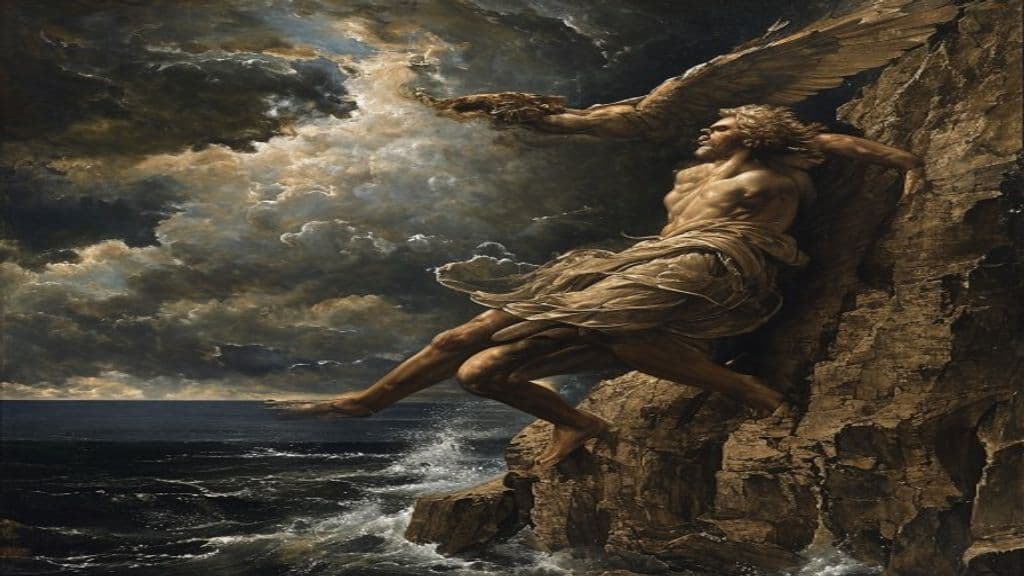
Aesacus appears in Greek myth as a son of King Priam of Troy. Traditions vary over his maternity and status: Apollodorus names Arisbe (daughter of Merops) as his mother and presents Aesacus as legitimate; Ovid gives him as an illegitimate son (mother Alexirhoe, daughter of the river Granicus). In the narrative conserved by Ovid, Aesacus falls in love with Hesperia (daughter of the river Cebren); when she is bitten by a snake and dies as she flees, he mourns and leaps from a high cliff into the sea, where the sea-goddess Tethys changes him into a diving seabird (mergus). In Apollodorus and Tzetzes Aesacus is additionally a practitioner of dream-interpretation learned from his grandfather Merops and is credited with interpreting Hecabe’s portentous dream about Paris.
As a human Aesacus is attested primarily by genealogy and narrative role: identified as a son of Priam and variously the husband or would-be lover of a river-nymph (named Asterope in Apollodorus; Hesperia in Ovid). Ovid narrates that, overwhelmed with grief, Aesacus leaps from a tall cliff and, in mid-plunge into the sea, is transformed by the sea-goddess Tethys into a diving seabird called mergus. Classical commentators and later readers have read mergus variably as a merganser, cormorant, or Scopoli’s shearwater; the precise species is not fixed in the sources.
Aesacus’s primary characteristic in the sources is profound, grief-driven behavior leading to self-destructive action. In Ovid his avian form continues the impulse to plunge and dive into the sea. In Apollodorus and Tzetzes he is described as having learned the art of dream-interpretation from his grandfather Merops and thus functions as an interpreter of dreams (specifically, he interprets Hecabe’s dream in that tradition). Beyond these narrative traits—grief, diving behavior after transformation, and, in some accounts, skill in dream-interpretation—the sources record no other supernatural powers or recurring magical functions.

Acanthus (son of Autonous)
Acanthus is a mythic human figure in a Greek metamorphosis tale (recorded by Antoninus Liberalis) who, with his family, was transformed by Zeus and Apollo into a bird named after him. The story functions etiologically, explaining the origin and behaviors of certain birds by linking them to formerly human persons and their experiences.
Admetus
Admetus is a mortal king of Pherae in Thessaly in the Greek tragic tradition (notably Euripides' Alcestis). His life becomes the subject of a divine bargain in which Apollo intervenes to delay his appointed death, a bargain that requires another to die in his stead — most famously his wife Alcestis.
Admetus of Pherae
Admetus of Pherae is a mortal king of Thessaly in Greek myth whose household and fate intersect with Olympian gods (notably Apollo and Artemis), the Fates, the personification of Death (Thanatos), and the hero Heracles. He is celebrated for hospitality and justice and is best known from the tragic cycle surrounding his wife Alcestis, who dies in his stead and is later recovered.
Aegiale
Aegiale is a mortal woman in Greek mythic tradition, best known as the wife of the hero Diomedes. In post‑Trojan War nostos narratives she is depicted in several accounts as unfaithful and as plotting against her husband; some traditions attribute her conduct to the vengeance of the goddess Aphrodite.
Aeopolus
Aeopolus (Ancient Greek: Αἰπόλος, gen.: Αἰοπόλου, romanized Aipolus or Aiopólos, lit. 'goatherd') is a mortal figure in Greek mythic genealogical tradition recorded only in brief scholia and summaries. He is named as the father of Cleobule, who in one variant is cited as a possible mother of Myrtilus by Hermes; some sources note he was also called Aeolus. Attestations are limited and no cult, deeds, or narratives are preserved for him.
Aerope
Aerope (Ancient Greek: Ἀερόπη) is a mythological mortal woman of Greek tradition, a Cretan princess connected to the royal house of Mycenae (the Atreidai). In surviving accounts she functions as a human agent whose sexual relationships and/or the transfer of a symbolic object (the "golden lamb") are narrated as catalysts in the dynastic feuds of Atreus and Thyestes; sources preserve variant and sometimes conflicting traditions about her fate and parentage.
Aeëtes
Aeëtes is a mythic, semi-divine king of Aea (identified with Colchis) in the Greek heroic tradition, son of Helios and the Oceanid Perseis. He is guardian of wondrous objects—most famously the Golden Fleece—and functions as a royal task-master whose demands and possessions test visiting heroes (notably Jason and the Argonauts).
Agrius and Oreius
Agrius (Ἄγριος) and Oreius/Orius (Ὄρειος) are twin sons of Polyphonte and a bear in a Greek mythic tale. Presented as 'twin savage bear-like children,' they committed acts of impiety and violence and were ultimately transformed by the gods into ominous birds (vulture and eagle-owl) as part of divine punishment and resolution.
Alcimenes
Alcimenes (Ancient Greek Ἀλκιμένης) is a personal name borne by multiple mortal figures in Greek myth and literary history — including a Boeotian prince, one of the sons of Jason and Medea, and several authors. The sources treat Alcimenes as human characters within mytho-historical narratives and literary tradition rather than as a distinct supernatural class or spirit.
Aloadae
The Aloadae (Otus and Ephialtes) are twin, exceptionally large brothers of Greek myth—variously portrayed as gigantic, hubristic challengers to the Olympian order and as local culture-bringing founders and worshipers of the Muses. Traditions report prodigious growth and strength, an attempt to scale the heavens by stacking mountains, the capture of Ares in some versions, and several differing accounts of their deaths or posthumous punishment.
Amycus
Amycus (Ancient Greek: Amykos / Ἄμυκος) is a named figure in Greek myth chiefly attested as the king of the Bebryces of Bithynia who challenges the Argonauts and is slain in single combat by Pollux. The name is also reused in other, distinct contexts (a centaur in other sources; modern onomastic reuses such as an asteroid, a naval ship, and taxonomic names).
Amykos
Amykos is a semi-divine legendary king of the Bebryces in Bithynia who challenged strangers to lethal boxing matches and was killed by a visiting Argonaut. He is presented in Greek myth as a son of Poseidon and the Bithynian nymph Melia and functions as a localized antagonist encountered during the Argonauts' voyage.
Community Record
- [1]Aesacus — Wikipedia. Wikipedia, 'Aesacus' articlewiki
- [2]Who's Who in Classical Mythology. Who's Who in Classical Mythology (archive.org)literary
- [3]Liber Studiorum: Aesacus and Hesperie (Turner print). Turner, 'Aesacus and Hesperie' (print, Liber Studiorum) (archive.org)other
- [4]Wikidata: Aesacus. Wikidata entry for Aesacuswiki