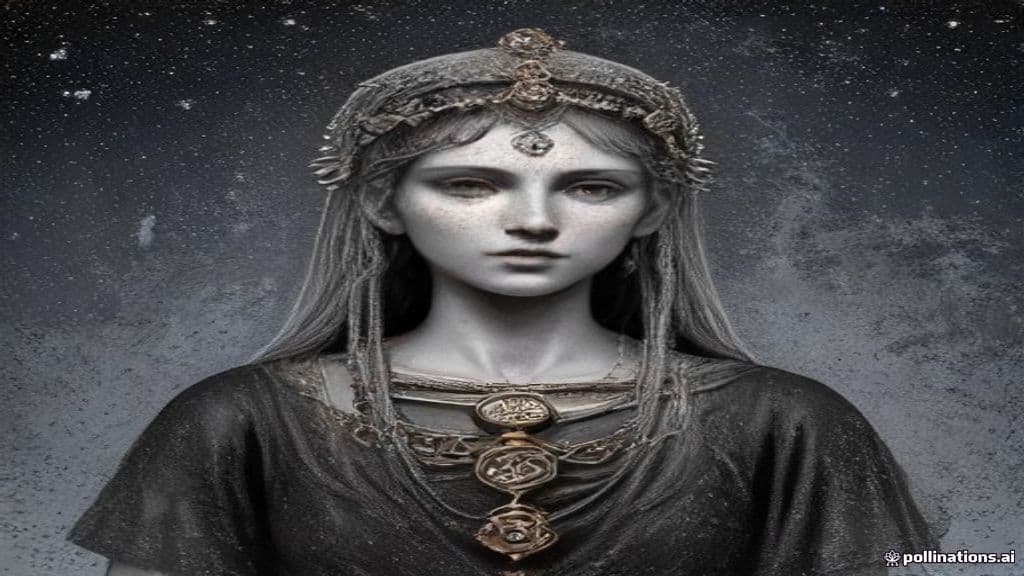
Aeternitas arises in Roman official religion as the personified abstract noun aeternitas, the quality or state of being eternal. Cultic evidence places her among the repertory of deified virtues promoted by the state and attached to the Imperial cult from the Julio-Claudian through Severan periods (1st–3rd centuries AD). Her role as Aeternitas Imperii — the eternity of Roman rule — and her inclusion among deities receiving sacrifices from collegia such as the Arval Brethren (e.g., thanksgiving when Nero survived conspiracy) demonstrate development as a civic-religious institution intended to sacralize imperial continuity. In late-antique literary reception (e.g., Martianus Capella) she is allegorically listed among Jupiter's daughters; in medieval scholastic writing the Latin term is continued as a technical term for divine duration rather than as an object of cult.
Iconography on Roman coinage and in late-antique description presents Aeternitas with cosmological and imperial symbols. Coins of Vespasian (c. 75–79 AD) depict her holding heads representing Sol and Luna; coins of Titus (80–81 AD) show her with a cornucopia, leaning on a scepter, and with one foot on a globe. From the 2nd to mid-3rd century, she is commonly shown with a globe, celestial bodies (stars or sun and moon), and the phoenix (sometimes perched on the globe); Martianus Capella describes her wearing a circular diadem symbolizing eternity.
As an abstract personification, Aeternitas does not act in narrative myth but functions symbolically and cultically. She embodies the enduring quality attributed to a deified emperor and to Roman rule (Aeternitas Imperii). In practice she was honored with sacrifices and temples — attested both in Rome and in the provinces (for example, the temple of Aeternitas Augusta at Tarraco) — and appears in state ritual contexts (e.g., offerings by the Arval Brethren during thanksgiving rites for imperial survival). Her associated imagery (cornucopia, scepter, globe, sun, moon, phoenix) links her symbolically to prosperity, authority, world dominion, and cyclical renewal rather than describing supernatural feats in narrative.
Weaknesses
- otherNo mythic vulnerabilities attested; as an abstract virtue her 'limits' are conceptual and depend on the political-religious standing of the emperor and the state
Wards
- otherNo wards attested; cultic practice consisted of sacrifices and temple maintenance to honor and sustain the virtue rather than magical warding
Community Record
- [1]Aeternitas (Wikipedia). Wikipedia, 'Aeternitas' article (summary of cult, iconography, coin evidence, Arval Brethren, Martianus Capella, and later reception).wiki
- [2]Albert the Great commemorative essays (summary source). Summary in the supplied material: Albert's taxonomy uses 'Aeternitas' to denote divine duration (late-medieval/scholastic conceptual reception).other
- [3]Wikidata entry: AETERNITAS. Wikidata entry referenced in research notes for modern cultural uses and identifiers.other
- [4]446 Aeternitas (asteroid — modern namesake). Modern astronomical naming showing persistence of the term 'Aeternitas' in later cultural contexts (provided in research notes).wiki