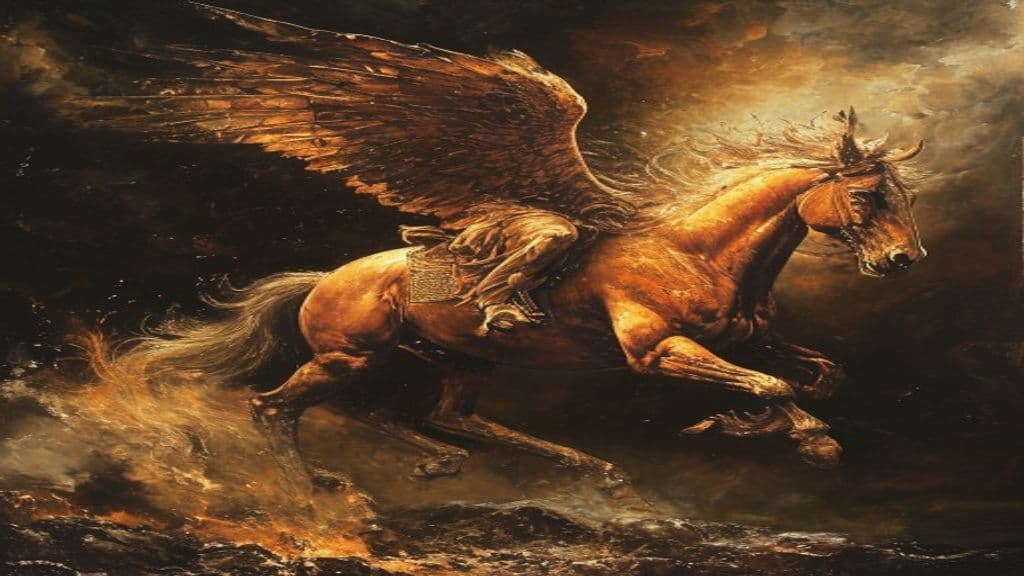
There is no mythic origin for a single independent entity named Aethon in the provided sources. Instead, Aethon appears in Homeric poetry (Iliad and Odyssey), fragments attributed to Hesiod (Catalogue of Women, fr. 43a.5), and later mythographic references (e.g., Hyginus; Claudian) as an epithet applied to animals—most commonly horses associated with deities such as Helios—and twice as a human name/pseudonym (Odysseus in Odyssey 19.183; Erysichthon described in Hesiod for his 'burning' hunger). The supplied modern records show the lexical reuse of the name in taxonomy and cultural works rather than a continuous cultic tradition.
Because Aethon is primarily an epithet rather than a fixed individual, appearances vary with application. In the classical texts it most often describes horses—implying a tawny or red-brown coloration and a 'blazing' visual quality—and is applied to oxen and once to an eagle (Homeric usage). When used for humans, as in Odysseus' disguise (Odyssey 19.183) or of Erysichthon (Hesiod fr. 43a.5), it functions as a name that evokes burning or shining qualities rather than supplying a consistent bodily form. No single, consistent physical description of an independent being called 'Aethon' is present in the sources.
The provided sources do not attribute inherent supernatural powers or a consistent behavioral repertoire to an independent Aethon. The epithet signals poetic or metaphorical qualities—brightness, blazing appearance, tawny color—and by association may link animals so described to solar (e.g., horses of Helios) or martial contexts (horses of Ares), or to a consuming internal state (Erysichthon's 'burning' hunger). Mythographers list beings named Aethon (notably horses) but do not ascribe unique powers to an autonomous entity called Aethon.
Androktasiai
Androktasiai (Ἀνδροκτασίαι, sing. Androktasia) are plural personifications in ancient Greek poetry that embody manslaughters or the slayings of men in battle. They appear chiefly as named offspring of Eris in Hesiod's Theogony and as elements in Homeric/Hesiodic ekphrasis (the Shield of Heracles), functioning as poetic embodiments of wartime slaughter rather than individualized cult-deities.
Ares
Ares (Ancient Greek: Ἄρης) is the ancient Greek Olympian god of war who personifies the physical violence, valor, and bloodlust of combat. Worshiped irregularly across Greece and Asia Minor, he was both honored and ritually restrained by communities that sought to direct his martial power toward protection rather than wanton destruction.
Aristaeus
Aristaeus (Ancient Greek: Ἀρισταῖος) is a mythic culture-hero and minor godlike figure in Greek tradition, honored as the patron and transmitter of rural arts (notably beekeeping, dairying, olive cultivation, and viticulture). He functions as a liminal figure between mortal heroes and divinities, appearing in local cults across the Greek world and in literary narratives that explain the origin and restoration of pastoral practices.
Artemis
Artemis is an ancient Greek goddess of hunting, the wilderness and wild animals, transitions (especially childbirth and puberty), vegetation, and chastity. Twin sister of Apollo and daughter of Zeus and Leto, she functions as a protector of young children and maidens while also capable of inflicting disease or punishment for transgressions against her sacred laws.
Chromios
Chromios is an ancient Greek personal name attested for several human figures in classical literary and historical sources (not a single supernatural being). Attestations include Chromios of Aitna, victor in a chariot race celebrated by Pindar (Nemean I, c. 473 BCE); a warrior/captain name found in epic/Homeric indices and scholia; an Argive survivor in the tradition of the Battle of the 300 Champions; and the modern asteroid 32726 Chromios, a Jupiter Trojan named from the Greek onomastic repertoire.
Ctesippus
Ctesippus (Greek Κτήσιππος, Ktēsippos) is an ancient Greek personal name attested for several distinct mortal figures in literary and mythographic sources: one or more sons of Heracles in genealogical lists, a wealthy and disorderly suitor of Penelope in the Odyssey, and a named minor interlocutor or symposium participant in Platonic dialogues. The attestations show recurring onomastic use rather than a single supernatural entity.
Elephantis
Elephantis (Ancient Greek: Ἐλεφαντίς) is a name attested in two distinct registers of the ancient Greek world: (1) a late 1st century BCE Greek poet/physician credited in Roman and Greek authors with erotic manuals, cosmetics and abortive recipes, midwifery, and medical remedies; and (2) a mythographic/mortal figure listed among the wives or consorts of Danaus and named as mother of some Danaïdes in variant genealogical traditions.
Euterpe
Euterpe is one of the nine Muses of Greek myth, daughter of Mnemosyne and Zeus, traditionally associated with music and (in later usage) lyric poetry. She functions as a divine inspirer of musicians and poets and is cultically associated with sacred springs and poetic sanctuaries such as Mount Helicon and Mount Parnassus.
Hypnos
Hypnos is the ancient Greek personification and god of sleep who induces slumber in mortals and gods. Son of Night (Nyx) and twin brother of Thanatos (Death), he dwells in liminal places associated with dreams and the underworld and appears in myth as a gentle, intervening deity.
Moirai
In ancient Greek religion and mythology, the Moirai (μοῖραι) are a triad of personified destinies who spin, allot, and cut the thread of life. They function as apportioners of fate, ensuring that both mortals and gods live out the portions assigned by the universe's ordering principles.
Terpsichore
Terpsichore is one of the nine Muses in ancient Greek tradition, the divine personification and patron of dance and choral song. She is named from Greek roots meaning "delight in dancing" and is conventionally depicted seated with a lyre, accompanying dancers and choruses.
Zeus
Zeus (Ancient Greek: Ζεύς) is the supreme deity of the classical Greek pantheon, a sky-and-thunder god who rules as king of the gods on Mount Olympus and functions as a sky‑father who assigns roles among the immortals.
Community Record
- [1]Aethon (Wikipedia). Wikipedia, 'Aethon' (summary of classical usages and modern name-uses)wiki
- [2]Aethon (Wikidata Q15727225). Wikidata entry identifying modern taxonomic reuse (genus of arthropods)other
- [3]Swindle Engine - Aethon (Jamendo archive item). Archive.org item titled 'Swindle Engine - Aethon' (modern cultural reuse of the name)other
- [4]Claude Magnetite Pyramids Natural Crystal Formation And Alleged Consciousness Effects (Archive item referencing 'Aethon'). Archive.org metadata referencing 'Aethon' in a modern study/project titleother
- [5]Claude Exploring Divine Discernment In Dreams (Archive item referencing 'Aethon'). Archive.org metadata referencing 'Aethon' in a modern study/project titleother