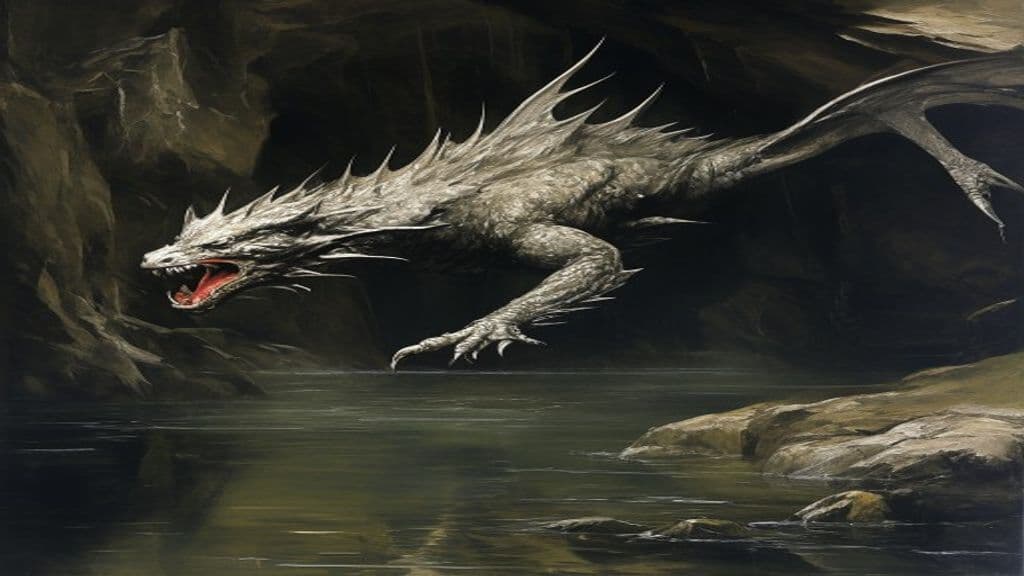
Medieval attestations place the creature in Welsh narrative cycles and manuscripts: the Addanc appears in the Peredur tale (White Book/Red Book tradition) as a lake/cave-dweller overcome by a hero, and poets such as Lewys Glyn Cothi (15th c.) mention an afanc living in Llyn Syfaddon. In manuscript tradition the name appears in variant forms (Middle Welsh avanc, Modern Welsh afanc, and addanc in some versions), showing long transmission. Later antiquarian and local legends, notably accounts associated with the antiquary Iolo Morganwg, recast the afanc as an agent of catastrophic flooding (its thrashings drown the inhabitants of Britain save two survivors) and relate tales in which Hu Gadarn’s oxen drag the creature from its lake so it can be killed; these later narratives link the afanc to etiologies of place‑names and floods.
Descriptions vary across sources and time. Medieval narratives do not fix a consistent morphology: the Peredur Addanc is functionally described (invisible and killing at range with poison darts) rather than given a precise corporeal form. Other strands and later popularizations portray it in diverse ways—beaver-like in some linguistic developments of the name, crocodile-like in popular retellings, or as dwarf-like in some accounts. Modern fictional descriptions (not medieval attestations) have sometimes depicted it as a marsh creature the size of a cow with fur, scales and many teeth. The tradition therefore preserves a stable role (lake-monster) while allowing variation in outward appearance.
Across sources the afanc is presented primarily as a predatory lake-being that kills those who enter or fall into its waters. In the Peredur tale the Addanc is specifically described as invisible and slaying victims with 'poison darts'—a capacity tied to that narrative and overcome there by an adder stone that makes the beast visible. In Iolo Morganwg’s account the creature’s violent thrashings are said to have caused massive flooding; in that version the afanc can be dragged from its watery environment (by Hu Gadarn’s oxen) and rendered powerless once removed from the water. Other stories record extraordinary close-contact strength (crushing a woman when it awakes) and recurring lethality (the Addanc slays three chieftains daily in Peredur until they are restored by maidens).
Weaknesses
- conditionRemoval from its lake (powerless once out of water) — Iolo Morganwg version
- otherVisibility required to attack the invisible Addanc — Peredur requires an adder stone to see it
Wards
- otherAdder stone (perception aid) — object that makes the invisible creature visible in the Peredur tale
- conditionAvoid entering or swimming in the named lakes (folkloric precaution implicit in legends)
Adar Llwch Gwin
Legendary large, intelligent birds from Welsh tradition said to understand human speech and obey their master's commands; best known for tearing their master Drudwas ap Tryffin to pieces when bound by a literal order in an Arthurian battle narrative. The term later came to be applied to raptors and metaphorically to brave men in medieval Welsh poetry.
Afagddu
Afagddu (also Avagddu, Y Fagddu) is a figure in Welsh tradition noted for extreme ugliness and associated darkness. He appears in the Taliesin/Ceridwen narrative as the intended recipient of Ceridwen's cauldron of inspiration, and functions as a narrative catalyst within bardic origin material and Welsh triadic/name-list contexts.
Caradoc
Caradoc is a semi-legendary heroic/ancestral figure from Welsh and Arthurian tradition, remembered in medieval genealogies and romances as a ruler of Gwent and as a Knight of the Round Table. He is treated in the sources as a human hero whose life is affected by wondrous events (enchantment, serpent-affliction, knightly tests) rather than as an independently supernatural being.
Cath Palug
A monstrous, unusually large cat from Welsh myth later adapted into continental medieval romance (Anglo‑Norman/Old French) as Chapalu/Capalu. Associated with islands, lakes, bogs, and shoreline liminal zones, it functions as a localized animal horror that confronts named heroes (Welsh Cai/Kay; continental sources often transfer the opponent to King Arthur).
Conan Meriadoc
Conan Meriadoc is a legendary ancestral founder and early medieval royal leader credited in Welsh and Breton tradition with founding Brittany (Llydaw). Presented in medieval literary and genealogical sources as a historicized king or prince associated with Magnus Maximus/Macsen Wledig, he functions primarily as a dynastic progenitor and a figure in brittonic prophetic expectation rather than as a supernatural spirit.
Creiddylad
Creiddylad is a named figure from early medieval Welsh narrative tradition, presented in Culhwch ac Olwen as a noblewoman of Arthur's court and daughter of King Lludd (Lludd Llaw Ereint). In the surviving tale she is the object of rivalry between two warriors whose annual May Day combat for her possession has been interpreted by later writers as a seasonal or 'May Queen' motif.
Cyhyraeth
A Welsh spirit whose groaning, sighing wail presages the death of a family member — heard but never seen, specifically associated with the families of Welsh descent.
Drudwas ap Tryffin
A human warrior and knight associated with Arthurian and medieval Welsh tradition, noted chiefly for possessing three supernatural birds (Adar Llwch Gwin) given to him by his fairy wife; a late tale records that his literal command to those birds led to his death.
Drudwyn
A fabulous wild boar figure attested in Arthurian/Welsh tradition; the sources provided identify the well-known monster Twrch Trwyth as a 'fabulous wild boar' whose hunt is narrated in the Welsh prose romance Culhwch and Olwen. The name 'Drudwyn' appears in the query but is not attested in the supplied source excerpts.
Elffin ap Gwyddno
Elffin ap Gwyddno is a human figure in medieval Welsh tradition, presented as the son of Gwyddno Garanhir and the foster-father who finds and raises the poet-seer Taliesin. He functions as a noble household member whose misfortunes and courtly trials provide the narrative context for Taliesin's prophetic and poetic demonstrations.
Geraint son of Erbin
Geraint son of Erbin (Middle Welsh: Geraint uab Erbin / Geraint mab Erbin) is a medieval Welsh legendary hero celebrated in early Middle Welsh englynion for his deeds at the Battle of Llongborth and later as the protagonist of the prose romance "Geraint and Enid," an adaptation of Chrétien de Troyes' Erec and Enide. He functions in the Welsh literary tradition as a martial exemplar situated in the heroic past rather than as a supernatural being.
Gwyllgi
The 'Dog of Darkness' of Welsh folklore — a monstrous black hound with baleful red or yellow eyes that haunts lonely roads at night, its appearance an omen of death.
Community Record
- [1]Afanc. Wikipedia: 'Afanc' entry (summary of traditions, Peredur tale, Iolo Morganwg account, and modern descriptions)wiki
- [2]Afanc (Wikidata). Wikidata item for Afancother
- [3]Afanc — archive art reference. Archive: Afanc (art/illustration collection referenced in notes)other