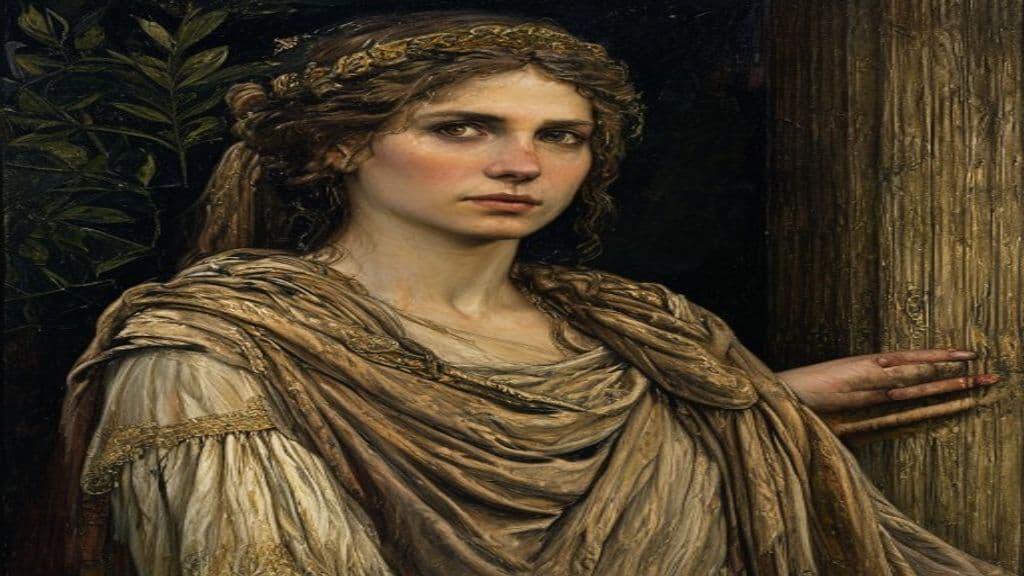
The name Agamede is applied to multiple figures in Greek tradition rather than to a single unified supernatural biography. In the Homeric-epic tradition she appears as an Elean woman skilled in herbcraft and healing (summarized from Homeric attribution in secondary sources). A separate tradition, recorded by Stephanus of Byzantium and cited in discussions of Lesbos, makes Agamede a daughter of Macar who gave her name to a town on Lesbos; Pliny the Elder notes the town had already disappeared by his day. Other accounts in later compilations and summaries associate an Agamede as daughter of Augeas and wife of Mulius (Elean genealogy), and still other variant genealogies name her as a daughter of Anchises and sister to Aeneas or as mother of sons by Poseidon (as preserved in mythographic summaries). The multiplicity of attestations indicates a flexible onomastic role: healer and herbalist in epic, local eponym in geographic lexica, and a genealogical node in various mythic lineages.
Ancient sources and the modern summaries provided do not record a consistent physical description of Agamede. Rather than describing bodily attributes, the texts identify her by social status and skill — as a princess in some genealogies (daughter of Augeas or of Macar) or as a learned woman practiced in the properties of plants (Homeric epithet summarized in secondary sources). Hellenistic poets who treat cognate name-forms (e.g., Perimede in Theocritus or Propertius contexts cited in modern summaries) likewise emphasize role and power rather than specified appearance. In short, Agamede is presented through roles and expertise, not through standardized corporeal features in the surviving excerpts.
The core attested ability in the sources is expertise with plants and remedies: a Homeric description summarized in reference works calls her "a Greek physician acquainted with the healing powers of all the plants that grow upon the earth," placing her among traditional female practitioners of botanical medicine. Later Hellenistic reception increasingly framed Agamede in the register of pharmakeia — the mixing of medicinal herbs, a term that can encompass both neutral therapeutic practice and the morally ambivalent or magical practices labeled "witchcraft." Secondary summaries explicitly compare the Hellenistic Agamede to literary sorceresses such as Circe and Medea, indicating a shift in some authors from purely medical competence to a sorceress archetype in poetic and mythographic literature. The supplied materials do not preserve specific acts of transformation, enchantment, or other discrete supernatural feats attributed to Agamede; her powers, as reported, center on herbal knowledge and the culturally fraught boundary between healing and pharmakeia.

Circe
Circe is a figure of Greek myth known as a practitioner of potent pharmacological and ritual arts who occupies a liminal status between goddess, nymph, and witch. She is famed for her knowledge of herbs and potions, her ability to transform humans into animals in narrative episodes, and for performing ritual purification in at least one classical source.

Apsara
Celestial dancers and water nymphs of Hindu cosmology — beautiful semi-divine beings who dance at the court of Indra and, by his command, descend to earth to distract sages from excessive asceticism.
Afriquiamus
No folkloric or mythological entity named Afriquiamus is attested in the supplied sources. The available material comprises paleontological and taxonomic references (Trechnotheria, lists of prehistoric mammals) and contains no information identifying Afriquiamus as a spirit, deity, or monster.
Aga of Kish
Aga of Kish (Aga, Agga, Akka) is an Early Dynastic Mesopotamian king recorded in the Sumerian King List, the Tummal Inscription, epigraphic objects, and the Sumerian poem "Gilgamesh and Aga." He functions in texts as a historical/legendary political actor who attempted hegemonic demands on Uruk and was ultimately captured and released by Gilgamesh.
Agabus
Agabus is an early Christian prophet attested in the Acts of the Apostles and later ecclesiastical tradition. He is reported in Acts to have predicted a famine and to have given a symbolic warning to Paul; later tradition lists him among the Seventy Disciples and attributes missionary activity and martyrdom to him.
Agag
Agag (Hebrew אֲגָג, ʾĂḡāḡ) is presented in the Hebrew Bible and later Jewish exegetical tradition as a royal personal name or dynastic title applied to the kings of Amalek. Treated as a human foreign king and eponymous ancestor of Amalekite hostility, Agag functions in scripture and rabbinic literature as a political antagonist whose fate embodies themes of memory, justice, and the consequences of royal failure.
Agagite
A literary ethnonym used in the Book of Esther to identify Haman as a descendant or representative of Agag, king of the Amalekites; in rabbinic and midrashic interpretation it functions as a symbolic marker of perennial enmity toward Israel rather than a description of a supernatural being.
Agaliarept
A named high-ranking spirit from post-medieval grimoire tradition, presented in the Grimoirium Verum and the Grand Grimoire as a commanding officer in a hierarchical host of spirits; credited with revealing secrets and commanding a legion, and cited in later printed occult imprints and modern fiction.
Agamemnon
Agamemnon is the legendary king of Mycenae (or Argos), head of the House of Atreus, and commander of the Achaean forces at Troy in Greek epic and tragedy. His story links dynastic guilt, ritual obligation, and political authority, culminating in the sacrifice-at-Aulis episode and his murder on return from Troy followed by juridical atonement in the Oresteia.
Aganippe (naiad)
Aganippe is the local Naiad of the spring called Aganippe at the base of Mount Helicon in Boeotia. The spring and its nymph are traditionally associated with the Muses and with poetic inspiration; the name Aganippe is also used as an epithet in other, sometimes divergent, local mythic or cultic contexts.
Aganjú
Primordial Orisha associated with the sun, fire, and the untamed wilderness in Yoruba tradition. (Note: - Remove "untamed wilderness" from Power tier description as it's a trait associated with Lesser entities, not Primordial. - Add Appearance section based on source material (e.g., no specific descript)
Agapenor
Agapenor (Ancient Greek: Ἀγαπήνωρ) is a legendary Arcadian leader in the Greek heroic-age tradition: commander of Arcadian contingents at Troy, participant in Trojan-cycle episodes (including the Trojan Horse and funeral games), and, in later tradition, shipwrecked on Cyprus and credited with founding New Paphos. He is presented as a mortal king and genealogical ancestor rather than a supernatural being.
Agapius of Athens
Agapius (Greek: Ἀγάπιος; c. 460 – after 511) is recorded in late antique sources as a learned Neoplatonic philosopher of Athens who lectured on Plato and Aristotle and as, in some traditions, a physician who worked in Alexandria and later Constantinople. The evidence is fragmentary and transmitted through later epitomes (notably Damascius via Photius and the Suda) and a report by John Lydus.
Agaptolemus
Agaptolemus (Ancient Greek: Ἀγαπτόλεμος) is a mythic Greek prince, one of the fifty sons of King Aegyptus, best known as the husband of the Danaid Pirene who, like most of the Danaids, slew her husband on their wedding night at the command of her father Danaus.
Community Record
- [1]Agamede (Wikipedia). Wikipedia, 'Agamede' article summary citing Homer, Hellenistic reception, and later sourceswiki
- [2]AGAMEDE - Elean Princess & Witch of Greek Mythology (theoi.com). Theoi Project entry summarizing Agamede as Elean princess and practitioner of pharmakeiaother
- [3]Agamede (Lesbos) (Wikipedia). Wikipedia entry on Lesbos place-name noting Stephanus of Byzantium's attribution and Pliny's remark that the town had disappearedwiki
- [4]Myths UVic: Agamede. Mythographic summary collecting variant genealogical attestations for Agamedeliterary
- [5]Agamede definitions and dictionary summaries. Modern dictionary/summary pages summarizing classical attestations and name-formother