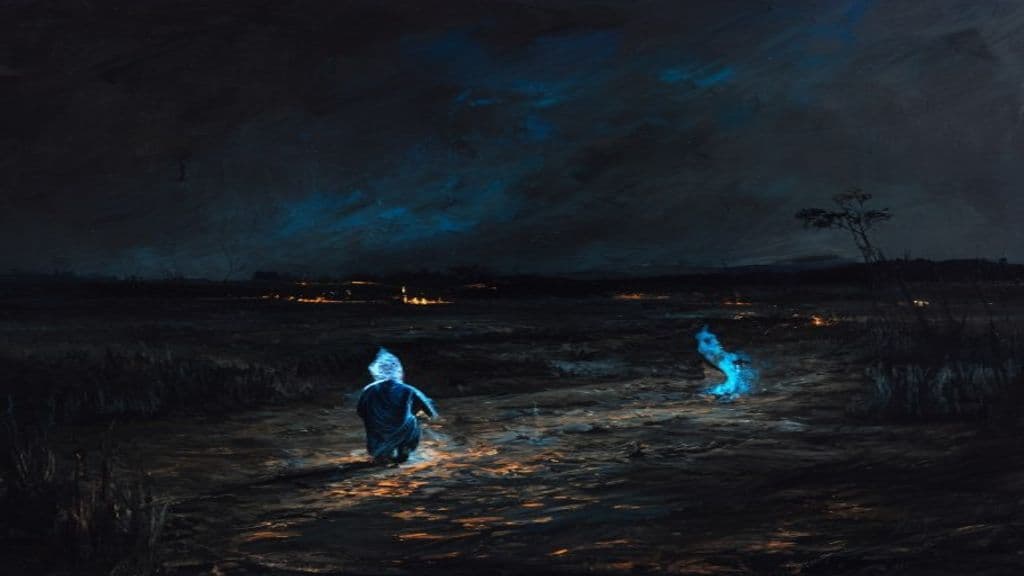
In the taxonomy of UP and Bihar folk belief, spirits are classified partly by how they manifest — those who appear in human form (manusha bhoot), those who appear in animal form (pashu bhoot), and those who appear as fire (agiya bhoot). The Agiya Baital is specifically a Vetala — a cremation ground spirit — that has taken the fire form.
This classification suggests the spirit is associated with a pyre death of unusual intensity: someone burned before properly dying, or burned in circumstances that were ritually incorrect, whose lingering energy took the shape of the fire that consumed them. Cremation grounds in UP that processed deaths during epidemic periods are particularly associated with Agiya Baital sightings in the generations after.
The Agiya Baital appears as a small, distinct flame — roughly the size of a lantern — that moves with apparent purpose across open ground, particularly marshes, fields, and the space between inhabited areas and cremation grounds. It is described as reddish-orange or blue-white, and it moves faster than a person walking.
The key observable detail that distinguishes it from ordinary fire: it does not flicker in wind, and it maintains a consistent distance from the observer — always receding when approached, pausing when the observer stops.
The Agiya Baital's power is the same as the Vetala class it belongs to: disorientation. Night travellers who follow it find themselves in unfamiliar territory — far from the road, sometimes in water, sometimes near the edge of a cliff or ravine they could not see in the dark.
Unlike ordinary will-o-wisps, the Agiya Baital is described as retaining the Vetala's predatory intelligence. It selects specific targets — solitary travellers, those who are drunk or drowsy — rather than simply drifting and attracting whoever is near.
Weaknesses
- conditionRefusing to follow the light and staying on the road
Wards
- substanceCarrying a lighted lantern — the Agiya Baital avoids competing light sources
- mantraHanuman Chalisa recited while walking past cremation grounds at night
Community Record
- [1]The Popular Religion and Folk-Lore of Northern India. Crooke, W. (1896). The Popular Religion and Folk-Lore of Northern India, Vol. 1 & 2. Archibald Constable, Westminster.academic
- [2]Death in Banaras. Parry, J. (1994). Death in Banaras. Cambridge University Press.academic