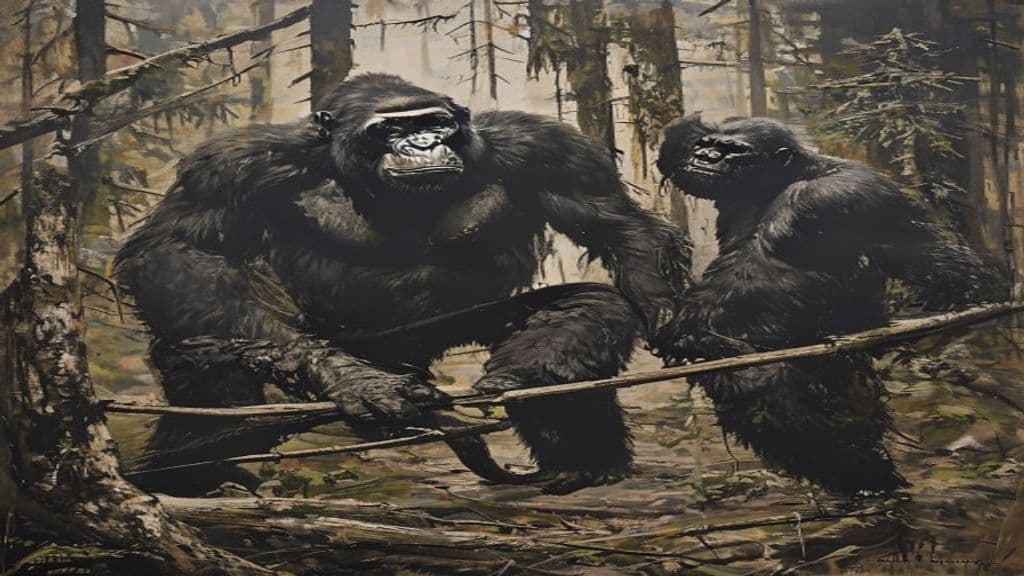
Sources present the Agropelter as a product of American lumbering/woodland tall-tale tradition and classify it among the so-called "fearsome critters," even given a mock-taxonomic name (Anthrocephalus craniofractens) in some summaries. The supplied materials do not record any cosmogonic origin, cultic founding myth, or religious genealogy; instead the creature appears in anecdotal and cataloguing accounts used by storytellers and camp lore to explain forest hazards and entertain.
Accounts vary. One formulation describes a "slender, wiry body, the villainous face of an ape, and arms like muscular whiplashes," a comparison that includes the simile that it can "snap off dead branches and hurl them... like shells from a six inch gun." Other tellings depict "the head of a gorilla or some other terrifying ape, but fully furred, and its body... like that of a stretched-out, starving bear." A separate description gives its coloration as "completely black save for its face, which had a ... ash-grey skull pattern." Sources note variation among tellings and also remark on the creature's elusiveness.
Folkloric accounts ascribe to the Agropelter the behavior of perching in hollow conifer trees and hurling wooden splinters, branches, and other thrown wood at intruders; one source emphasizes great strength and accuracy in this action. Tales list a humorous/folk diet ("subsists on woodpeckers, hoot owls, high-holes, and dozy (rotten) wood") and include reproductive lore that "pups are born on February 29 and always arrive in odd numbers." In tall tales the creature is blamed for disappearances in northern forests and for logging accidents in which falling branches killed workers; individual anecdotes include a story of an Agropelter kidnapping a pioneer surveyor and feeding him raw fish until escape.
Weaknesses
- otherNo recorded weaknesses in supplied sources
Wards
- otherNo recorded wards or protective practices in supplied sources
Cactus Cat
A legendary 'fearsome critter' of American Southwestern frontier folklore: a bobcat-like feline covered in thorny spines, said to slash cacti to drink their fermented juices. It appears in tall-tale storytelling among miners, cowboys, and regional compendia rather than in documented ritual or indigenous cosmologies.
Agrippa
Agrippa is a polyvalent Latin personal name attested across Roman myth (a legendary king of Alba Longa), multiple historical figures (e.g., Marcus Vipsanius Agrippa, Agrippa Postumus, Herod Agrippa I & II), and a Renaissance occult author (Heinrich/Heinrich Cornelius Agrippa). The supplied sources treat Agrippa primarily as an onomastic label rather than a single, consistent supernatural entity.
Agrius
Agrius (Ancient Greek: Ἄγριος, 'wild') is an onomastic figure in Greek myth whose name is applied to multiple distinct personae—including a Giant, a centaur, a bear‑born twin, a princely son, a suitor of Penelope, and one of Actaeon's dogs—rather than a single unified supernatural being. Each attestation places an Agrius in different narrative registers (Gigantomachy, Heracles' labors, heroic genealogies, the Odyssean cycle, and the Actaeon hunt).
Agrius and Oreius
Agrius (Ἄγριος) and Oreius/Orius (Ὄρειος) are twin sons of Polyphonte and a bear in a Greek mythic tale. Presented as 'twin savage bear-like children,' they committed acts of impiety and violence and were ultimately transformed by the gods into ominous birds (vulture and eagle-owl) as part of divine punishment and resolution.
Agrius of Calydon
Agrius of Calydon is a mythological mortal attested in Greek genealogical lists as a son of the Calydonian king Porthaon and Euryte and brother to Oeneus and other siblings. He is presented in the sources as a member of the Calydonian royal household rather than a supernatural being.
Agron
Agron (Ancient Greek: Ἄγρων, 'wild' or 'rustic') is a human/mortal figure attested in the summary of Antoninus Liberalis' Metamorphoses (as presented on Wikipedia) who, because of impiety toward certain gods, is transformed by Hermes into a plover. The tale functions as an etiological metamorphosis and moral exemplum about observing cult obligations.
Agronā
Agronā is a scholarly, linguistically reconstructed Proto‑Celtic river-name/theonym proposed to underlie later hydronyms such as the River Ayr (Scotland) and Aeron (Wales). It is a hypothetical reconstruction coined in academic discussion (not attested in primary mythic or ritual sources) and has been interpreted by one scholar as denoting a violent or martial river-goddess.
Agrotera
Agrotera (Ancient Greek: Ἀγροτέρα) is a cultic epithet of the goddess Artemis emphasizing her role as huntress and recipient of civic-military sacrifices. The title is closely associated with a temple at Agrae on the Ilissos near Athens and with an annual sacrifice (Agroteras Thusia) tied to a vow connected to the Battle of Marathon.
Aguano
Aguano is an ethnonym for an indigenous people of Peru (also recorded as Awano, Ahuano, Hilaca, Uguano, Aguanu, Santacrucino, Tibilo). Sources identify them as inhabitants of riverine areas of the Huallaga, Samiria and Marañón and note demographic collapse after European contact; the provided materials do not document Aguano as a supernatural being.
Aguara
Aguara is a mythological fox figure in Ava Guaraní and Chané oral traditions who functions primarily as a trickster and cultural agent; traditions describe him as both malignant and a cultural hero and associate him with the constellation Scorpius.
Aguingay
Aguingay (also Agingay) is a legendary woman from the Bulusan epic of Sorsogon, Philippines. Presented as a mortal of exceptional beauty and tragic fate, her life and death are etiologically linked to local landscape features (Mt. Bulusan and two lakes) and commemorated in an annual festival.
Agum II (Agum‑Kakrime)
Agum II (called Agum‑Kakrime in the inscriptionary tradition) is a Kassite-era Babylonian king known from the Agum‑Kakrime Inscription and later copies. He appears in Akkadian inscriptional and king-list traditions as a royal restorer who recovered and reinstalled the cult statue of Marduk and refurbished the É-sagila, presenting himself as a legitimate shepherd‑king and temple benefactor.
Community Record
- [1]Agropelter — Wikipedia. Wikipedia, "Agropelter"wiki
- [2]Argopelter — Wikidata entry (catalogue). Wikidata, Q4789696 (Argopelter)other
- [3]Best Epics of 2025 Show #13 (archive record referencing modern cultural use). Archive.org: Best Epics of 2025 Show #13other
- [4]Episode #1124: MiW Award Show - 2025 (archive record referencing modern cultural use). Archive.org: Episode #1124: MiW Award Show - 2025other