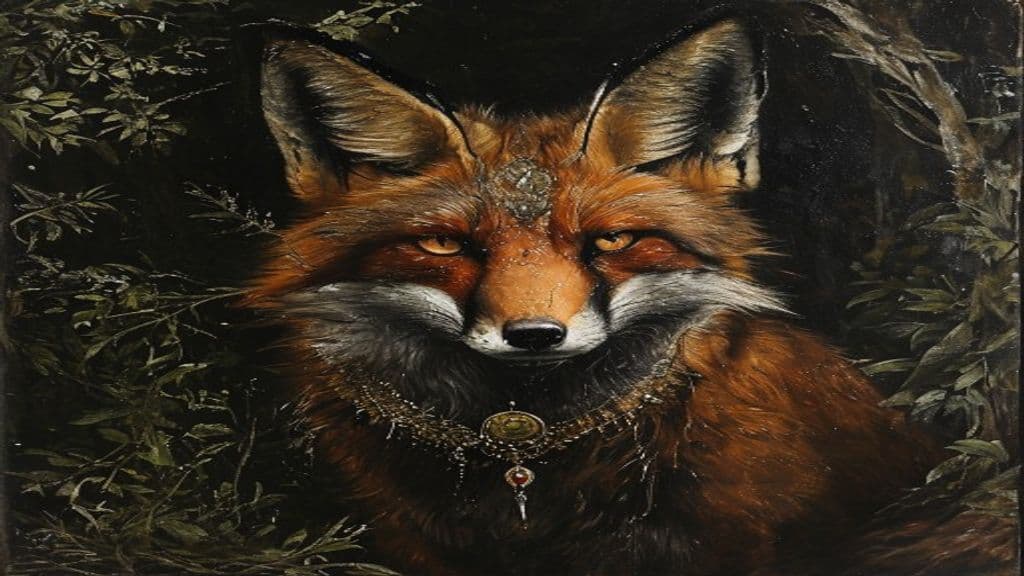
In Ava Guaraní and Chané oral narrative contexts Aguara appears as a named mythic fox whose actions explain aspects of the human world. Specific origin motifs recorded in the sources credit Aguara with stealing algarroba seeds from the Viscacha and with capturing a Vulture and demanding rubber as a ransom, an act described in the tradition as creating rubber for humankind. He is also presented as a progenitor-like figure through accounts in which beautiful women bear his children; additionally he enters an extended mythic genealogy and rivalry field through stories in which he contests and ultimately kills the mythological armadillo Tatu-tunpa. These episodes position Aguara as an origin-agent for material culture and as an active participant in mythic social relations (Wikipeida: Aguara).
Sources identify Aguara simply as a mythological fox; the oral traditions refer to him using the fox identity and sometimes attach the honorific suffix tunpa to form Aguara-tunpa (glossed in sources as 'sacred'). Beyond the identification as a fox and the culturally significant epithet, the provided materials do not record detailed physical attributes (such as size, color, or additional supernatural features) and do not supply consistent descriptive detail in the available accounts (Wikipedia: Aguara).
Aguara's characteristic mode is trickery: he repeatedly deceives humans and other mythic animals. Traditions describe him variably as malignant and as a cultural hero, reflecting morally ambivalent behavior. Specific mythic acts attributed to him in the recorded narratives include theft of algarroba seeds from the Viscacha and the capture of a Vulture to extort rubber for humanity; he also fathers children with human women and engages in lethal rivalry, notably killing Tatu-tunpa the armadillo. These episodes indicate capacities for cunning, interaction with humans including sexual/ancestral crossing, initiation of culturally significant resources, and lethal conflict with other mythic animals (Wikipedia: Aguara).
Agrius of Calydon
Agrius of Calydon is a mythological mortal attested in Greek genealogical lists as a son of the Calydonian king Porthaon and Euryte and brother to Oeneus and other siblings. He is presented in the sources as a member of the Calydonian royal household rather than a supernatural being.
Agron
Agron (Ancient Greek: Ἄγρων, 'wild' or 'rustic') is a human/mortal figure attested in the summary of Antoninus Liberalis' Metamorphoses (as presented on Wikipedia) who, because of impiety toward certain gods, is transformed by Hermes into a plover. The tale functions as an etiological metamorphosis and moral exemplum about observing cult obligations.
Agronā
Agronā is a scholarly, linguistically reconstructed Proto‑Celtic river-name/theonym proposed to underlie later hydronyms such as the River Ayr (Scotland) and Aeron (Wales). It is a hypothetical reconstruction coined in academic discussion (not attested in primary mythic or ritual sources) and has been interpreted by one scholar as denoting a violent or martial river-goddess.
Agropelter
A North American "fearsome critter" of lumbercamp tall-tale tradition said to dwell in hollow conifer trees and hurl broken branches and splinters at unwary people; presented in folklore as an animal-like, mischievous or predatory woodland creature rather than a deity or spirit of formal cosmology.
Agrotera
Agrotera (Ancient Greek: Ἀγροτέρα) is a cultic epithet of the goddess Artemis emphasizing her role as huntress and recipient of civic-military sacrifices. The title is closely associated with a temple at Agrae on the Ilissos near Athens and with an annual sacrifice (Agroteras Thusia) tied to a vow connected to the Battle of Marathon.
Aguano
Aguano is an ethnonym for an indigenous people of Peru (also recorded as Awano, Ahuano, Hilaca, Uguano, Aguanu, Santacrucino, Tibilo). Sources identify them as inhabitants of riverine areas of the Huallaga, Samiria and Marañón and note demographic collapse after European contact; the provided materials do not document Aguano as a supernatural being.
Aguingay
Aguingay (also Agingay) is a legendary woman from the Bulusan epic of Sorsogon, Philippines. Presented as a mortal of exceptional beauty and tragic fate, her life and death are etiologically linked to local landscape features (Mt. Bulusan and two lakes) and commemorated in an annual festival.
Agum II (Agum‑Kakrime)
Agum II (called Agum‑Kakrime in the inscriptionary tradition) is a Kassite-era Babylonian king known from the Agum‑Kakrime Inscription and later copies. He appears in Akkadian inscriptional and king-list traditions as a royal restorer who recovered and reinstalled the cult statue of Marduk and refurbished the É-sagila, presenting himself as a legitimate shepherd‑king and temple benefactor.
Agunua
Agunua is the chief cosmic-serpent deity of San Cristobal (Makira) in the Solomon Islands, worshiped as a creator and nourisher and associated with the sea. In some accounts the name Hatuibwari is treated as an alternate form emphasizing a dragon-like composite appearance.
Agur ben Jakeh
Agur ben Jakeh is presented in the Hebrew Bible (Proverbs 30) as a sage and compiler or speaker of a distinct collection of sayings. The figure functions in textual tradition as a named human sage, a possible pedagogical persona, and—in some readings—an oracular voice; there is no evidence in the supplied sources that Agur is a supernatural being.
Agwé
Agwé is a high-ranking lwa in Haitian Vodou associated with the sea, navigation, fishing, and certain funerary conveyances. He is portrayed as a naval officer who lives in a palace beneath the sea, commands attendant spirits, and is propitiated with maritime offerings and ceremonies.
Ah Muzen Cab
Ah Muzen Cab is a Yucatán Maya divine figure associated with bees and honey, attested in summary sources as protector of Melipona bees and as a participant in Chilam Balam creation and ritual chapters. He is also linked in secondary accounts to the upside-down 'Descending' or 'Diving God' image found in Maya iconography at sites such as Tulum.
Community Record
- [1]Aguara. Wikipedia, article 'Aguara'.wiki
- [2]Aguará (Wikidata). Wikidata entry for 'Aguará'.other
- [3]Aguara 16 10 17 (Archive listing). Archive.org item 'Aguara 16 10 17' (listed among sources consulted; content relevance uncertain).other
- [4]CUMBRE DEL AHUA Eríka Cañari (Archive listing). Archive.org item 'CUMBRE DEL AHUA Eríka Cañari' (listed among sources consulted; content relevance uncertain).other
- [5]INTIMIDADES Que Hacen Producciones Lujan Fernandez Luna (Archive listing). Archive.org item 'INTIMIDADES Que Hacen Producciones Lujan Fernandez Luna' (listed among sources consulted; content relevance uncertain).other