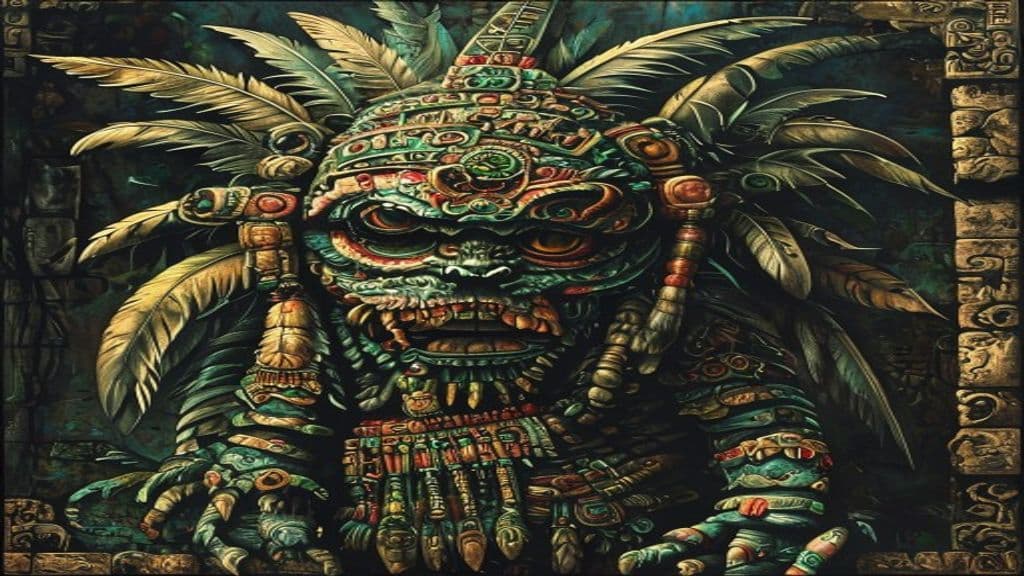
The provided source does not give a cosmogonic or narrative origin myth for the ahuizotl. Within Aztec cultural context the creature functions as part of the ensemble of water-associated beings and is described as allied with rain deities; politically, the image of the ahuizotl was adopted as an emblem by a ruler bearing the same name. The source frames the ahuizotl primarily as a named mythic being in Aztec tradition rather than supplying a specific birth or creation story.
The provided sources do not contain an original mythological description of the Ahuizotl's appearance. Two archive items in the source set are modern artworks: one titled simply "Ahuizotl" (art by Disastrous_Band_9477) and another titled "The Ahuizotl from Aztec Mythology as A Giant Water Opossum" (art by Hodari Nundu). Those modern renderings imply an interpretation of the creature as resembling a large aquatic opossum, but the sources do not corroborate this as a traditional or primary-source description; therefore no definitive traditional physical description can be asserted from the available materials.
According to the source, the ahuizotl is said to lure people to their deaths and is described as a "friend of the rain gods," linking its activity to water and weather. The creature's dexterous hands and prehensile tail are noted; modern descriptions interpret these features as enabling the ahuizotl to grasp or drag victims into water, though the source frames this as descriptive interpretation rather than detailing specific mechanics of killing.
Atlaua
Atlaua (also recorded as Atlahua, Ahtlahua, Atlahoa, Atlavâ) is an Aztec water deity described in the provided sources as a water god, fisherman and archer who was worshiped at multiple temples and was prayed to by the Aztecs when there were deaths in water.
Chalchiuhtlatonal
Chalchiuhtlatonal is presented in the cited sources as an Aztec god of water related to the water goddess Chalchiuhtlicue. The sources state that "he looks over the sea, and protects the animals living in it," and that "he granted the gift of water to one human in 10,000 years to help look after the sea."
Dragon (Long)
Long (龍, "dragon") is a pervasive cultural and artistic motif that appears in Taoist sacred-geographical contexts, Chinese literature, and modern exhibitions; the provided sources treat it as part of the broader mythic imagery present around Taoist sites and ritual scenes rather than as a single, consistently described doctrinal entity.
Feathered Serpent
A composite avian-serpent supernatural figure attested across multiple Mesoamerican cultures (Olmec, Teotihuacan, Maya, Toltec, Aztec, Kʼicheʼ). Associated in sources with cosmological roles such as creation, wind and rain, knowledge, Venus, and calendric/origin mythic functions, and widely represented in monumental architecture and iconography.
Huītzilōpōchtli
Huītzilōpōchtli is the principal Aztec (Nahua) solar and war deity, patron of the Mexica and Tenochtitlan. In Aztec cosmology he is a cosmic warrior whose continued vigor is sustained by ritual nourishment—notably human blood and hearts—administered in formal festivals and sacrifices.
Ilamatecuhtli
Ilamatecuhtli (attested also as Citlāllīcuē and Citlālinīcuē) is identified in the supplied sources as a creator goddess within Aztec mythology. The provided excerpts give no further mythic narrative, iconography, or ritual context.
Metztli
Metztli (Nahuatl: Mētztli) is the Nahuatl term for the Moon and in the supplied sources is described as a god or goddess associated with the moon, the night, and farmers in Aztec/Nahuatl cultural context. The available material treats Metztli both as the celestial Moon and as a lunar deity, but supplies no detailed myths, iconography, or ritual corpus.
Opochtli
Opochtli is an Aztec deity whose name means "The Left" or "The Left-Handed." He is associated with fishing, hunting, and the technologies of lacustrine and marsh livelihoods, credited with inventing the atlatl, the fishing net, the canoe pole, and the bird snare, and is commonly depicted riding a dolphin. He is described in some sources as a representative or attendant aspect of the rain god Tlaloc and is directionally linked to the south in Aztec ritual geography.
Personifications of Death
Named, often anthropomorphic figures across cultures that embody, govern, or mediate death and the realm of the dead. Roles vary from psychopomp guide to judge or sovereign of an underworld, and forms range from skeletal reapers to regal underworld rulers and spirit families.
Quetzalcoatl
Quetzalcoatl is the central Mesoamerican 'Feathered' or 'Plumed Serpent' figure prominent in Aztec and broader pre-Columbian religious thought, associated with wind (Ehecatl), the planet Venus, learning, arts and crafts, merchants, and the priesthood. Represented as a hybrid serpent-and-bird emblem, Quetzalcoatl functions as both a deity and an organizing sacred principle linking sky and earth.
Ahtola (Kalevala) (tradition)
In the supplied sources, no supernatural entity named "Ahtola" is attested in the Kalevala or other Finnish mythic texts. The name Ahtola appears in the source set only as a modern Finnish surname and a place-name; the closely related mythic figure attested in the material is Ahti/Ahto, a Finnish water god associated with the sea.
Ahura
Ahura is an Avestan term that designates a class of divinities in the Indo‑Iranian and Zoroastrian tradition, marking the sacred ‘lords’ who are to be reverenced and opposed to the rejected class of daevas. In Zoroastrian scripture the label functions as both a technical category and an honorific applied to high divine figures such as Ahura Mazda, Mithra, and Apam Napat.
Community Record
- [1]Ahuizotl — Wikipedia. "Ahuizotl may refer to: Ahuitzotl, also transcribed Ahuizotl, an Aztec emperor (r. 1486–1502); Ahuizotl (mythology), a Mesoamerican mythological creature; Ahuizotl (Dungeons & Dragons), a creature from Dungeons & Dragons; Ahuizotl, a My Little Pony: Friendship Is Magic character." — Wikipediawiki
- [2]ahuizotl — Wikidata. "Aztec mythological creature" — Wikidatawiki
- [3]Ahuizotl, art by Disastrous_Band_9477 — Archive.org. Archive item titled "Ahuizotl , art by Disastrous_Band_9477"other
- [4]My Little Pony: The Daring Do Adventure Collection (2014) — Archive.org. My Little Pony archive blurb mentioning "Ahuizotl" as a named antagonist in one of the boxed-set storiesother
- [5]The Ahuizotl from Aztec Mythology as A Giant Water Opossum, art by Hodari Nundu — Archive.org. Archive item titled "The Ahuizotl from Aztec Mythology as A Giant Water Opossum , art by Hodari Nundu."other
- [6]Ahuizotl (mythology) — Wikipedia. Wikipedia contributors, "Ahuizotl (mythology)," Wikipedia, The Free Encyclopedia.wiki