Modern scholarly reconstructions do not preserve a single, fully attested mythic birth narrative for Aiapæc; instead, sources report differing placements within Moche cosmology. Colonial records preserve the lexical form aiapæc/aiapäk (reconstructed pronunciation *[ajapʷɨk]) and gloss it as 'creator' in some grammars, but those same colonial-era forms have been shown to be at least partly anachronistic — the name was first recorded and applied by Spanish grammarians, sometimes used to render the Christian God. Archaeological and iconographic scholarship thus treats the colonial name with caution: some reconstructions (drawing on iconographic context and comparative readings) place Aiapæc as an active, possibly high-ranking god who ranged beneath a nameless supreme sky‑creator whose throne sat on a mountain, and who in one reading may even be considered a principal or creator figure. The Archive source, for example, suggests Aiapæc may have been seen as son or agent of a mountain god and operated beneath a higher sky creator, reflecting scholarly disagreement about whether the figure was supreme or subordinate.
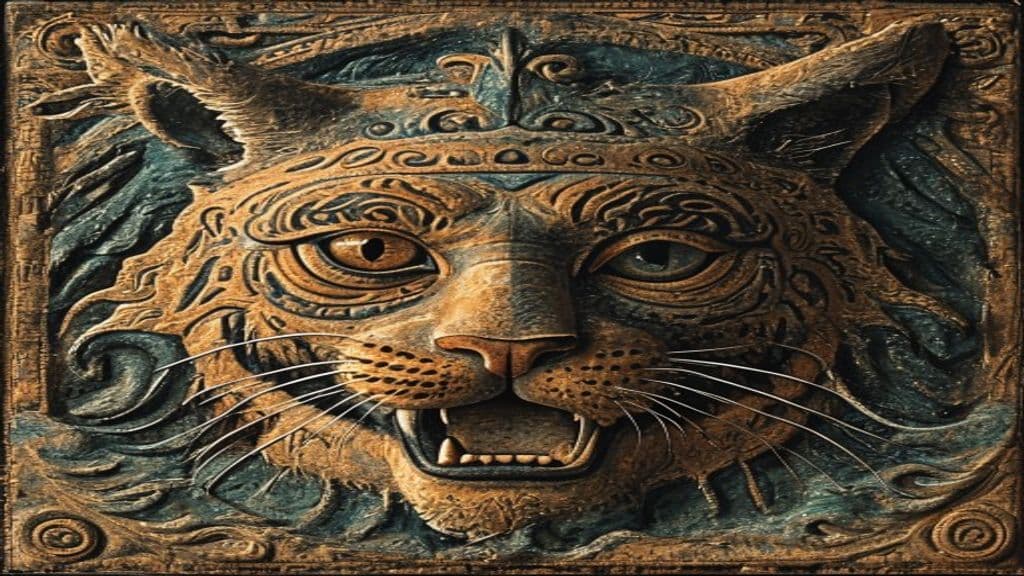
Aiapæc's depiction varies considerably across media, suggesting no single fixed iconography. Murals (notably from the Temples of the Sun and Moon) commonly show an anthropomorphic face with pronounced feline (jaguar) fangs framed by stylized ocean waves. In metalwork Aiapæc is sometimes rendered with an eight‑legged (spider) body bearing an anthropomorphic face with jaguar fangs. Ceramic representations tend to be more anthropomorphic: a figure shown with its head in its hands and occasionally with two snakes sprouting from the head. Sculptural examples show the figure carrying a staff. Descriptive notes in secondary sources add consistent attributes such as a jaguar headdress and snake‑head earrings; the shared feline mouth motif links Aiapæc iconography to broader creator or jaguar imagery in Andean art. Thus the visual record combines mountain/marine motifs, feline features, serpentine elements and occasional arachnid form depending on medium and context.
Scholarly sources ascribe multiple overlapping social and cosmic functions to Aiapæc based on iconography and ethnohistoric reports. The figure is widely interpreted as a provider and protector of the Moche—supplying or being petitioned for water, food and military triumphs—and simultaneously as a punitive, fear‑eliciting deity whose cult demanded serious offerings. Colonial glosses record the lexical meaning 'creator' for aiapæc, but archaeologists caution that this label is anachronistic and that iconographic evidence alone does not settle whether the figure acted as supreme creator, as a subordinate active god, or as one of several related mythic personages. Ritual practice recorded in secondary sources includes human sacrifice: some accounts state that during sacrificial rites prisoners were decapitated and their heads presented to Aiapæc; secondary sources attribute this practice to ceremonial exchange intended to secure provision and victory and to avert the deity's punitive power. Because primary ritual liturgies and full narratives are not preserved in the cited materials, descriptions of agency and behavior remain interpretive and contested among scholars.
Ahti (Ahto)
Ahti (also Ahto) is a Finnish water haltija — a named supernatural proprietor of the sea and aquatic resources who appears in Kalevala-derived epic material, regional runic fishing songs, and healing spells. He functions as a sea-king/sea-god figure, provider of fish and other water-given wealth, and a ritual addressee in practical subsistence and healing contexts.
Ahtola (Kalevala) (tradition)
In the supplied sources, no supernatural entity named "Ahtola" is attested in the Kalevala or other Finnish mythic texts. The name Ahtola appears in the source set only as a modern Finnish surname and a place-name; the closely related mythic figure attested in the material is Ahti/Ahto, a Finnish water god associated with the sea.
Ahuizotl
Ahuizotl is identified in the provided sources as an Aztec mythological creature; the same lexical form also names an historical Aztec emperor (Ahuitzotl). The available materials for this entry are limited to modern reference pages and a small set of artistic and popular-culture uses of the name, and do not contain primary indigenous mythic accounts or detailed ethnographic descriptions.
Ahura
Ahura is an Avestan term that designates a class of divinities in the Indo‑Iranian and Zoroastrian tradition, marking the sacred ‘lords’ who are to be reverenced and opposed to the rejected class of daevas. In Zoroastrian scripture the label functions as both a technical category and an honorific applied to high divine figures such as Ahura Mazda, Mithra, and Apam Napat.
Ahura Mazda
Ahura Mazda is the principal deity of Zoroastrian tradition, invoked as the supreme source of goodness and wisdom who instructs Zoroaster and commands helper spirits (yazatas). Historically attested in Achaemenid royal inscriptions, Ahura Mazda occupies a central role in Zoroastrian liturgy (notably the Yasna) and in various Iranian religious formulations.
Ahurani
Ahurani (Avestan ahurani; pl. ahuranis) is a Zoroastrian divinity or class of divinities of the waters in the Avesta. In hymnic contexts (notably Yasna Haptanghaiti and Yasna 68) the ahurani(s) are invoked as companions of the ahura(s), bearers of health, fertility and other gifts, and the ritual recipients of libations (Ab‑Zohr).
Aibell
Aibell (Aoibheall, Aoibheal; anglicised Aeval, Eevill) is a powerful female Otherworld figure in Irish tradition, variously described as a pre‑Christian regional goddess and, after Christianisation, as a Fairy Queen and guardian spirit associated with north Munster. She is linked to a specific entrance to the Otherworld at Craig Liath, acts as a patron/guardian of certain kin‑groups, functions as an oracular/prophetic presence, and is famed for a harp whose music is a death‑omen.
Aicha Kandicha (Qandisa)
Aicha Kandicha (also romanized Qandisa/Qandisha) is a female mythological figure in Moroccan folklore described as a jinn-like seductress associated with water. She appears as a beautiful woman with hoofed lower limbs who dwells at rivers, springs, lakes and the sea and is said to use sexual allure to seduce men, sometimes driving them mad or killing them.
Aicha Qandicha
Aicha Qandicha is a female seductress spirit in northern Moroccan folklore, often associated with bodies of water and implicated in harmful encounters with men. She appears both as a wild liminal monster and as a named spirit incorporated into local ritual systems (Hamadsha, Zār, Buffi Sufi orders).
Aidos
Aidos (Ancient Greek: Αἰδώς) is the personification of shame, modesty, and reverent restraint in classical Greek thought. Treated variously as an ethical feeling, a moral force, and occasionally as a goddess with local cults, Aidos embodies the inner reverence that restrains wrongdoing and governs social propriety.
Aigamuxa
Aigamuxa are legendary humanoid man‑eaters from Khoikhoi‑recorded traditions of southern Africa, described in the available sources as desert‑dwelling predators—especially of Kalahari dunes—notable for having their eyes located on their feet and for needing to invert their bodies to see.
Aigosages
Aigosages (Greek Αἰγοσάγες, Latin-alphabet Aegosages) were a Gallic/Galatian tribal group recorded in Hellenistic sources as a recruited mercenary body active c. 218–216 BC. Recruited in Thrace by Attalus I of Pergamon, they were transported across the Hellespont, settled on its shores, conducted raids in the Troad, besieged Ilium, and were annihilated by Prusias I of Bithynia.
Community Record
- [1]Aiapæc. Wikipedia, 'Aiapæc' (entry summarizing Moche iconography, name forms, functions, and sacrificial practice).wiki
- [2]Ai apaec (Wikidata). Wikidata item for Ai apaec (identifier and linked data record).other
- [3]AI APAEC. Archive entry 'AI APAEC' (discussion of Aiapæc as 'a late name for an active god of the Mochica', relation to a nameless sky‑god, jaguar headdress and snake‑head earrings).other