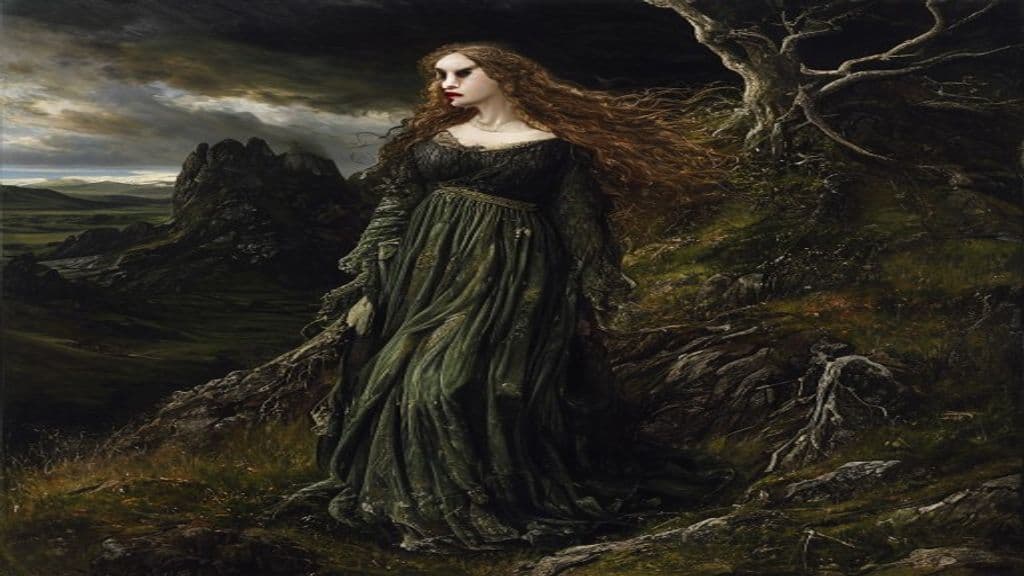
In the sources consulted, Aibell appears in two overlapping developments: as a pre‑Christian regional goddess of Munster in older strands of Irish belief and, following Christianisation, as a ruler of the fairy Otherworld (sidhe) of Thomond. Local tradition and later summaries describe her as the guardian spirit associated with kin groups including the Dál gCais, the Delbhna, and Clan Ó Bríen. The literature and folklore do not preserve a single canonical birth myth; rather, she is attested as an enduring local supernatural presence whose status shifts from deity to fairy queen in the historical transition to medieval and early modern Irish folklore.
Accounts vary by genre. In aisling‑style and folkloric material she is presented both as a beautiful supernatural woman (the etymological association with Gaelic aoibh/aoibhinn suggests beauty) and, in satirical literary use (Merriman's Cúirt an Mheán Oíche), as a large, imposing female figure described in the poem's opening as a hideous giant who drags the poet before her court. A separate folk tale tradition records that her sister Clíodhna turned her into a white cat. No single, consistent physical description is canonical across the sources; instead, her appearance ranges from alluring Otherworld queen to terrifying giantess and to the form of a white cat in localized folktales.
Sources attribute to Aibell several specific roles and powers: guardianship and patronage of named kin‑groups; prophetic and oracular function (she is said to have appeared in a dream to Brian Boru on the night before the Battle of Clontarf to foretell his death); judicial/legal authority in Otherworld contexts (presiding over an Otherworld court in Brian Merriman's poem); and enchantment, illustrated in retellings where she uses a 'Druid covering' to hide a lover and offers otherworldly propositions. She also possesses or grants a magic/golden harp whose music is said to presage death — 'whoever heard its music did not live long afterwards' — linking her to fate and death‑omen motifs in Irish tradition.
Ahtola (Kalevala) (tradition)
In the supplied sources, no supernatural entity named "Ahtola" is attested in the Kalevala or other Finnish mythic texts. The name Ahtola appears in the source set only as a modern Finnish surname and a place-name; the closely related mythic figure attested in the material is Ahti/Ahto, a Finnish water god associated with the sea.
Ahuizotl
Ahuizotl is identified in the provided sources as an Aztec mythological creature; the same lexical form also names an historical Aztec emperor (Ahuitzotl). The available materials for this entry are limited to modern reference pages and a small set of artistic and popular-culture uses of the name, and do not contain primary indigenous mythic accounts or detailed ethnographic descriptions.
Ahura
Ahura is an Avestan term that designates a class of divinities in the Indo‑Iranian and Zoroastrian tradition, marking the sacred ‘lords’ who are to be reverenced and opposed to the rejected class of daevas. In Zoroastrian scripture the label functions as both a technical category and an honorific applied to high divine figures such as Ahura Mazda, Mithra, and Apam Napat.
Ahura Mazda
Ahura Mazda is the principal deity of Zoroastrian tradition, invoked as the supreme source of goodness and wisdom who instructs Zoroaster and commands helper spirits (yazatas). Historically attested in Achaemenid royal inscriptions, Ahura Mazda occupies a central role in Zoroastrian liturgy (notably the Yasna) and in various Iranian religious formulations.
Ahurani
Ahurani (Avestan ahurani; pl. ahuranis) is a Zoroastrian divinity or class of divinities of the waters in the Avesta. In hymnic contexts (notably Yasna Haptanghaiti and Yasna 68) the ahurani(s) are invoked as companions of the ahura(s), bearers of health, fertility and other gifts, and the ritual recipients of libations (Ab‑Zohr).
Aiapæc (Ai Apaec)
Aiapæc (Colonial Mochica: aiapæc, aiapäk) is a prominent mythological figure identified in Moche (Mochica) iconography. Scholarly reconstructions present Aiapæc as a powerful provider and protector associated with mountains, water, food and military success, and also as a feared punitive recipient of offerings including human heads; the exact rank and identity of the figure within pre‑Hispanic Moche religion is debated in the secondary literature.
Aicha Kandicha (Qandisa)
Aicha Kandicha (also romanized Qandisa/Qandisha) is a female mythological figure in Moroccan folklore described as a jinn-like seductress associated with water. She appears as a beautiful woman with hoofed lower limbs who dwells at rivers, springs, lakes and the sea and is said to use sexual allure to seduce men, sometimes driving them mad or killing them.
Aicha Qandicha
Aicha Qandicha is a female seductress spirit in northern Moroccan folklore, often associated with bodies of water and implicated in harmful encounters with men. She appears both as a wild liminal monster and as a named spirit incorporated into local ritual systems (Hamadsha, Zār, Buffi Sufi orders).
Aidos
Aidos (Ancient Greek: Αἰδώς) is the personification of shame, modesty, and reverent restraint in classical Greek thought. Treated variously as an ethical feeling, a moral force, and occasionally as a goddess with local cults, Aidos embodies the inner reverence that restrains wrongdoing and governs social propriety.
Aigamuxa
Aigamuxa are legendary humanoid man‑eaters from Khoikhoi‑recorded traditions of southern Africa, described in the available sources as desert‑dwelling predators—especially of Kalahari dunes—notable for having their eyes located on their feet and for needing to invert their bodies to see.
Aigosages
Aigosages (Greek Αἰγοσάγες, Latin-alphabet Aegosages) were a Gallic/Galatian tribal group recorded in Hellenistic sources as a recruited mercenary body active c. 218–216 BC. Recruited in Thrace by Attalus I of Pergamon, they were transported across the Hellespont, settled on its shores, conducted raids in the Troad, besieged Ilium, and were annihilated by Prusias I of Bithynia.
Ailill
Ailill (variants Ailell, Oilioll) is an Old Irish male personal name prominent in Irish legendary and early medieval sources. It was borne by numerous kings, druidic figures, and clerics across mytho-historical and historical traditions and is said in the cited material to mean something like "beauty."
Community Record
- [1]Aibell (Wikipedia). Wikipedia article 'Aibell' (summarizing folkloric and literary attestations, including Lady Gregory and Merriman)wiki
- [2]Aibell (Wikidata). Wikidata entry summarizing role as 'Guardian Spirit'wiki
- [3]Cúirt An Mheán Oíche (Brian Merriman) — literary context (summarized in Wikipedia). Summary of Merriman's poem in which Aoibheal presides over an Otherworld court (as presented in Wikipedia)literary
- [4]Lady Gregory retellings (as cited in Wikipedia article). Lady Gregory material recounted within the Wikipedia article (accounts of the Druid covering, the harp as death‑omen, and tales of lovers)literary
- [5]The Celtic / Irish Gods and Goddesses [Part 2] (Archive.org). General contextual background on Celtic deities and mythic patterns used for comparative framing in the compiled notesother