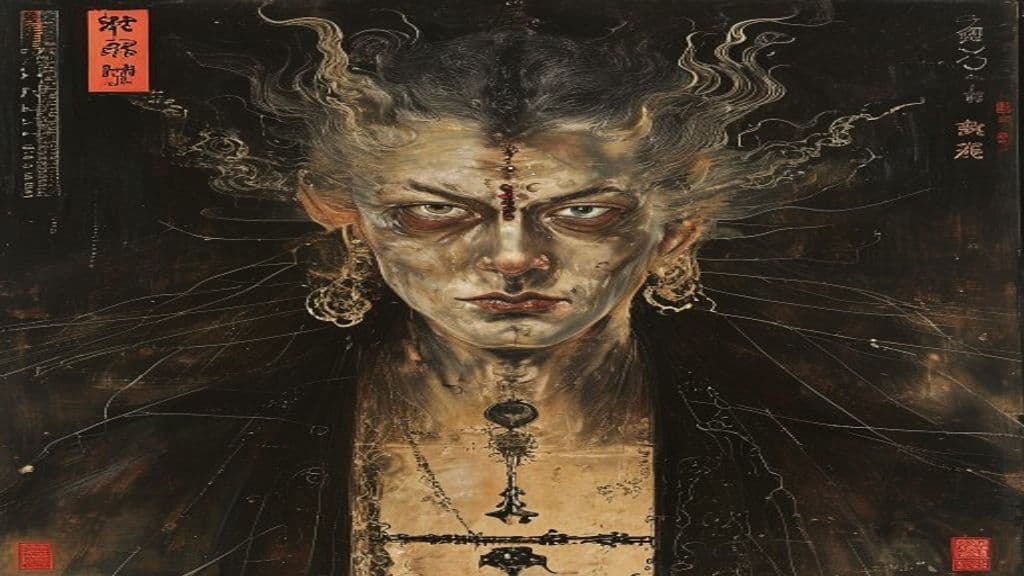
Not attested in provided sources. The supplied material identifies the figure by name (Rāgarāja / Aizen Myō-ō) and locates it within Esoteric and Vajrayāna Buddhist devotional worlds, noting particular reverence in Chinese Esoteric Buddhism and in the Shingon and Tendai schools of Japan. No mythic origin narrative or hagiography is given in the cited sources.
Not attested in provided sources. The available citations do not provide a verified physical description. Wikidata associates a Japanese painting labeled with an English gloss “(The Great Passion)” for Aizen Myō-ō, but the sources do not permit further iconographic details to be asserted.
Not attested in provided sources. The citations state only that Rāgarāja/Aizen Myō-ō is a deity venerated within Esoteric and Vajrayāna Buddhism and used within those ritual and soteriological contexts; they do not enumerate specific powers, functions, or behaviors in the supplied excerpts.
Weaknesses
- othernot attested in provided sources
Wards
- othernot attested in provided sources
Shakyamuni Buddha
Shakyamuni Buddha (Siddhartha Gautama) is the historical founder of Buddhism, an awakened teacher (muni) of the Shakya clan whose life—birth in Lumbini, awakening at Bodh Gaya, teaching across the Indo-Gangetic plain, and parinirvāṇa at Kushinagar—forms the foundation of Buddhist doctrine, monastic order, and much devotional practice. In material religion he is also represented in images and texts that serve as loci of sacred presence and ritual efficacy.
Aitvaras
Aitvaras is a Baltic (primarily Lithuanian) household/nature spirit that, according to available summaries, lodges in homes and provides its household with material goods—often described as stolen gold and grain—while also bringing misfortune or trouble. It is variously described as a rooster- or chicken-like bird indoors and as a dragon-like or serpentine bird outdoors, often with fiery/meteor imagery.
Aiwass
Aiwass is the name given by Aleister Crowley to a discarnate intelligence that he reported as audibly dictating Liber AL vel Legis during three days in Cairo in April 1904. Crowley presents Aiwass as an objectively separate revelatory being, variously called the minister of Hoor‑paar‑kraat and later identified by Crowley with his Holy Guardian Angel.
Aiwohikupua
Aiwohikupua is a personal name attested once in the supplied corpus of collected Hawaiian-language narrative material. The available sources provide only a short fragmentary occurrence of the name and no corroborating description, role, or attributes.
Aiy (Aiy-auk)
Aiy (also rendered Aiy-auk) is a name mentioned in relation to Siberian contexts in the queryer's sources, but the provided documents do not contain usable folkloric descriptions or ethnographic data about the entity. This entry records what the supplied materials do and do not establish and points to the research gap.
Aiyanar
Aiyanar (Aiyaṉār, ஐயனார்) is a Tamil rural tutelary deity venerated chiefly in village contexts of Tamil Nadu and among Tamil communities in Sri Lanka. Portrayed as a martial guardian often mounted on a horse or elephant and accompanied by attendant spirits, he functions primarily to protect village boundaries, people, and livestock and has later been syncretized with the Sanskritic Sastha tradition.
Aiyyanar
Aiyyanar (also spelled Aiyanar) is a Tamil rural village deity venerated in South India and Sri Lanka, primarily among rural Tamil communities. He is associated in material culture with large, colorful roadside and temple statues often shown with companions and mounted on horses or elephants, and functions as a local protective/patronal figure within village devotional practice.
Ajak
Ajak is a fictional character created by Jack Kirby who first appeared in The Eternals #2 (1976). Within Marvel Comics continuity Ajak is a member of the near-immortal race called the Eternals, serves as a mediator/communicator with the cosmic Celestials, and has exhibited cosmic and molecular-level abilities across multiple eras and media adaptations (including the MCU film Eternals).
Ajatar
Ajatar (also Ajattara, Aijotar; runic variants Aattara, Ajaster(i)) is an evil female spirit in Finnish traditional belief associated with wild places, serpents, and the spread of disease and pestilence. She functions in the folk corpus as a dangerous woman-like haltija of forests and mountains who leads people astray and is linked to other hostile powers such as Hiisi and Lempo.
Ajax (Aias)
Ajax (Ancient Greek: Aias) is a human heroic figure of the Trojan-cycle tradition and the tragic protagonist of Sophocles' play Ajax. In the surviving tradition he is a mortal Salaminian warrior celebrated for physical strength and martial reputation whose wounded honor, rage, and resulting suicide are the focus of Sophocles' drama.
Ajax the Great
Ajax the Great (Ancient Greek: Αἴας, Aíās) is a mortal heroic figure of the Trojan War cycle, famed as a towering, steadfast Greek champion and defender of the Achaean ships. Prominent in Homer’s Iliad, he is portrayed as second only to Achilles in martial standing and as a paragon of defensive strength and reliability.
Ajax the Lesser (Aias, the Locrian)
A mortal Greek heroic warrior of the Trojan War (son of Oileus) distinguished from Ajax son of Telamon by the epithet "the Lesser." Celebrated for martial skill, he is chiefly remembered for a sacrilegious act at Athena's sanctuary during the sack of Troy that provoked divine vengeance and led to his violent death at sea; some locales and his native Locrians later maintained a hero-cult.
Community Record
- [1]Rāgarāja. Wikipedia lead: "Rāgarāja is a deity venerated in the Esoteric and Vajrayana Buddhist traditions. He is especially revered in Chinese Esoteric Buddhism in Chinese communities as well as Shingon and Tendai in Japan."wiki
- [2]Aizen Myo-o (The Great Passion) — Wikidata item Q79013296. Wikidata label/context: painting by Japanese; '(The Great Passion)' associated with Aizen Myō-ō.wiki