Aker's role is first fully described in Egyptian funerary literature such as the Pyramid Texts (notably those of king Teti) and later in the Coffin Texts and the Book of the Dead. He emerges in these corpora as the personification of the horizon (linking eastern Bakhu and western Manu), an earth/underworld figure who assists the solar cycle and the dead. Over time his functions shift in the textual tradition: in Coffin Texts he takes on duties formerly ascribed to Kherty, becoming a ferryman or guardian for Ra on the nocturnal barque, and in Book of the Dead passages he is narratively involved in protecting and conveying Khepri's sarcophagus through the underworld.
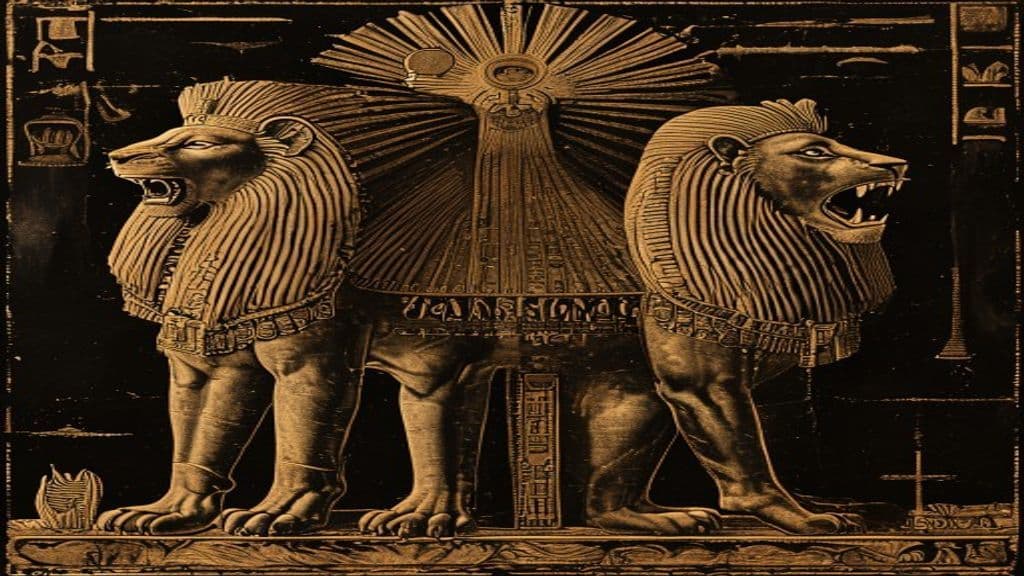
In early iconography Aker appears as the torso of a recumbent lion with a widely opened mouth. From the Middle Kingdom onward he is commonly depicted as twin, back-to-back recumbent lions—one named Duaj ('tomorrow') and the other Sefe ('yesterday')—often with the horizon hieroglyph and a sun-disc placed between them. Later variants show two merged torsos of recumbent sphinxes with human heads. The twin-lion pairing visually encodes his liminal, temporal function of looking forward and behind.
Aker is described in the funerary and solar texts as a guardian of the eastern (Bakhu) and western (Manu) horizons and as a protector of the deceased king from demonic snakes named Hemtet, Iqeru, and Jagw. In Coffin Texts he replaces Kherty in some passages to serve as ferryman or protector of Ra during his nocturnal voyage through underworld caverns; in Book of the Dead narratives Aker is said to 'give birth' to Khepri after carrying Khepri's sarcophagus safely through the caverns, a motif tied to solar regeneration. Texts sometimes cast Aker as representing or enclosing passageways of the underworld rather than as a simple traveling agent; he is also linked with earth-deities such as Geb and has occasional affiliations or identifications with Seth in some inscriptions.
Weaknesses
- otherNo mortal vulnerabilities recorded in provided sources; classical texts do not describe specific weaknesses
Wards
- ritualInvocation in funerary texts (Pyramid Texts, Coffin Texts, Book of the Dead)
- symbolTwin-lion imagery and horizon hieroglyphs placed at thresholds or in tomb iconography
Community Record
- [1]Aker (deity) — Wikipedia. Wikipedia contributors. "Aker (deity)." Wikipedia, The Free Encyclopedia.wiki
- [2]Aker (Akeru, Akerui) — Deity of the Week (blog summary). Deity of the Week. "Aker." Deity of the Week blog summary.other
- [3]Aker | Megami Tensei Wiki (fandom). Megami Tensei Wiki. "Aker." Fandom summary referencing twin-lion placements.other