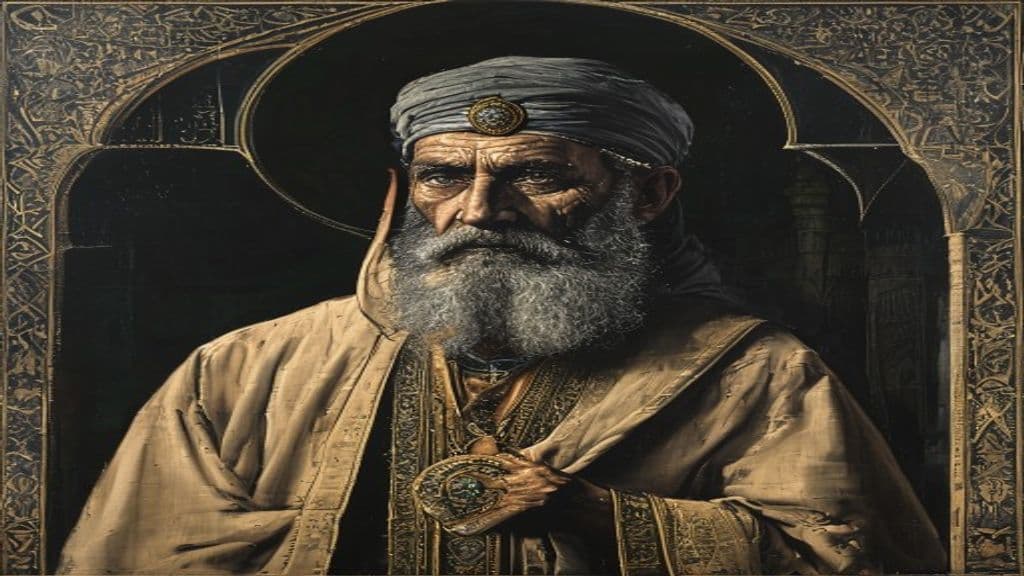
In the Qur'anic narrative located in Sūra Ghāfir (40:28–30), a man described only by the participial epithet al‑Mu'min ('the believer') is presented as a member of the Pharaoh's people who had embraced faith in God. The text recounts that he kept his belief hidden while speaking up in the Pharaoh's court to question the planned execution of Moses, citing Moses' clear signs and warning of divine consequence. Classical exegetical tradition, as reported in modern summaries, debates his precise familial or social relation to the Pharaoh (with figures such as al‑Suddī and al‑Tabarī offering interpretive remarks), but the Qur'anic text itself gives no personal name or full biography; later scholars use the brief scriptural mention to portray him as an early insider believer who protected Moses through negotiation and speech.
The Qur'anic verses and the provided summaries do not record any physical description of al‑Mu'min. He is only identified by his status as 'a believing man from the people of the Pharaoh' (rajulun muʾminun min āl fir'awn). Exegetical discussions cited in secondary summaries focus on his anonymity and social position rather than bodily features, and no details of age, dress, or rank are documented in the supplied sources.
No supernatural powers are attributed to al‑Mu'min in the sources. His agency is moral and social: he concealed his faith while using rhetorical argument and his standing within the Pharaoh's household to intercede on behalf of Moses. The provided material emphasizes his argumentative defense of Moses, his warning about divine retribution, and exegetical suggestions that his ability to be heard derived from familial or social connection to the Pharaoh rather than any extraordinary faculty.
Alyosha Popovich
Alyosha Popovich (Алёша Попович / Олешко Попович) is a named human hero (bogatyr) of the East Slavic byliny tradition, remembered as the youngest member of the canonical trio of Kievan Rus' warriors. He is chiefly characterized by slyness, mockery, and trickery, and defeats foes by craft often aided by pious petition rather than mere brute strength.
Alyoshenka
Alyoshenka (Russian: Алёшенька) is the local name given to a small mummified body found in mid-1996 near Kyshtym, Chelyabinsk Oblast, Russia. Sources treat the find ambiguously — medical investigators concluded preserved tissue samples indicated a severely malformed premature human infant, while other observers and popular commentators proposed animal, non‑human, or extraterrestrial explanations. The original corpse disappeared after passing through local custody, and subsequent DNA testing (2004) was performed on preserved tissue samples rather than the lost original.
Alû (Alu)
A named lemma attested in modern reference lists as 'ALU / Alu', but for which the supplied research corpus contains no substantive primary- or secondary-source information about nature, appearance, powers, or rituals in Mesopotamian tradition.
Al‑Ahmar
Al‑Ahmar is an attested name in Arabic-language lists of notable jinn. Literally 'the Red', the name appears in compilations and occult rosters alongside other named jinn, but surviving sources provide no detailed independent folklore, powers, or rituals specific to this figure.
Al‑Kawthar
Al‑Kawthar (الكوثر) is a Qur'anic term and described heavenly bounty granted to the Prophet Muhammad, rendered in tradition both as 'abundant good' and as a river/pond/fount in Paradise. It functions as an eschatological topographical feature and theological gift rather than an autonomous supernatural agent.
Al‑Masih ad‑Dajjal
An Islamic eschatological antagonist described in hadith and later apocalyptic literature as a false Messiah who will deceive many before the Day of Judgment. He is depicted variously as an individual man or as a devil in human form, performs counterfeit miracles, and is ultimately defeated by the return of ʿĪsā (Jesus).
Al‑Qaum
Al‑Qaum (Arabic: القوم) is a major Nabataean deity associated with war, the night, and the protection of caravans and clans. Attested in numerous inscriptions and later compared by commentators to Greek/Roman war gods, he functioned as a protector of travelers and as a guardian of souls during nocturnal journeys.
Al‑Yasa (Elisha)
Al‑Yasa (Elisha) is a prophetic figure attested in Abrahamic scriptural traditions. In the Hebrew Bible he is described as an Israelite prophet and 'wonder‑worker'; later traditions in Christianity and Islam also recognize him among the line of prophets.
Am Fear Liath Mòr
A place-bound uncanny presence associated with the summit and passes of Ben Macdui in the Cairngorms, traditionally reported as a mist-cloaked figure or overwhelming oppressive presence that causes intense fear and the sensation of large footsteps following climbers.
Am-heh
Am-heh is an Egyptian underworld deity described in modern summaries as a terrifying devourer who dwells in a lake of fire and threatens beings in the netherworld. He is portrayed in sources as a minor underworld god sometimes correlated with the devourer-figure Ammit and is said in one account to be repelled only by the god Atum.
Ama (Mother of Waters)
No documentation for a Siberian supernatural figure called 'Ama' or 'Mother of Waters' was found in the supplied sources. The reviewed materials either list unrelated senses of the string 'Ama' or are unrelated recordings titled 'AMA.'
Ama no Fuchigoma
Ama no Fuchigoma (天乃斑駒, "heavenly spotted foal") is a named mythical horse attested in the Nihon Shoki (Chronicles of Japan). In the surviving summaries it is recorded as the spotted mount ridden by the storm/sea god Susanoo; no further powers or rituals are supplied in the cited modern summaries.
Community Record
- [1]Al‑Mu'min (Islamic figure) — Wikipedia. Wikipedia, entry 'Al‑Mu'min (Islamic figure)' (summarizing Qur'an 40:28–30 and classical exegesis)wiki