No preserved pre-Islamic birth-myth for al-ʻUzzā survives in the supplied sources. Later exegetical commentary recorded in Islamic tradition (e.g., at-Tabarī citing ʿAbdullāh ibn ʿAbbās) links her name to the epithet al-ʿAzīz ('the Mighty') from Qurʾanic theonyms, but this is a medieval interpretive derivation rather than an attested pre-Islamic origin account.
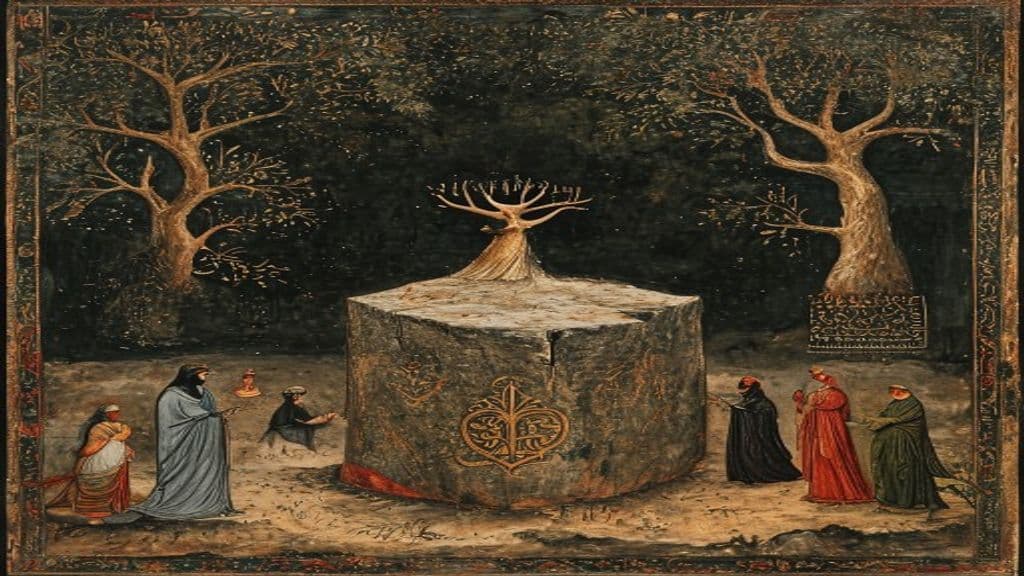
The supplied sources preserve no consistent, reliable pre-Islamic iconography. Tradition records a stone cube at Nakhlah and three sacred trees as cult foci. A late medieval narrative in Ibn al-Kalbī's Kitāb al-Aṣnām describes a dramatic apparition of 'a woman with wild hair' at Nakhlah during the reported destruction of the shrine, but that specific visual episode is attested only in Ibn al-Kalbī and is treated as uncertain by later commentators and modern scholarship.
Surviving accounts present al-ʻUzzā primarily in cultic terms: an object of invocation for intercession and protection, the recipient of offerings and sacrifices, and the focus of oracular consultation at a shrine-house (per Ibn al-Kalbī's summary). The dramatic episode in Ibn al-Kalbī in which a woman appears to defend the sacred trees frames a human-like manifestation in that narrative, but beyond protective intercession and oracular function no wider supernatural powers are preserved in the supplied material.
Weaknesses
- ritualDestruction of cult objects and shrine
- ritualCutting down sacred trees (Nakhlah)
- conditionAbolition of cult by replacement with Islamic monotheistic practices
Wards
- ritualOfferings and sacrifices to solicit favor
- otherOath-swearing and anthroponymic devotion (e.g., names like ʿAbdu l-ʻUzzá)
- ritualDestruction/eradication campaign (as recorded in Islamic narratives)

Community Record
- [1]Al-Uzza - Wikipedia. Wikipedia: 'Al-ʻUzzá or al-ʻUzzā ... was one of the three chief goddesses of Arabian religion in pre-Islamic times...' (accessed source summary provided).wiki
- [2]Kitāb al-Aṣnām (summary in secondary sources, Ibn al-Kalbī). Summary of Ibn al-Kalbī's Book of Idols as presented in the supplied material: descriptions of shrine at Nakhlah, oracular house 'Buss', offerings, and the Nakhlah destruction episode.literary
- [3]Wikidata: Al-ʿUzzá. Wikidata entry cited in the dossier.other
- [4]Archived video listings (contextual modern treatments). Archive: modern critical/polemical video listed in the dossier; noted as not contributing primary cultic ritual detail.other
- [5]Archived video listings (contextual modern treatments). Archive: modern critical/polemical video listed in the dossier; noted as not contributing primary cultic ritual detail.other