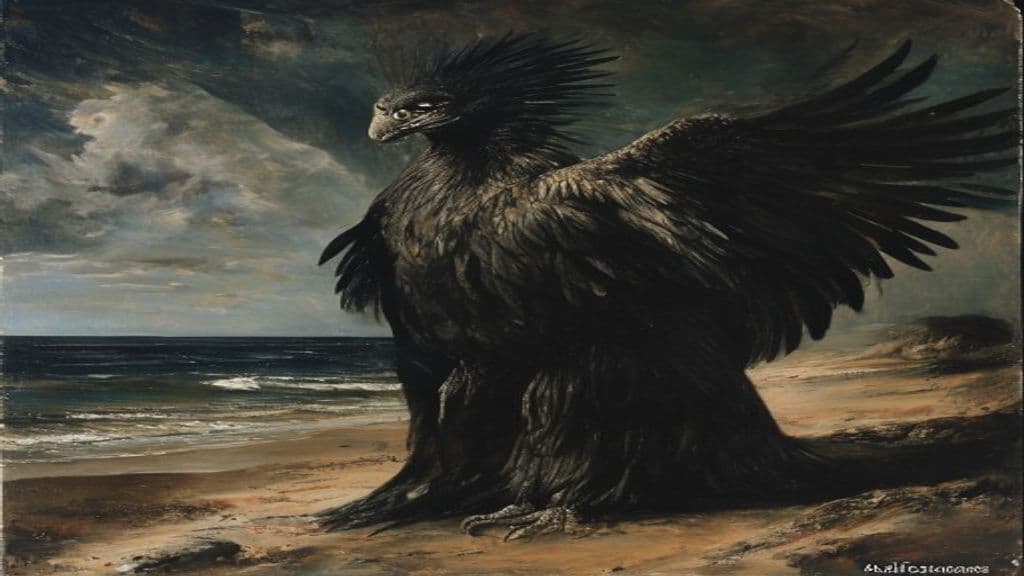
Sources present Alkonost as an individual legendary bird-woman within East Slavic lore rather than a generic species. Folkloric accounts place her in the underworld with the Sirin; this pairing and the narratives about her actions link her to seasonal and cosmological functions in Slavic folk worldview. The name Alkonost is reported by the available sources to derive from the Greek name Alcyone, a classical figure transformed into a kingfisher, suggesting cross-cultural influence on the bird's name and certain conceptual parallels (Wikipedia).
In the supplied materials Alkonost is consistently described as a woman-headed bird: an avian body bearing a female human head. The sources provide no standardized details of size, exact plumage color, or the precise species of bird she resembles; descriptions in summaries and encyclopedia entries maintain the core motif of the human-headed bird-form as the defining visual feature (Wikipedia).
Folklore sources attribute several distinct powers and behaviors to the Alkonost. Her song is famed as extraordinarily beautiful and enchantingly dangerous: those who hear it 'forget everything they know and want nothing more ever again,' a motif repeated across sources (Wikipedia; supplemental blog summary). Narratives tie her reproductive behavior to weather phenomena: she lays eggs on a beach and rolls them into the sea, and when those eggs hatch a thunderstorm arises and the sea becomes impassably rough (Wikipedia). In a calendrical/ritual context, tales say that on the Apple Feast of the Saviour day Sirin cries in the morning while the Alkonost appears in the afternoon to rejoice; by brushing dew from her wings she grants healing powers to the fruits on the tree where she alights, connecting her action to blessing and fertility of harvest (Wikipedia). She is also named as a sister-figure to other Slavic mythic birds such as Rarog and Stratim (Wikipedia).
Alatyr
A sacred world-stone in East Slavic and wider Slavic folklore, described as the "father to all stones" and the "navel of the earth." Located at the world's center (often on Buyan island), it is associated with a miraculous spring, sacred letters, healing properties, and liminality between the human world and other realms.
Baba Yaga
Baba Yaga is an ambivalent female figure of East Slavic folktale tradition, depicted variously as a fearsome, child-eating crone or as a helpful, maternal donor. She is associated with the deep forest, a hut described as standing on chicken legs, and the motific accoutrements of a mortar and pestle.
Chernava
Chernava is a water spirit in East Slavic (Russian) folklore portrayed as a mermaid and the personification of the river Chernava; in the Sadko bylina she is presented as one of the Sea Tsar's daughters (in some versions, his niece) who aids the hero by transforming into the river Chernava and returning him to the human world.
Gamayun
Gamayun (Russian: Гамаю́н) is a prophetic, wisdom-bearing bird of Russian folklore, normally depicted as a large bird with a woman's head that "spreads divine messages and prophecies" and "knows everything of all creation, gods, heroes, and man." She is placed in the mythic geography on an island in the east near paradise and is presented as a symbol of wisdom rather than a hostile creature.
Alipherus
Alipherus is a mythological Arcadian prince in ancient Greek tradition, named among the many sons of King Lycaon. He is chiefly remembered as an eponymous founder of the town Aliphera and as a participant in the impious episode in which Lycaon's sons served a meal to Zeus containing human entrails and were destroyed by divine lightning.
Alisanos
Alisanos is a theonym attested in two Gallo‑Roman votive inscriptions from the Côte-d'Or (near Dijon) and interpreted by Celticists as a localized landscape divinity (possibly 'of the rock' or of certain trees). Separately, the name has been repurposed in modern fantasy literature as a sentient, predatory deepwood; the two usages are distinct in origin and evidence.
Alka
Alka (plural alkas) is a class of sacred natural places in pre-Christian Baltic religion—Latvian and Lithuanian—functioning as set-apart cult sites where offerings and sacrifices were made. Treated as holy ground rather than a single anthropomorphic spirit, alkas served as loci connecting communities with ancestors and otherworldly realms and frequently appear in toponyms across the Baltic landscape.
Alke
Alke (Ancient Greek: Ἀλκή) is the anthropomorphic personification of prowess, courage, and battle-strength in archaic and classical Greek poetic tradition. She is attested as a named figure depicted on Athena's aegis in Homeric epic and the name also appears in later mythographic lists as a number of distinct proper-name figures.
Alkyonides
In classical Greek mythology the Alkyonides (Alcyonides) are the seven daughters of the giant Alcyoneus. Classical summaries record that, in grief at their father's death, the daughters threw themselves into the sea; the mythic name survives in modern Greek toponymy as the Alkyonides Gulf.
All-Flash
All-Flash (originally All-Flash Quarterly) is a Golden Age American comic-book magazine series published 1941–1947 that served as the first solo magazine vehicle for Jay Garrick, the original Flash. The title is a commercial/branding name later used as an English lexical phrase in unrelated technical and web contexts.
All-Winners Squad
A fictional Golden Age superhero team published by Timely Comics (later Marvel) that operated in-universe in the immediate post–World War II period; assembled prominent costumed heroes of the publisher into a collective that appeared in two 1946–1947 comics stories and was later reused in reprints and retroactive continuity.
Alla
Alla (Alla‑gula) is a Mesopotamian underworld‑associated deity attested in Ur III and Old Babylonian texts. He functions in sources as the sukkal (attendant) of Ningishzida and is grouped with lamentation literature’s ‘dying gods’; many details of his character remain fragmentary and debated.
Community Record
- [1]Alkonost. Wikipedia contributors, "Alkonost," Wikipedia, The Free Encyclopedia.wiki
- [2]Alkonost – Siren Of the Sky (blog summary). Blog: 'Alkonost – Siren Of the Sky', tfwalsh.wordpress.com, 2011.folk
- [3]Alkonost (Wikidata entry). Wikidata: Q867336 (Alkonost).wiki
- [4]Alkonost (archive materials). Archive.org holdings referencing 'Alkonost'.other