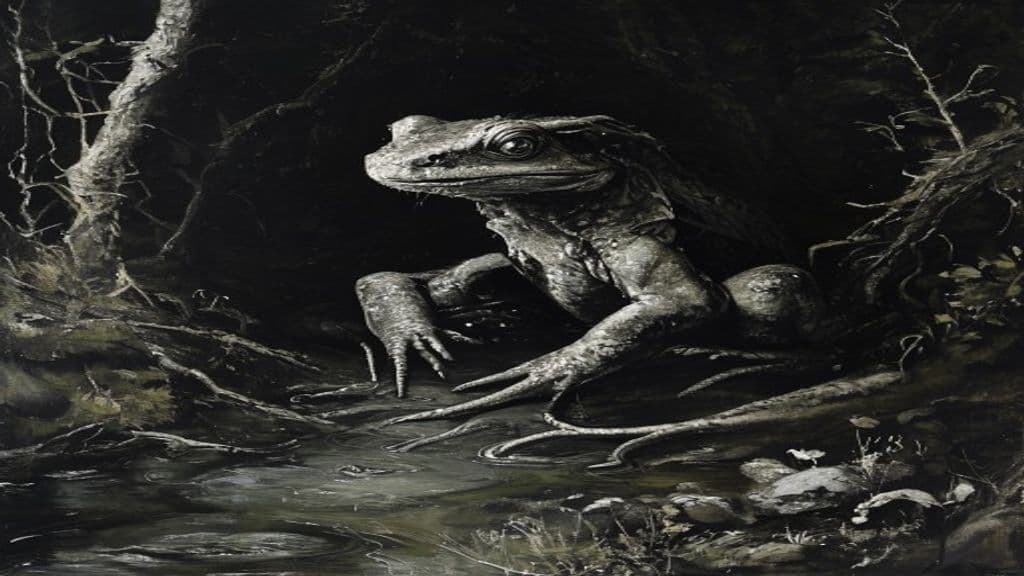
Available sources (notably summaries of Robert Kirk's material) describe the Alp-luachra's behavior and typical circumstances of attack but do not provide a cosmogonic or mythic origin narrative for the being. The material situates it within Irish/Celtic accounts of fairylike beings that interact with human nourishment, emphasizing functional description (feeding on the nutritive essence of food) rather than an account of its creation, lineage, or place within a larger fairy polity.
Sources emphasise the Alp-luachra's usual invisibility and report a specific visible manifestation when it acts: it is said to take the form of a newt. In the descriptive accounts the creature 'sits invisibly' and when it feeds it 'appears in the form of a newt' and is said to crawl down a sleeping person's mouth. Thus the tradition conveys a being that is normally unseen but associated with a small amphibian shape during the act described in the sources.
Accounts (as summarised from Robert Kirk and later summaries) describe the Alp-luachra as consuming half of a victim's food not by eating the physical substance but by taking the 'pith or quintessence'—an unseen nutritive essence—thereby depriving the person of part of the effective nourishment. Its recorded mode of action is intimate and nocturnal/while-asleep: when a person falls asleep by a spring or stream the Alp-luachra appears in newt form and crawls down the sleeper's mouth to feed off the food they had eaten. The consequence presented in the sources is loss of part of the nourishment, reflected in the English descriptive labels 'Joint-eater' and 'Just-halver.'
Weaknesses
- conditionAvoid sleeping by springs or streams
Wards
- conditionDo not fall asleep beside running water
Biróg
Biróg (also Biroge, Birog of the Mountain) is a female supernatural helper in Irish narrative tradition who aids Mac Cinnfhaelaidh/Cian in gaining access to the imprisoned Ethniu and rescues the surviving infant of that union; later retellings variably portray her as a leanan sídhe (female familiar spirit), a filidh (poet/seer), or a druidess.
Cat sìth
A feline supernatural being in Celtic folklore, especially Scottish tradition, described in some accounts as a large black cat with a white spot on its chest associated with the fairy/otherworld; alternative traditions identify it as a witch able to transform into a cat up to nine times.
Clurichaun
A solitary Irish fairy-like household and cellar spirit associated with drinking places (breweries, pubs, wine cellars). He is a heavy drinker and smoker, a mischievous trickster who can also act as a protective domestic spirit for a household that tolerates him; accounts are primarily from 19th-century collectors and later summaries.
Crom Dubh
Crom Dubh is a fluid mythological and folkloric figure from Irish tradition, variously represented as a remnant cultic god, a pagan chieftain or robber, a servant-figure, and the focal figure of seasonal first-fruits rites (Crom Dubh Sunday). In later narratives he is frequently framed as an antagonist subdued or reinterpreted by St. Patrick.
Far darrig (fear dearg)
A solitary Irish faerie-class trickster traditionally called fear dearg ('Red Man'), the far darrig is noted for practical—and sometimes gruesome—jokes, a reputed connection to changelings and nightmares, and a characteristic red coat and cap. Accounts portray it as an ambivalent domestic/liminal being that can bring good luck if placated but imaginative punishments if offended.
Gancanagh
A male member of the Irish little people traditionally portrayed as a seductive, fairylike 'love-talker' who courts and harms human women; depicted variously as a leprechaun-like little man and in poetic sources as an incubus-like handsome seducer.
Gwragedd Annwn
In Welsh tradition the Gwragedd Annwn are female Otherworld fairies tied to freshwater—lakes and rivers—counted among the Tylwyth Teg. Depicted as beautiful women (often dressed in green) who live beneath lakes, they herd enchanted white cattle and occasionally cross into the human world.
Leprechaun
A diminutive, solitary supernatural being from Irish folklore, commonly depicted as a shoemaker who delights in mischief and is associated with hidden or buried treasure. Prominent in later folkloric collections and the 19th‑century literary revival rather than central early mythic cycles.
Maine mac Darthacht
Primordial entity associated with darkness and light, connected to Celtic mythology's Tuatha Dé Danann pantheon. (Note: 1. "Primordial entity associated with darkness and light" - source material only mentions association with night/darkness, but not explicitly light. 2. Power tier should be reviewed as Maine mac Darth)
Merrow
A sea-being of Irish/Celtic folklore, the Merrow (Hiberno-English) denotes a class of half-human marine supernatural persons — often female 'sea-maidens' and uglier male counterparts — capable of interaction and occasional intermarriage with humans. Medieval Irish terms connect the figure to older siren- and sea-nymph motifs, while 19th-century collectors shaped much of the modern folk image.
Pillywiggin
Pillywiggins are very small faery or 'little people' in English and Irish folkloric compilations who function as guardians and personifications of spring flowers and small flora. Described in modern sources as trooping, winged flower-fairies, they are generally benign and largely indifferent to humans, associated with gardens, meadows and the seasonal rhythms of plants.
Púca (Pooka / Puca)
A long-standing folkloric spirit from Irish and related Celtic traditions, the púca is a shape‑shifting, ambivalent supernatural being commonly associated with rural and maritime communities and said to bring both good and ill fortune.
Community Record
- [1]Joint-eater (Alp-luachra) - Wikipedia summary. Wikipedia entry 'Joint-eater' summarising Irish tradition and Robert Kirk's accountwiki
- [2]Alp in a modern city (archive upload; disambiguation notice). Archive.org upload titled 'Alp in a modern city' which warns 'Not to be confused with Alp-luachra' and does not supply additional folkloric detail on Alp-luachraother