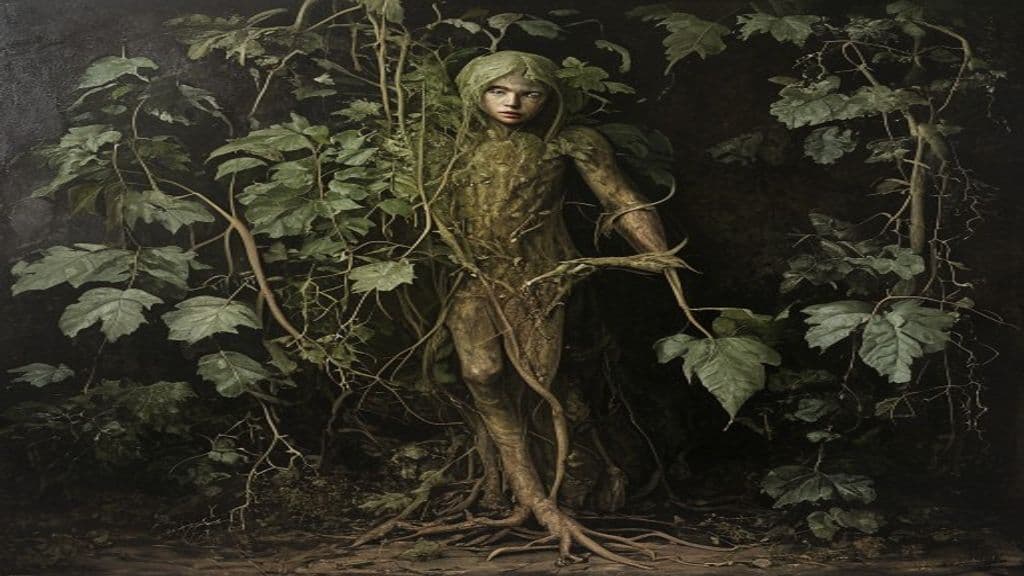
In medieval German legend the humanoid-shaped mandrake was said to be produced beneath the gallows by the bodily emissions (in some versions semen, in some tellings blood) of hanged men; alchemical and popular commentators sometimes claimed hanged men ejaculated or released vital matter at execution, which the earth absorbed and could take the form of a mandrake root. This gallows-origin myth links execution, a liminal death-space, with the creation of a plant that embodies transgressive generative power. Hanns Heinz Ewers's 1911 novel Alraune reinterprets this folklore: a scientist deliberately inseminates a woman with the semen of a hanged murderer, producing a girl named Alraune whose unnatural origins drive the novel's moral and psychological plot.
Folkloric descriptions emphasize a humanoid-shaped mandrake root—a root that resembles a human figure. Literary treatments differentiate the plant-figure from the human character: in Ewers's novel Alraune is depicted as a female child and later woman (the sources summarize her role and behavior but do not supply a detailed physical description). Film adaptations later presented the character visually, but those portrayals are adaptations of the literary figure rather than elements of the medieval plant legend.
Folklore attributes to the mandrake a role in love and fertility magic: the root was believed to be used in love philtres and potions and its fruit alleged to facilitate pregnancy. Folk belief held that intercourse with or use of the mandrake could result in offspring lacking 'real' love or a soul; sources present these claims as cultural beliefs rather than empirical fact. In Ewers's novel the human Alraune is narratively characterized by obsessive sexuality, an apparent incapacity for normal love, and ultimately vengeance when she discovers her origins—literary themes that echo and dramatize the folkloric moral about artificially generated offspring.
Weaknesses
- otherno reliably recorded weaknesses in provided sources (sources do not supply protective formulas or empirical vulnerabilities)
Wards
- otherno specific wards recorded in the provided materials (the excerpts contain no named protective rituals or charms against mandrake/Alraune)
Alpha Primitive
A term used within Marvel Comics' Inhumans setting to denote a category of created or subordinate beings associated with Inhuman society. The available provided source (Wikipedia's Inhumans overview) references the Inhumans generally but does not supply detailed canonical information about Alpha Primitives themselves.
Alpha and Omega
A titulary formula and visual symbol formed from the first and last letters of the Greek alphabet (Α/α and Ω/ω), used in Christian scripture and art to denote God's or Christ's totality — 'the beginning and the end.' It functions as a theological appellation rather than an independent supernatural being.
Alphesiboea
Alphesiboea (Ancient Greek Ἀλφεσίβοια, Alphesíboia) is a proper name used for several distinct women in Greek mythic genealogies and narratives. Bearers of the name include mortal princesses and wives tied to dynastic stories (notably a Psophian princess married to Alcmaeon), an attested variant as wife of Pelias, a supposed mother of Adonis in one tradition, and an 'Indian' nymph who appears in a Dionysian episode.
Alpheus
Alpheus (Ancient Greek: Ἀλφειός) is the personified river and river-god of the Alpheios in the Peloponnese. He is classed among the river-deities descended from Oceanus and Tethys and appears in myths linking the Arcadian/Elian river to the Sicilian well Arethusa, to Artemis, and to the labors of Heracles.
Alphyn
The alphyn is a heraldic composite creature from medieval European heraldry and bestiary traditions, depicted as a chimera-like emblematic beast used on coats of arms, badges, and tapestries. Sources treat it as a stock heraldic motif with variable parts rather than as a folkloric spirit or deity.
Alpos
Alpos is a monstrous, multi-armed giant of Greek epic poetry, presented by Nonnus in the Dionysiaca as a chthonic son of Earth who terrorizes the Pelorus region of Sicily until slain by the god Dionysus.
Alrek and Eirík
Alrek and Eirík (also rendered Alaric and Eric) are legendary Swedish kings from the Old Norse saga tradition who are presented as joint rulers and as members of the Ynglinga royal genealogies. They appear in saga narratives as sons and heirs of King Agni, famed for martial and athletic prowess, and as hosts who receive the hero Starkaðr after the sacrificial death of Vikar.
Alseid
An Alseid (Ancient Greek: Ἀλσηΐδες, Alsēïdes) is a class of nymph in classical Greek mythology specifically associated with groves and glens. The term functions as a locality-category within the broader Greek taxonomy of nymphs; later modern sources reuse the label for varied fantasy and game creations.
Altes
Altes is a named Lelegian king of Pedasus attested in the Homeric tradition and later mythographic summaries. He functions in the epic genealogical network as the father of Laothoe (one of Priam's wives) and is in some accounts named as father of the Argonaut Ancaeus of Samos; no supernatural attributes are recorded in the supplied sources.
Altgermanische Religionsgeschichte
A historical survey of Germanic religious history, providing an overview of the pantheon of gods and goddesses. (Note: - Power tier is not applicable to historical surveys - The article should reflect that it's a historical survey, not an entity with abilities or appearance - Consider adding information on the signifi)
Althaea
Althaea is attested in the provided sources as (1) the Latinized form of the Greek name Ἀλθαία (Althaia), a mythological human figure recorded as daughter of Thestius and mother of Meleager, and (2) a botanical genus (Malvaceae) of perennial herbs including the marshmallow plant; the name may be etymologically linked to Greek ἀλθος (althos) 'healing'. The supplied material contains no evidence that Althaea is a supernatural being.
Althaemenes
Althaemenes is a mythic Cretan prince in Greek tradition, son of King Catreus, whose story centers on an oracle foretelling that he would kill his father. He fled Crete for Rhodes to avoid the fate, established an altar at Mount Atabyrus, accidentally killed his father in a case of mistaken identity, died tragically, and was later honored locally as a hero.
Community Record
- [1]Alraune (Wikipedia). Wikipedia contributors. 'Alraune.' Wikipedia, The Free Encyclopedia. https://en.wikipedia.org/wiki/Alraunewiki
- [2]Der Hexengarten (archive listing). Der Hexengarten (archive.org listing). Book description and chapter listing referencing Alraune among witch plants.other
- [3]Alraune (1928) film (archive). Alraune (1928) film listing on Archive.org; documents a cinematic adaptation of Ewers's novel.other