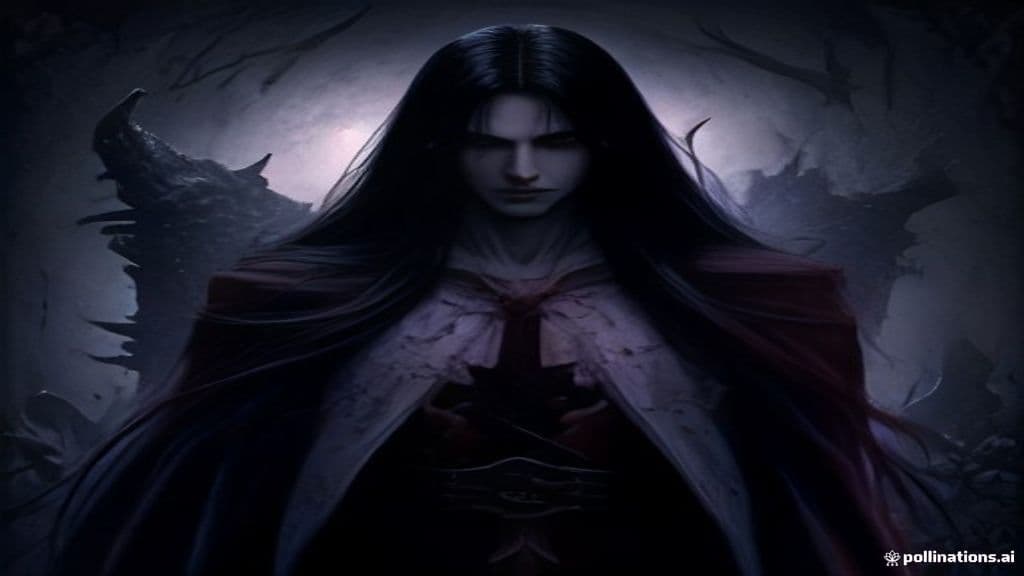
Within the Castlevania narrative universe, Alucard is presented and framable as intimately linked to Dracula—the character's name is the reverse spelling of 'Dracula'—a deliberate etymological signal of mirrored or inverted identity. Sources indicate his precise role and genealogy vary by title and adaptation: he is frequently depicted as Dracula's offspring or dark reflection, but portrayals shift from ally to antagonist across different games and the Netflix animated adaptation. The supplied materials treat Alucard as a narrative device that expresses the franchise's motifs of familial complexity, inversion (including the game's architecture such as an inverted castle), and ambivalent moral alignment rather than as a fixed mythic origin rooted in an external folklore.
The provided sources supply only limited, consistently attested visual detail: Alucard is presented onscreen and in-game as a humanoid, playable character (for example, the player assumes his role in Castlevania: Symphony of the Night) and as an animated humanlike figure in adaptations such as the Netflix series. The supplied excerpts do not provide a full canonical physical description (specific clothing, hair, and coloration details are not given in the cited materials).
The supplied materials document Alucard's variable behaviors across media rather than enumerating a canonical powerset. In gameplay contexts he functions as a playable protagonist controlled by the player (explicitly noted for Symphony of the Night), and in other titles he serves as a boss or challenger (noted in Castlevania Legends where he challenges Sonia Belmont). Narrative adaptations show him operating as an ally to human protagonists (e.g., in the Netflix Castlevania series). While his association with Dracula implies vampiric heritage, the provided excerpts do not list specific supernatural powers, magic, or vampiric abilities or mechanics; sources describe his role and interactions rather than enumerating explicit abilities.
Community Record
- [1]Alucard (Castlevania) — Wikipedia. Wikipedia entry summarizing appearances and character variations across Castlevania media.wiki
- [2]Alucard — Wikipedia (disambiguation / etymology note). Disambiguation and etymology noting 'Alucard' as the reversal of 'Dracula'.wiki
- [3]CASTLEVANIA SYMPHONY OF THE NIGHT - (PAL) — PSX DataCenter. Describes gameplay in which 'you assume the role of Alucard', supporting his playable-protagonist status in Symphony of the Night.other
- [4]Castlevania Legends — Wikipedia (Alucard as boss). Notes that in Castlevania Legends Alucard functions as a boss who challenges Sonia Belmont, indicating adversarial portrayals in some titles.wiki
- [5]Ambivalence and Recursion in Castlevania: Symphony of the Night — eludamos. Scholarly commentary on Symphony of the Night discussing the inverted castle and themes of doubling/inversion that contextualize Alucard's name and role.academic
- [6]Dracula (Castlevania) — Wikipedia / Film Review references. Contextual material on the Netflix Castlevania series noting Alucard's presence in the cast and his allied interactions with Trevor and Sypha; reviews cite mixed responses to the animated characterization.wiki
- [7]Film Review: 'Castlevania' — MARIST CIRCLE. Review noting character interactions among Trevor, Sypha, and Alucard in the animated adaptation and reception of his characterization.other
- [8]CASTLEVANIA NOCTURNE / PSONE entries and related pages — PSX DataCenter (various). Additional game-entry references showing Alucard's recurring presence across Castlevania titles, supporting variable roles across releases.other