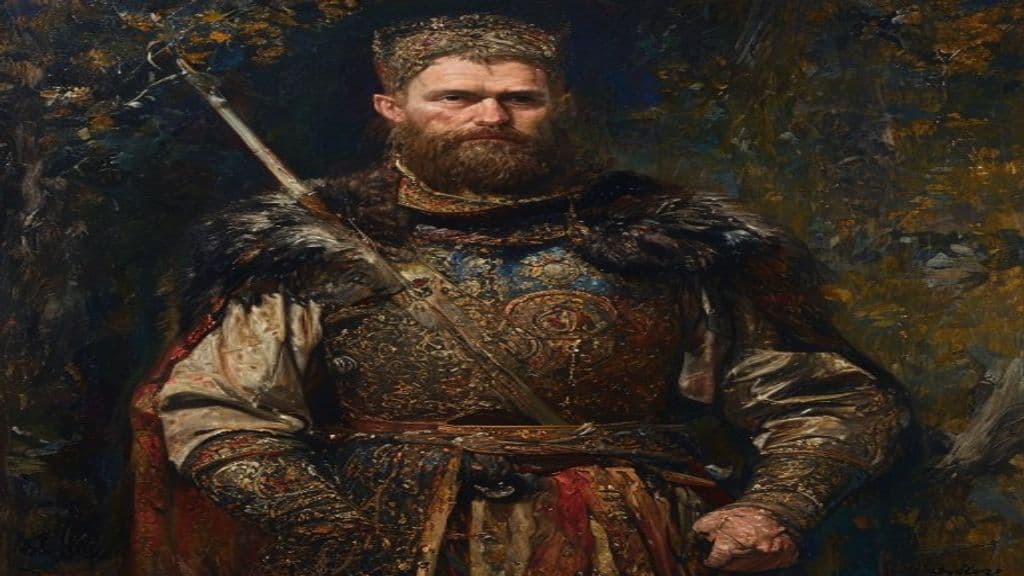
Alyosha Popovich is presented in the byliny as the priest's son (Popovich/Popovych literally 'son of the priest') who joins Prince Vladimir's druzhina at the Kyiv court. Some chronicle passages and later commentators attempt to link him to a historical Alexander Popovich of Rostov (Nikon Chronicle and related manuscript mentions), but sources note this historicity is uncertain and may be a later interpolation under the influence of epic poetry. In tradition he stands as the youngest of the three canonical bogatyrs—complementing Ilya Muromets and Dobrynya Nikitich—and embodies a stock character: the clever, clerically connected warrior who attains heroic status by wit and cunning.
As a bogatyr Alyosha is depicted as a medieval warrior/knight-errant in byliny contexts and in visual art alongside the other two bogatyrs (notably in Viktor Vasnetsov's painting "Bogatyrs"). Specific physical descriptions in the sources are limited, but narrative motifs repeatedly record him adopting pilgrim's robes or exchanging clothes with a pilgrim (kalêka) as a disguise—sometimes posing as a hard-of-hearing psalm-singer—to deceive opponents. He is often characterized in stories as younger or more slight than his fellow bogatyrs, with costume and behavior emphasizing trickster and mocker roles rather than only martial display.
Alyosha's defining capabilities are craftiness, slyness, agility, quick wit, and a propensity for mockery. In tales he defeats the dragon-like antagonist Tugarin by stratagem rather than pure force: variants describe him using disguise, prayer, and improvised weapons. In the central Tugarin episode Alyosha prays to the Mother of God and the Savior to bring rain that soaks Tugarin's wings and grounds him; versions then have Alyosha dispatch Tugarin with either a heavy walking staff (палица) of legendary weight or a knife obtained earlier. He commonly employs disguise (pilgrim/kalêka) to lower an opponent's guard and uses sharp repartee and public humiliation as tactical tools.
Weaknesses
- otherNo supernatural vulnerabilities recorded in sources
Wards
- otherNone recorded (Alyosha is a heroic human figure; sources do not provide wards used against him)
Alukah
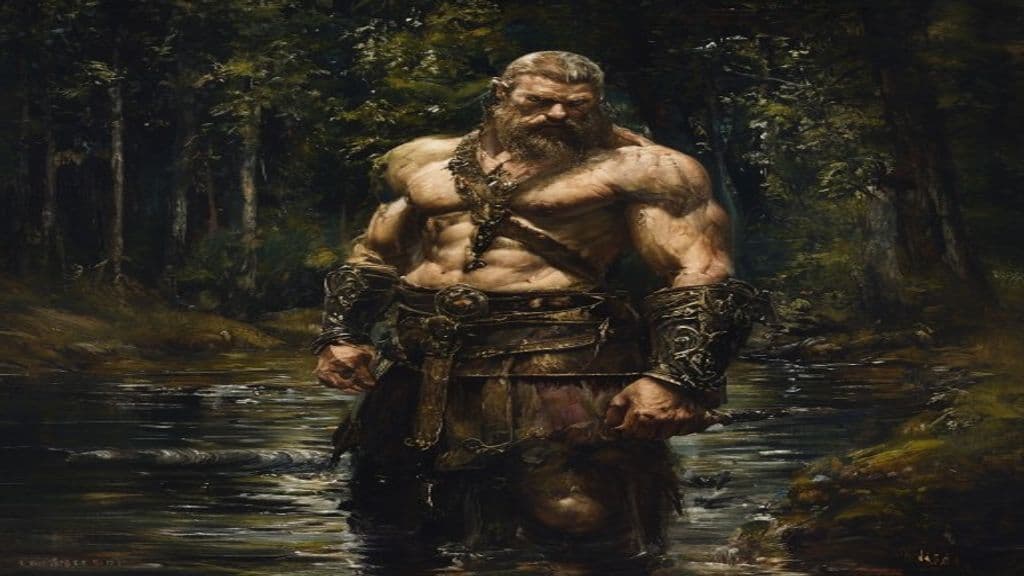
In Jewish tradition, Alukah is a blood-lusting monster or vampire described in the Hebrew Bible's Proverbs 30:15. (Note: 1. Power tier should be Minor Spirit (or possibly Lesser) since it feeds on animals and doesn't match the Primordial description. 2. Abilities don't accurately reflect "blood-lusting monster" or vampi)
Alulim
Alulim is the legendary antediluvian 'first king' of Eridu in Mesopotamian tradition, presented in king lists and mythic compositions as the initial ruler appointed by the gods. He functions etiologically to explain the origin of kingship and, in late ritual texts, is invoked in agricultural incantations associated with driving off field pests.
Alusi
Alusi (also spelled arusi) are spirit-agents or divinities in the traditional religion of the Igbo people, each responsible for specific domains such as health, agriculture, rivers, justice, and the sky. They are worshipped and served through localized cults with priests and devotees and are distinct from clan ancestors (Ndichie).
Alux (aluxoʼob)
The alux (plural aluxoʼob or aluxob) is a small, place-bound sprite or spirit in Maya tradition of the Yucatán Peninsula, Belize, and Guatemala, conceived as knee-high, miniature, traditionally dressed Maya-like beings created by ancient gods and normally unseen but able to assume physical form to communicate or frighten humans.
Alvaldi
Alvaldi (Old Norse: Alvaldi / Ölvaldi) is a jötunn in Norse mythic genealogies, attested chiefly as the father of the notable jötunn Þjazi and described in one source as exceedingly rich in gold. He survives in the record mainly as a familial antecedent and an etiological figure rather than as an active participant in preserved narratives.
Alvíss
Alvíss (Old Norse: 'All‑Wise') is a dwarf in Norse mythology who appears in the Poetic Edda poem Alvíssmál as a prospective husband for Thor's daughter Þrúðr. In the surviving narrative Thor tests Alvíss's wisdom through a lengthy question-and-answer session that lasts until sunrise, whereupon the dwarf is petrified by exposure to sunlight.
Alyoshenka
Alyoshenka (Russian: Алёшенька) is the local name given to a small mummified body found in mid-1996 near Kyshtym, Chelyabinsk Oblast, Russia. Sources treat the find ambiguously — medical investigators concluded preserved tissue samples indicated a severely malformed premature human infant, while other observers and popular commentators proposed animal, non‑human, or extraterrestrial explanations. The original corpse disappeared after passing through local custody, and subsequent DNA testing (2004) was performed on preserved tissue samples rather than the lost original.
Alû (Alu)
A named lemma attested in modern reference lists as 'ALU / Alu', but for which the supplied research corpus contains no substantive primary- or secondary-source information about nature, appearance, powers, or rituals in Mesopotamian tradition.
Al‑Ahmar
Al‑Ahmar is an attested name in Arabic-language lists of notable jinn. Literally 'the Red', the name appears in compilations and occult rosters alongside other named jinn, but surviving sources provide no detailed independent folklore, powers, or rituals specific to this figure.
Al‑Kawthar
Al‑Kawthar (الكوثر) is a Qur'anic term and described heavenly bounty granted to the Prophet Muhammad, rendered in tradition both as 'abundant good' and as a river/pond/fount in Paradise. It functions as an eschatological topographical feature and theological gift rather than an autonomous supernatural agent.
Al‑Masih ad‑Dajjal
An Islamic eschatological antagonist described in hadith and later apocalyptic literature as a false Messiah who will deceive many before the Day of Judgment. He is depicted variously as an individual man or as a devil in human form, performs counterfeit miracles, and is ultimately defeated by the return of ʿĪsā (Jesus).
Al‑Mu'min (The Believing Man from the People of the Pharaoh)
An anonymous human figure in the Qur'anic account of Moses (Sūra Ghāfir 40:28–30), described as 'a believing man from the people of the Pharaoh' who concealed his faith and intervened verbally to defend Moses before the Pharaoh. He is presented as a righteous insider who used social standing to argue against killing the prophet.
Community Record
- [1]Alyosha Popovich — Wikipedia. Wikipedia entry 'Alyosha Popovich'wiki
- [2]Wikidata: Alyosha Popovich. Wikidata entity Q1812186wiki
- [3]Tugarin — Wikipedia. Wikipedia entry 'Tugarin'wiki
- [4]Alyosha Popovich | Wikizilla. Wikizilla summary entry on Alyosha Popovichother
- [5]Archive: Alyosha Popovich i Tugarin Zmey / Алёша Попович и Тугарин Змей (2005). Archive collection item referencing the Alyosha–Tugarin taleother
- [6]Analogue Hobbies: 28mm Russian Folk Hero Alyosha Popovich. Blogpost on popular depictions and miniatures of Alyosha Popovichother
- [7]Russian Fables and Folktales – The Gold Scales. Collection including summaries of Russian folktale material referencing bogatyr motifsfolk