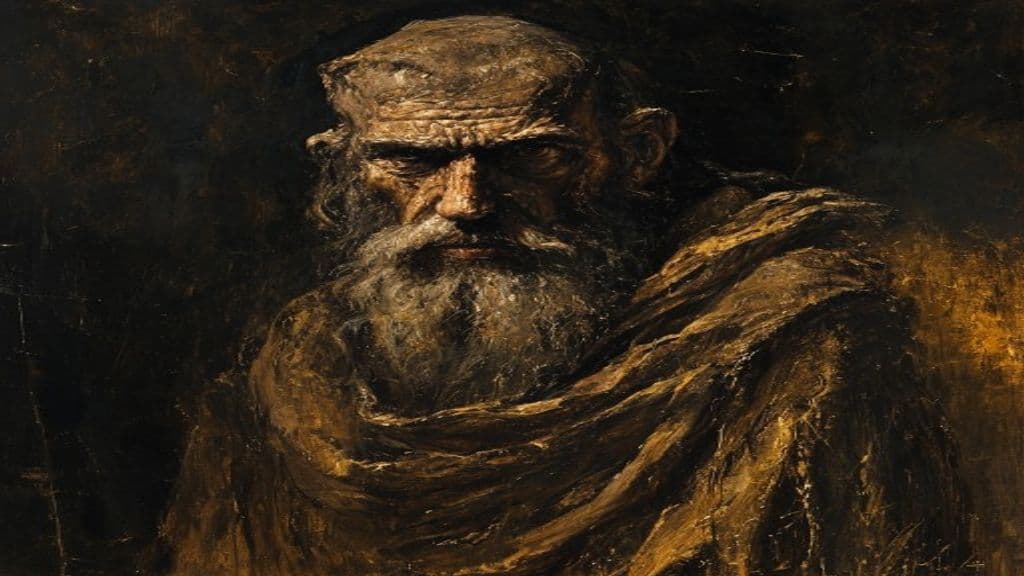
In the biblical genealogical framework summarised in the provided sources, Amalek is an eponymous ancestor (the son of Eliphaz by Timna) and thus the progenitor of the Amalekite clan; this places Amalek as a grandson of Esau in the wider family networks. Over time in Israelite textual tradition Amalek moves from a named tribal founder and historic adversary to a legal-theological category: the ambush of Israel after the Exodus becomes paradigmatic and is legally encoded in Deuteronomy as a command to 'blot out the remembrance of Amalek.' Scholarly discussion of the name's linguistic origin is unsettled in the supplied materials: most modern scholars list the origin as unknown, rabbinical tradition offers a folk etymology (am lak, 'a people who lick [blood]'), and one scholarly proposal (Richard C. Steiner) suggests an Egyptian-derived term meaning 'hostile Asiatic.'
The supplied sources do not provide a physical or supernatural description of Amalek as an individual supernatural being. Amalek is treated as a human ancestor and as a people — the Amalekites — described in biblical narrative as nomadic or semi‑nomadic inhabitants of steppe zones bordering settled Canaan (Negev and Sinai). No corporeal, monstrous, or spirit-like appearance is recorded in the provided materials; descriptions concern social identity, territory, and collective action rather than individual physical traits.
The biblical accounts summarized in the supplied sources ascribe no supernatural powers to Amalek or the Amalekites. Instead, their recorded 'abilities' are military and predatory behaviors: ambushing the Israelites (Exodus 17:8–16), raiding and oppressing Israelite settlements, destroying crops and herds alongside other nomadic raiders (Judges accounts), burning Ziklag and taking captives (1 Samuel 30), and recurring warfare across the period of the Exodus through the judges and early monarchy. The tradition frames Amalek as a persistent human adversary whose violent actions elicit military and juridical responses rather than magical countermeasures.
Weaknesses
- othermilitary defeat / juridical condemnation
- otherdivine judgment as recorded in Israelite law (Deuteronomic injunction to 'blot out' Amalek)
Wards
- conditionmilitary action and legal injunction
Ahab
Ahab (Hebrew: אַחְאָב, ʾAḥʾāḇ) is principally the historical/biblical seventh king of the northern Kingdom of Israel, son and successor of Omri, remembered in Hebrew scripture and later rabbinic literature for political activity, promotion of Baal worship, and confrontation with prophets. The name is also reused in later literature (notably Herman Melville's Captain Ahab), but the supplied sources treat these as distinct human figures rather than supernatural beings.
Amalekites
The Amalekites are a people-group in the Hebrew Bible and later tradition portrayed as Israel's archetypal hostile enemy. Presented as a tribal/national antagonist descended from Amalek (a grandson of Esau), they appear in narratives of raids and battles and later as a theological symbol of implacable enmity that some texts treat as warranting eradication.
Anakim
In Hebrew Bible tradition the Anakim (עֲנָקִים, 'sons/descendants of Anak') are an ancestral people remembered for extraordinary size and a fearsome appearance. Presented as inhabitants of the southern hill country of Canaan who opposed Israelite settlement, they are narrated as a martial/territorial population rather than as supernatural beings; biblical and later sources compare or associate them with other ancient 'giant' categories (Nephilim, Rephaim) and note possible non‑biblical echoes (Egyptian Execration texts' ly Anaq).
Ataroth
Ataroth is a toponym attested in Iron Age Levantine sources (Hebrew Bible and the Mesha Stele). The name labels several distinct towns east and west of the Jordan and functions in those texts as a marker of tribal allotment, territorial boundary, settlement, and cultic-political action.
Azariah IV
Azariah IV is presented in the supplied materials as a label applied to a biblical/historical person bearing the theophoric name Azariah (Hebrew Azaryah/Azari'ah). The sources do not treat Azariah IV as a supernatural being; rather, Azariah is one of several individuals named in Israelite genealogies, priestly lists, and prophetic narratives (e.g., 1 Chronicles 6; prophetic episode with King Asa).
Eliphaz
Eliphaz is a personal name in Hebrew scripture borne by at least two distinct human figures: Eliphaz son of Esau, a genealogical progenitor whose descendants include Amalek; and Eliphaz the Temanite, one of Job's three friends and a principal speaker in the Book of Job. Both figures function in narrative, genealogical, and wisdom-theological roles rather than as supernatural beings.
Amaethon
Amaethon is a figure from medieval Welsh mythology, son of Dôn and a member of the Children of Dôn, identified as a mythic ploughman whose actions (notably a theft from Arawn) figure in the Cad Goddeu ('Battle of Trees'). He is primarily attested in medieval prose and later poetic tradition as an agricultural specialist and participant in otherworld conflict.
Amahuaca
Amahuaca refers to an Indigenous people of the southeastern Amazon Basin (Peru and Brazil) and their Panoan language. The provided sources treat Amahuaca as a human ethnolinguistic group with documented history, language materials, and shamanic practices; there is no evidence in these sources that Amahuaca denotes a supernatural entity.
Amalanhig
Amalanhig are Visayan undead beings in Philippine folk belief, described as aswang who failed to transfer their monstrosity or power before death and who rise from graves to attack living humans. Accounts portray them as externally human in appearance with enlarged upper canines and as predators that bite, feed with a pointed tongue in some tellings, or — in an alternative variant — tickle victims to death.
Amalthea
Amalthea (Α᾿μάλθεια) in Greek myth is the foster-mother or nurse of the infant Zeus (Jupiter). Traditions describe Amalthea either as a goat that nursed the child-god or as a nymph who suckled or fed him with goat's milk; poets in antiquity differ on these interpretations.
Amalthea
Amalthea (Ancient Greek Ἀμάλθεια) is a figure of Greek myth most commonly identified as the nurse of the infant Zeus. Traditions variously portray her as a nymph who tended a goat that fed Zeus or, in later Hellenistic treatments, as the goat itself; she is also associated with the "horn of Amalthea" (cornucopia), a horn reputed to yield inexhaustible food and drink.
Amamikyu
Amamikyu is the female creator deity of the indigenous Ryukyuan religion who, by command of the Heavenly Emperor and aided by the spirit Shinerikyu, fashions the Ryukyu Islands, founds sacred sites and castles, and whose descendants institute kingship and the noro priesthood. She is the focal ancestor of Ryukyuan political-religious order and was ritually venerated at key utaki such as Sefa-utaki.
Community Record
- [1]Amalek - Wikipedia. Wikipedia contributors, 'Amalek,' Wikipedia, The Free Encyclopedia.wiki
- [2]Amalek - Wikidata. Wikidata entry Q372091 (Amalek).other
- [3]Im Bund Jahwes: Erdogan ist ein Krypto Jude.... Archive.org item containing polemical usage of 'Amalek' as epithet.other
- [4]Documentary: A Path to Salvation: Looking upon an Unending Road 3 (PRESSTV). Archive.org documentary listing included in supplied materials.other