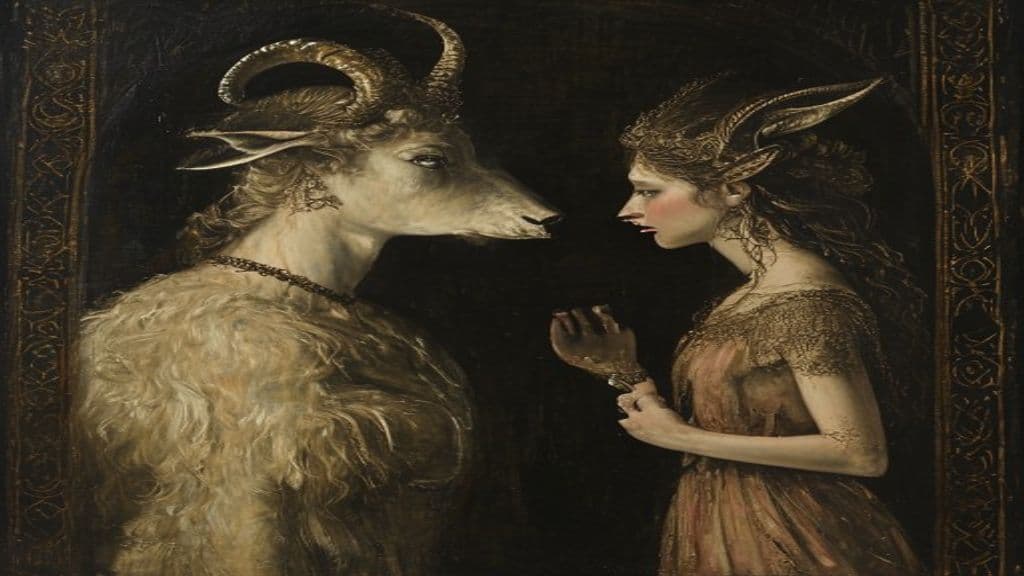
In Greek poetic tradition Amalthea appears in the narrative of Zeus's infancy as the being who nourished and fostered the future chief god. Sources preserved in summaries of classical poetry record two principal variants: some poets name Amalthea as the goat that directly nursed the infant Zeus (Jupiter), while others identify her as a nymph who weaned the child using the milk of a goat. The figure functions within the wider mythic motif of subordinate natural or semi-divine caregivers who preserve and raise a principal deity in his vulnerable youth; poets vary in their accounts rather than presenting a single fixed cult origin.
Classical sources summarized in the available material do not supply a detailed iconography. Two principal conceptualizations are attested in poetic variants: Amalthea as a female caprid (a goat) and Amalthea as a youthful nymph (a minor female divine attendant). Beyond this dual identification, the excerpts provide no reliable details on color, dress, physical measurements, or distinguishing ornaments.
The attested and primary function of Amalthea in the cited traditions is nurturing: she nurses or weans the infant Zeus (Jupiter) and provides him with nourishment (explicitly via goat's milk in some accounts). The sources do not attribute broader supernatural powers, hostile behaviors, or cosmological agency to Amalthea in the provided excerpts; her role is domestic and protective caregiving rather than martial or judicial. Poetic treatments differ in form (animal vs. nymph) but agree on the fostering role.
Community Record
- [1]Amalthea - Biblical Cyclopedia. Biblical Cyclopedia, entry 'Amalthea' — summary noting poets' differing interpretations (goat vs. nymph).other
- [2]Amalthea (mythology) — Wikipedia. Wikipedia, disambiguation / mythology entry listing Amalthea as the foster-mother of Zeus.wiki
- [3]Wikidata: Amalthea. Wikidata entry for Amalthea (mythological figure).wiki