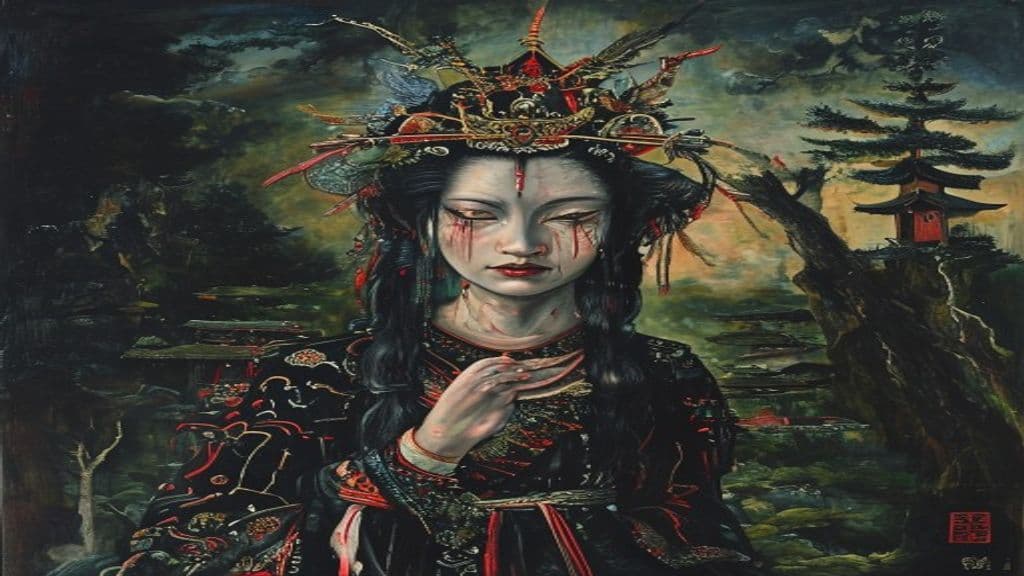
In the Ryukyuan creation account summarized in Chūzan Seikan, the Heavenly Emperor (天帝) in the Heavenly Gusuku (天城) saw there were no islands and commissioned Amamikyu (阿摩美久) to create the Ryukyu Islands. She descended to Earth at Kudaka Island and made landfall at Sefa-utaki on Okinawa. The divine spirit Shinerikyu (志仁禮久; Okinawan: シニリチュー) brought materials (grasses, trees, stones) for her work and with that assistance Amamikyu fashioned islands and populated them; through her descendants (notably a 'heavenly grandchild' Tentei and his children) the five principal social roles—king, Aji (feudal lord), farmer, royal noro, and village noro—are established, rooting political and priestly institutions in her line.
Sources provide no detailed physical description. Amamikyu is represented in the tradition as a female divine figure who descends from the heavenly realm to specific terrestrial sites (notably Kudaka Island and Sefa-utaki) and is associated with founding place-structures such as Tamagusuku Castle and Chinen Castle and with a tomb on Hamahiga Island.
Mythically, Amamikyu's powers are creative and institutional: she fashions islands and settlements using materials brought by Shinerikyu, becomes the progenitor of human social orders through her offspring, and establishes or is linked to sacred geography (Sefa-utaki, Kudaka, Tamagusuku, Chinen, Minton Castle, Hamahiga). Her cult function legitimized political and religious authority—during the Ryukyu Kingdom era the king and the kikoe-ōgimi made annual pilgrimage to Sefa-utaki to worship her facing Kudaka Island.
Amahuaca
Amahuaca refers to an Indigenous people of the southeastern Amazon Basin (Peru and Brazil) and their Panoan language. The provided sources treat Amahuaca as a human ethnolinguistic group with documented history, language materials, and shamanic practices; there is no evidence in these sources that Amahuaca denotes a supernatural entity.
Amalanhig
Amalanhig are Visayan undead beings in Philippine folk belief, described as aswang who failed to transfer their monstrosity or power before death and who rise from graves to attack living humans. Accounts portray them as externally human in appearance with enlarged upper canines and as predators that bite, feed with a pointed tongue in some tellings, or — in an alternative variant — tickle victims to death.
Amalek
Amalek (Heb. עֲמָלֵק, ʿĂmālēq) is presented in the supplied sources as an eponymous ancestor and the nation/tribe of the Amalekites in the Hebrew Bible — a recurring human enemy of Israel whose ambushes and raids become the paradigm for a legal-theological injunction to eradicate their memory.
Amalekites
The Amalekites are a people-group in the Hebrew Bible and later tradition portrayed as Israel's archetypal hostile enemy. Presented as a tribal/national antagonist descended from Amalek (a grandson of Esau), they appear in narratives of raids and battles and later as a theological symbol of implacable enmity that some texts treat as warranting eradication.
Amalthea
Amalthea (Ancient Greek Ἀμάλθεια) is a figure of Greek myth most commonly identified as the nurse of the infant Zeus. Traditions variously portray her as a nymph who tended a goat that fed Zeus or, in later Hellenistic treatments, as the goat itself; she is also associated with the "horn of Amalthea" (cornucopia), a horn reputed to yield inexhaustible food and drink.
Amalthea
Amalthea (Α᾿μάλθεια) in Greek myth is the foster-mother or nurse of the infant Zeus (Jupiter). Traditions describe Amalthea either as a goat that nursed the child-god or as a nymph who suckled or fed him with goat's milk; poets in antiquity differ on these interpretations.
Amamit
Amamit is a female planetary figure in Mandaean cosmology associated with the planet Venus (Libat/Ishtar) and counted among the entourage of Ruha in the World of Darkness; she is attested in Mandaean texts with a role in eschatological decline.
Amanasy
Amanasy is a name referenced in modern compilations as associated with the category of water deities, but the single provided source does not supply any direct attestation, description, or cultural context for Amanasy itself. The available material only explains the general concept of water deities.
Amanda Belle Waller
Amanda Belle Waller is a fictional human bureaucrat in DC Comics who operates as a high-level government organizer of covert operations, most notably directing Task Force X / the Suicide Squad. She is depicted as non-powered, politically ruthless, and an expert tactician who manages and weaponizes extranormal actors within the DC Universe.
Amanojaku
Amanojaku (天邪鬼 / あまのじゃく) is a Japanese yōkai-type being portrayed as a contrarian, heart-reading trickster. Treated in different contexts as a small ogre (ko-oni), a wicked demon (jaki) in Buddhist iconography, and a folkloric spirit that provokes human vice, it appears across regional tales with variable roles from malicious kidnapper to household oddity.
Amanozako
Amanozako is a Japanese divine/monstrous figure described in classical summaries as a furious, contrarian kami produced from the ferocious aspect (ara-mitama) of the storm-god Susanoo; later glosses present her as an ancestor-figure for ill-tempered yōkai such as tengu and amanojaku.
Amaracus
In Greek myth, Amaracus (Ancient Greek Ἀμάρακος, Amarakos) is a young Cypriot prince and royal perfumer who is transformed into the marjoram plant (amarakon). The tale is an etiological metamorphosis that links the aromatic herb Origanum majorana to Aphrodite and to Cypriot cultic and utilitarian uses such as bridal wreaths, aphrodisiac lore, and folk medicine.
Community Record
- [1]Amamikyu - Wikipedia. Wikipedia, 'Amamikyu' article summarizing Chūzan Seikan and related materialwiki
- [2]Amamikyu - Wikidata. Wikidata entry for Amamikyuwiki
- [3]Noro (priestess) - Wikipedia. Wikipedia summary on noro priestesses and their role in Ryukyuan religionwiki
- [4]Creation | Okinawa History/World Heritage Series A. Okinawa.com, historical summary of Ryukyuan creation traditions and sacred sitesother
- [5]THE UNITY OF GOVERNMENT AND RELIGION IN THE RYUKYU ISLANDS TO 1,500 A.D.. Academic article discussing political-religious institutions in Ryukyu and the role of creation mythsacademic
- [6]Hamahiga Island | VISIT OKINAWA JAPAN. Tourism guide noting location of Amamikyu's tomb on Hamahiga Islandother