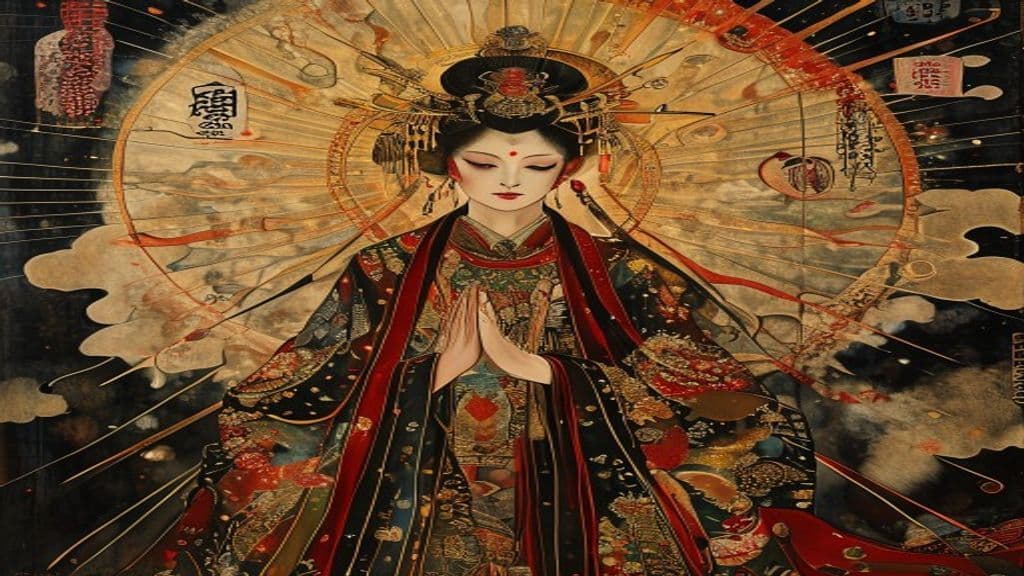
According to the provided sources, Amaterasu was produced during Izanagi's cleansing (misogi) after his return from the underworld, emerging from Izanagi's left eye; classical texts Kojiki and Nihon Shoki place her among the principal offspring of Izanagi and Izanami and among the 'Three Precious Children'. Mythic narratives recorded in these sources also relate conflicts with her younger brother Susanoo that lead to his exile from heaven. She is later linked genealogically to the Imperial House through her grandson Ninigi and is enshrined at Ise, a cult center established in tradition by Yamatohime-no-mikoto.
The provided textual sources do not give a consistent canonical bodily description. Instead Amaterasu is represented symbolically by solar imagery and by cult objects associated with her — notably the sacred mirror (Yata-no-Kagami) and the jewel (Yasakani-no-Magatama) of the Imperial regalia mentioned in source summaries — and by her residence in Takamagahara and enshrinement at Ise. Artistic depictions in modern media (cards, videos) exist but are interpretive rather than authoritative in the cited texts.
Sources present Amaterasu as the sun goddess and ruler of Takamagahara, a chief kami whose status establishes cosmic and political order: she is one of Izanagi's main offspring, part of the 'Three Precious Children', and the mythic ancestress of the imperial line via Ninigi. Mythic episodes recorded in the sources include her birth in Izanagi's misogi and her long-running quarrel with Susanoo that culminated in his exile from heaven. The role described in the sources is chiefly sovereign and cultic rather than malevolent: she is venerated at Ise and central to formal Shinto practice.
Weaknesses
- conditionretreat into Amano‑Iwato (withdrawal into a cave after conflict)
- otherclassical sources do not enumerate personal weaknesses beyond mythic episodes (e.g., the cave retreat) in the provided materials
Wards
- ritualEnshrinement at Ise (custodial cult and proper ritual care)
- symbolSacred mirror and regalia (Yata‑no‑Kagami, Yasakani‑no‑Magatama) as cult objects associated with Amaterasu's authority and ritual custody
- otherNo specific warding formulas against Amaterasu are attested in the provided sources; she is a venerated kami rather than a being for which protective charms are prescribed
Ajisukitakahikone
Ajisukitakahikone is a kami in Japanese mythic literature (Kojiki/Nihon Shoki). He appears in the transfer-of-rule cycle between heaven and earth, is described as a son of Ōkuninushi, associated with the Kamo cult (called Kamo no ōmikami in some modern museum/catalog entries), and features in narratives that explain landscape formation and meteorological genealogy.
Amatsuhikone
Amatsuhikone (天津日子根命 / 天津彥根命) is a kami in Japanese mythology described as a son of the sun goddess Amaterasu. He functions primarily as a member of the heavenly genealogy used to legitimize clan lineages and is later identified as the shintai (sacred body) of Mount Mikami, where Mikami Shrine stands to venerate him.
Amatsumara
Amatsumara (天津麻羅), also called Amenomahitotsu, is a Shinto kami presented in sources as the divine smith of Takamagahara who is said to have aided in making the mirror used in the Amaterasu cave episode and who serves as a patron of earthly blacksmiths.
Ame-no-Koyane-no-mikoto
Ame-no-Koyane-no-mikoto is a male Amatsukami (heavenly kami) in classical Shinto myth, presented as the ritual-official ancestor of the Nakatomi clan and linked genealogically to the Fujiwara. He functions as a divine ritual specialist—performing divination and liturgical speech in foundational myths (notably the Ama-no-Iwato episode) and as guardian of the sacred mirror—and is venerated at major shrines such as Kasuga Taisha and Hiraoka Shrine.
Ame-no-Minakanushi
Ame-no-Minakanushi (天之御中主) is a primordial kami named in Japan's classical creation texts as one of the very first deities to come into being in Takamanohara (High Heaven). Presented in the Kojiki and Nihon Shoki as a solitary, hidden first god, he functions primarily as a mythic point of cosmic origin rather than an actively intervening deity in surviving narratives.
Ame-no-Tajikarao
Ame-no-Tajikarao is a kami in Japanese Shinto myth notable for exceptional physical strength. He appears in the Ama-no-Iwato narrative as the deity who pulls Amaterasu from the heavenly rock cave, and he is venerated at numerous shrines across Japan with associations to physical power and local lineage claims.
Ame-no-Tokotachi
Ame-no-Tokotachi is a primordial kami in classical Shinto cosmology attested in summaries of the Kojiki and Nihon Shoki tradition. Sources identify a very early solitary or among-the-first deity who manifests at the creation of heaven and earth; supplied materials also reference a closely related name, Ame-no-Minakanushi, in English summaries of those chronicles.
Ame-no-Uzume-no-Mikoto
Ame-no-Uzume-no-Mikoto is a Shinto kami of dawn, mirth, revelry and the performing arts whose comic and erotic dance at the entrance of Amano‑Iwato lures the sun goddess Amaterasu from hiding, restoring light; her action is cited as the mythic origin of kagura and of certain ritual/performance lineages.
Ame-no-hohi
Ame-no-hohi (also rendered Ame no Fuhi) is a male kami in Japanese mythology identified in sources as the second son of the sun goddess Amaterasu. He is principally attested as an ancestral figure: historical rulers of Izumo and the modern heads of Izumo Taisha and Izumo-taishakyo claim descent from him.
Ame-no-wakahiko
Ame-no-wakahiko is presented in the provided sources as a kami in Japanese mythology, described specifically as a god of grains and counted among the Amatsukami (heavenly deities). The sources identify him as a son of Amatsukunitama and note a medieval prose narrative, the Ame no Wakahiko Monogatari, exists about him.
Amenohoakari
Amenohoakari (天火明) is a Japanese kami associated with sunlight, heat, and the ripening of grain; he functions as an agricultural deity and a divine ancestor claimed by multiple clans and hereditary priestly lineages. Textual sources place him within heavenly genealogy (tensonzoku) while other records give alternate parentage, producing divergent traditions about his origins and relationships to other kami.
An (案)
An (案) is a small table, desk, or platform used in Shinto ceremonies to bear offerings. It is a liturgical furnishing and material mediator in shrine rites rather than a sentient supernatural being.
Community Record
- [1]Amaterasu Ōmikami - Wikipedia. Wikipedia: Amaterasu Ōmikamiwiki
- [2]Amaterasu (Archive card description). Archive: Amaterasu Omikami (‘the great divinity illuminating heaven’)other
- [3]The Name of Amaterasu Ōmikami – Mimusubi. Mimusubi: The Name of Amaterasu Ōmikamiother
- [4]Silk for Amaterasu Ōmikami – Mimusubi. Mimusubi: Silk for Amaterasu Ōmikami (Kanmisosai garment preparation)other
- [5]Yamatohime-no-mikoto - Wikipedia. Wikipedia: Yamatohime‑no‑mikoto (establishment of Ise Shrine where Amaterasu is enshrined)wiki
- [6]Kojiki exhibition - Green Shinto. Green Shinto: Kojiki exhibition (context for Kojiki/Nihon Shoki traditions)other
- [7]Amaterasu, la déesse du soleil - Mythologie Japonaise (video transcript archive). Archive video: Amaterasu, la déesse du soleil (mentions siblings Susanoo and Tsukuyomi)other
- [8]Amaterasu - Wikidata. Wikidata entry Q455602, label "Amaterasu".wiki