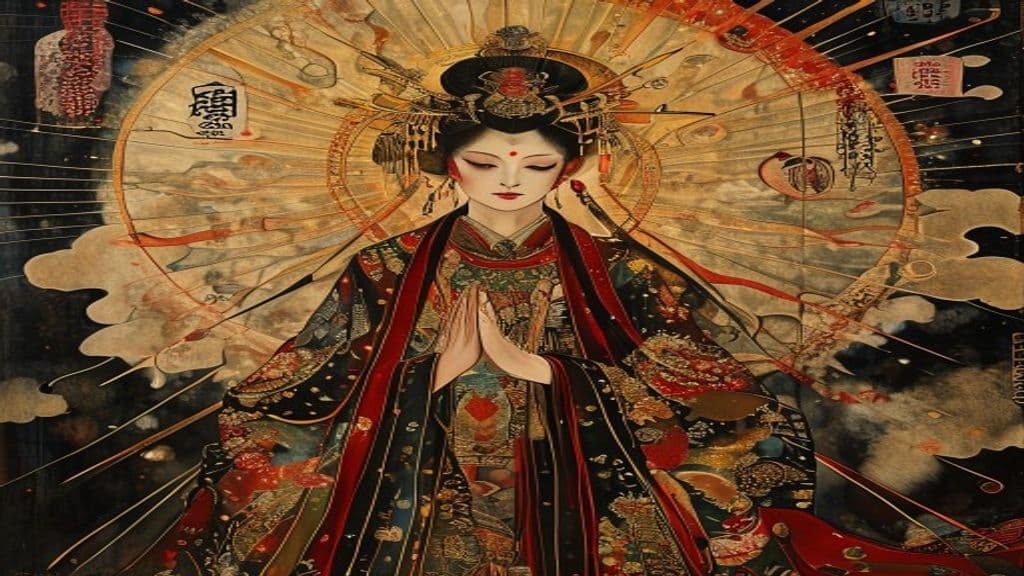
According to the provided sources, Amaterasu was produced during Izanagi's cleansing (misogi) after his return from the underworld, emerging from Izanagi's left eye; classical texts Kojiki and Nihon Shoki place her among the principal offspring of Izanagi and Izanami and among the 'Three Precious Children'. Mythic narratives recorded in these sources also relate conflicts with her younger brother Susanoo that lead to his exile from heaven. She is later linked genealogically to the Imperial House through her grandson Ninigi and is enshrined at Ise, a cult center established in tradition by Yamatohime-no-mikoto.
The provided textual sources do not give a consistent canonical bodily description. Instead Amaterasu is represented symbolically by solar imagery and by cult objects associated with her — notably the sacred mirror (Yata-no-Kagami) and the jewel (Yasakani-no-Magatama) of the Imperial regalia mentioned in source summaries — and by her residence in Takamagahara and enshrinement at Ise. Artistic depictions in modern media (cards, videos) exist but are interpretive rather than authoritative in the cited texts.
Sources present Amaterasu as the sun goddess and ruler of Takamagahara, a chief kami whose status establishes cosmic and political order: she is one of Izanagi's main offspring, part of the 'Three Precious Children', and the mythic ancestress of the imperial line via Ninigi. Mythic episodes recorded in the sources include her birth in Izanagi's misogi and her long-running quarrel with Susanoo that culminated in his exile from heaven. The role described in the sources is chiefly sovereign and cultic rather than malevolent: she is venerated at Ise and central to formal Shinto practice.
Weaknesses
- conditionretreat into Amano‑Iwato (withdrawal into a cave after conflict)
- otherclassical sources do not enumerate personal weaknesses beyond mythic episodes (e.g., the cave retreat) in the provided materials
Wards
- ritualEnshrinement at Ise (custodial cult and proper ritual care)
- symbolSacred mirror and regalia (Yata‑no‑Kagami, Yasakani‑no‑Magatama) as cult objects associated with Amaterasu's authority and ritual custody
- otherNo specific warding formulas against Amaterasu are attested in the provided sources; she is a venerated kami rather than a being for which protective charms are prescribed
Community Record
- [1]Amaterasu Ōmikami - Wikipedia. Wikipedia: Amaterasu Ōmikamiwiki
- [2]Amaterasu (Archive card description). Archive: Amaterasu Omikami (‘the great divinity illuminating heaven’)other
- [3]The Name of Amaterasu Ōmikami – Mimusubi. Mimusubi: The Name of Amaterasu Ōmikamiother
- [4]Silk for Amaterasu Ōmikami – Mimusubi. Mimusubi: Silk for Amaterasu Ōmikami (Kanmisosai garment preparation)other
- [5]Yamatohime-no-mikoto - Wikipedia. Wikipedia: Yamatohime‑no‑mikoto (establishment of Ise Shrine where Amaterasu is enshrined)wiki
- [6]Kojiki exhibition - Green Shinto. Green Shinto: Kojiki exhibition (context for Kojiki/Nihon Shoki traditions)other
- [7]Amaterasu, la déesse du soleil - Mythologie Japonaise (video transcript archive). Archive video: Amaterasu, la déesse du soleil (mentions siblings Susanoo and Tsukuyomi)other