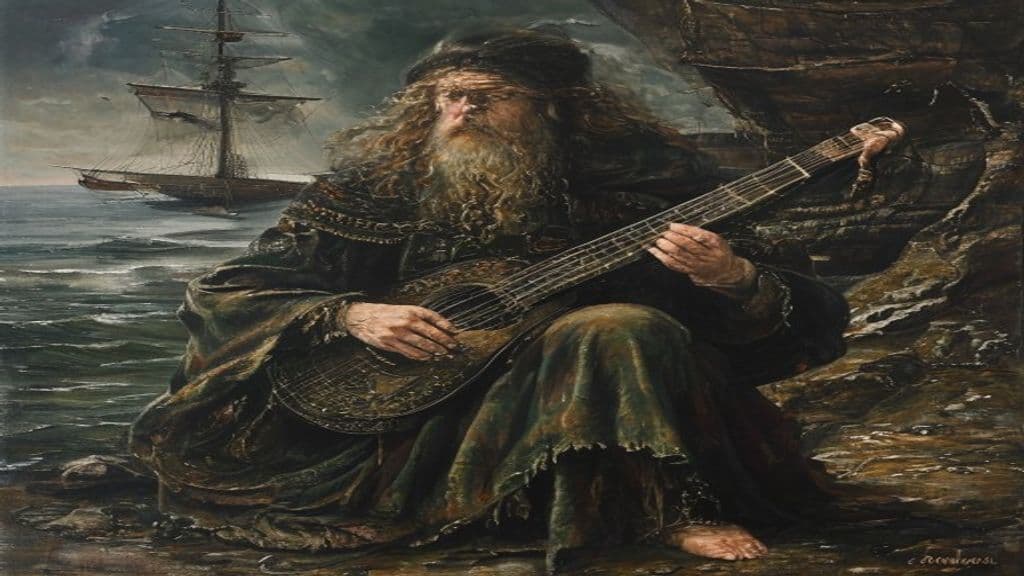
Amergin is presented in the Mythological Cycle as a son of Míl Espáine, one of the seven brothers who lead the Milesian invasion of Ireland. During the Milesian attempt to land at Inber Scéne, after retreating beyond the narrative boundary called the 'ninth wave', Amergin sings an invocation invoking the spirit of Ireland (the Song of Amergin) which parts the storm raised by the Tuatha Dé Danann and allows the ships to land. After the conquest narrative he helps divide the land between his brothers and is appointed Chief Ollam of Ireland; local tradition in Drogheda later locates his burial under Millmount.
Sources give no sustained physical description beyond the epithets attached to his name. The cognomen Glúingel is glossed as 'white knees' and the variant Glúnmar as 'big knee'; these function as distinguishing nicknames in the tradition rather than detailed anatomical descriptions. No clothing, stature, or other bodily detail is recorded in the provided material.
Amergin's principal capacities in the narratives are poetic, juridical, and ceremonial. He is credited with composing and performing the Song of Amergin, an invocation addressed to the spirit of Ireland that in the story parts a storm and secures a safe landing for the Milesians. He acts as an impartial judge mediating terms between the Milesians and the Tuatha Dé Danann, setting rules of engagement prior to combat, and later is named Chief Ollam — the highest poetic/learned office — and participates in the division of land among his brothers as narrated in the conquest story. The corpus attributes multiple poems to him as part of Milesian mythology. The sources do not record ritual formulas, material implements, or step‑by‑step procedures for his rites.
Weaknesses
- otherNo specific vulnerabilities attested in the sources
Wards
- otherNo protective wards directed against Amergin are attested; he is not presented as a hostile spirit in the sources
Balor
Balor is a leader of the Fomorians in the Irish Mythological Cycle, portrayed in medieval texts as a formidable war‑champion and in later folklore as a one‑eyed giant/tyrant whose baleful eye causes great destruction; he is killed by his grandson Lugh in the battle narratives and in folktale variants. Scholarly readings link his name to a Common Celtic root meaning 'the flashing one,' which has informed interpretations of him as a personified destructive natural force.
Enbarr (Aonbharr of Manannán)
Enbarr (Énbarr, Aonbharr of Manannán) is a named supernatural horse in the Irish Mythological Cycle, owned by the sea‑god Manannán mac Lir and shown riding with the hero Lugh Lámhfhada in the tale Oidheadh Chloinne Tuireann. In the narrative tradition it is an otherworldly steed that can traverse land and sea and is said to confer extraordinary protection on its rider.
Failinis
Failinis is a wondrous hound in Irish tradition attested in Mythological and Fenian Cycle materials. In Lebor Gabála Érenn it appears among the eric (reparation) items associated with Lugh Lámhfhada; in later Fenian-cycle ballads and prose a similar or identical hound (also Fer Mac/Fermac) appears as a magical dog owned by princes from the foreign realm Iruaith.
Amemasu
Amemasu (雨鱒, アメマス), sometimes Ō-amemasu (大アメマス), is a giant fish- or whale-like lake-being in Ainu-related and regional Japanese folklore. Tales attribute to it dangerous behaviors (capsizing boats, drowning people), landscape-changing effects (blocking lakes, causing floods), and a cosmological role in which very large individuals can affect earthquakes by 'holding up' the earth.
Amenhotep I (tradition)
Amenhotep I was a historical pharaoh of Egypt's Eighteenth Dynasty who, after his death, was deified and venerated locally as a patron figure of the Theban necropolis and the artisan community of Deir el-Medina. In later funerary contexts his image appears among protective iconography on coffins and in temple decoration, functioning as a local funerary patron rather than a volatile supernatural aggressor.
Amenhotep, son of Hapu
Amenhotep, son of Hapu was a historically attested 18th‑Dynasty official who was posthumously venerated and integrated into Egyptian temple cult as a deified, local healing intercessor. His cult appears in Thebes and resurges in the Ptolemaic period, represented in votive reliefs, chapels, and statues.
Amenohoakari
Amenohoakari (天火明) is a Japanese kami associated with sunlight, heat, and the ripening of grain; he functions as an agricultural deity and a divine ancestor claimed by multiple clans and hereditary priestly lineages. Textual sources place him within heavenly genealogy (tensonzoku) while other records give alternate parentage, producing divergent traditions about his origins and relationships to other kami.
Ameonna
Ameonna (雨女, "rain woman") is a figure in Japanese folklore treated as a yōkai associated with rain. Sources depict her both as a rain-calling supernatural being (sometimes helpful in drought) and as a folk label for an unlucky person whom rain seems to follow; a key pictorial source is Toriyama Sekien's Konjaku Hyakki Shūi.
America Chavez
A fictional superhero published by Marvel Comics, America Chavez is a Latina, lesbian character whose signature ability is creating star-shaped portals that allow travel across space and time. Introduced in 2011, she has been depicted as originating from the extra-temporal "Utopian Parallel" in early stories and later retconned as the product of human experimentation; she has headlined solo series and appeared in team books and the MCU film Doctor Strange in the Multiverse of Madness (2022).
American Crusader
A Golden Age American costumed superhero, Professor Archibald "Archie" Masters gains flight, super-strength, bullet-invulnerability, and electromagnetic-pulse abilities after an 'atom smasher' accident and operates as a patriotic champion in serialized comics; later revivals rework him as a legacy figure subject to suspended animation, cloning, imprisonment, and resurrection for plot purposes.
Amesemi
Amesemi is a Kushite (Meroitic/Nubian) protective goddess, attested in temple reliefs and inscriptions from sites such as Musawwarat es Sufra, Naqa, and Amara from the late 3rd century BCE onward. She functions as the consort of the lion/war god Apedemak and appears in royal and state cult contexts where she is petitioned for life and receives offerings.
Amesha Spenta
Amesha Spenta (Avestan Aməša Spəṇta) are a canonical heptad of divine, bounteous principles in Zoroastrian thought, described as the first emanations of Ahura Mazda and later functioning as moral ideals and protectors or guardians of portions of creation.
Community Record
- [1]Amergin Glúingel — Wikipedia. Wikipedia: 'Amergin Glúingel' entry (accessed via provided research notes)wiki
- [2]Amergin Glúingel — Wikidata. Wikidata item Q463024 (linked in research notes)other
- [3]Balalaika bard (archive excerpt on bardic role). Archive summary providing contextual material on medieval Gaelic bardic office (cited in research notes)other