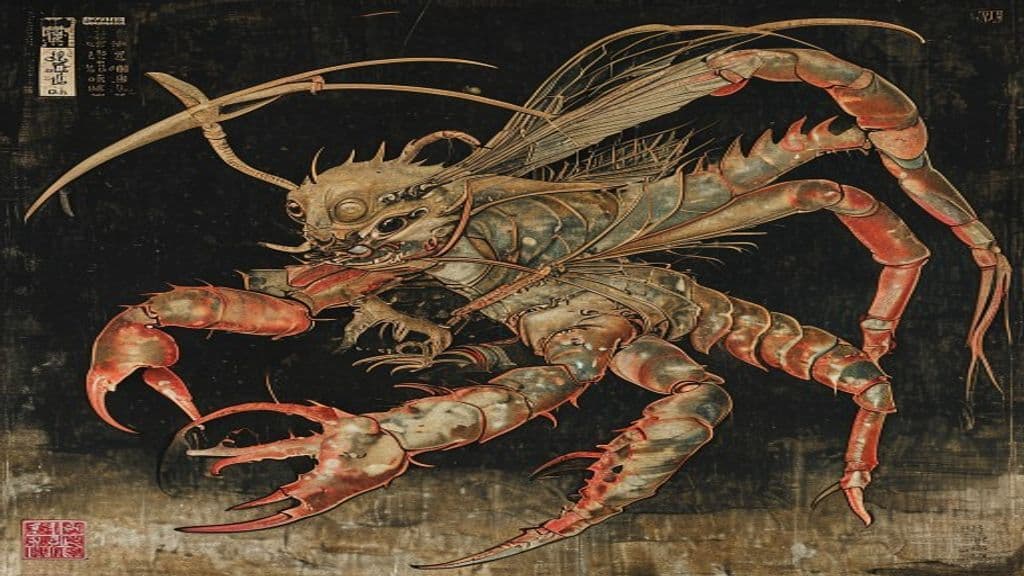
The amikiri's earliest known appearance is as an illustration in Toriyama Sekien's Gazu Hyakki Yagyō (1776). Sekien provided no explanatory caption, and later commentators reconstruct its origin as largely visual/iconographic. Researchers note Sekien sometimes borrowed or played on earlier yōkai imagery (for example the kamikiri motif in Sawaki Sūshi's Hyakkai zukan) and one hypothesis (Katsumi Tada) suggests Sekien may have seized on a pun between ami meaning 'net' (網) and ami referring to a mysid shrimp to invent or label this creature. Later 20th‑century writers projected the specific function of cutting nets onto Sekien's image; some folklorists (Kenji Murakami) consider these later tales uncorroborated and possibly modern inventions.
Sekien's 1776 illustration depicts a small chimera‑like creature variously described in sources as scorpion‑like or a cross between a serpent, bird, and lobster, notable for pincer claws resembling those of a crab or scorpion. Because Sekien supplied no caption or explanatory text, later descriptions and anatomical interpretations derive solely from the image; there is no canonical text defining its exact morphology.
In Shōwa‑period and later writings the amikiri is said to cut fishing nets, meshes hung out to dry, sudare (bamboo blinds), and household mosquito nets. A modern tale collected by Norio Yamada (1974) places such activity in a fishing village in the Shōnai region where nets were repeatedly shredded and mosquito nets left in houses were bitten through; researcher Kenji Murakami was unable to corroborate this local legend and treated it as likely Yamada's invention. The behavioral attribution thus stems from post‑Sekien literature rather than Sekien's original compendium.
Weaknesses
- otherNo documented weaknesses in available sources
Wards
- otherNo documented wards or protective rites in available sources
Amesha Spenta
Amesha Spenta (Avestan Aməša Spəṇta) are a canonical heptad of divine, bounteous principles in Zoroastrian thought, described as the first emanations of Ahura Mazda and later functioning as moral ideals and protectors or guardians of portions of creation.
Amestris
Amestris is primarily a proper name attested for Achaemenid royal women in classical sources and reused in modern fiction as a toponym (not a supernatural being). Historically it denotes at least one queen consort of Xerxes I and a daughter of Artaxerxes II; in modern culture it is best known as the nation-state named Amestris in the manga/anime Fullmetal Alchemist and as an evocative proper name in various creative works.
Amethyst, Princess of Gemworld (tradition)
No supplied sources document a supernatural entity called 'Amethyst, Princess of Gemworld.' The available materials instead discuss the mineral amethyst (etymology, physical properties, and historical beliefs), the use of 'Amethyst' as a given name, and an incidental modern music credit containing the word 'Amethyst.' Therefore this entry reports only what is attested in those sources and explicitly notes the absence of any attested folkloric figure by that name.
Amethyste (Amethystos)
Amethyste (Ancient Greek: Amethystos) appears in later European literary tradition as a beautiful maiden or nymph transformed into the amethyst gemstone; the story is a post-classical etiological invention explaining the stone's purple color and linking the gem to an ancient belief that it prevented drunkenness.
Amida Nyorai
Amida Nyorai (Amitābha / Amitāyus) is a principal Mahayana Buddha venerated across East Asia as the embodiment of Infinite Light and Infinite Life who presides over a Western Pure Land and is invoked as the savior who receives the dying into rebirth there.
Amihan
Amihan is a figure in Tagalog/Philippine tradition presented both as a bird-deity in origin narratives and as the name for the northeast monsoon season (a cool trade wind). In mythic accounts Amihan appears in the Malakas and Maganda creation story as the bird who frees or rescues the first humans from a bamboo; in cultural usage the same term denotes the recurring amihan season across the Philippines.
Amikuk
Amikuk is a Yup'ik / Alaskan Inuit spirit-creature associated with the ground and coastal waters; sources describe it as a shapeshifter that lives within the earth, can swim through earth and water, may take human form, and is dangerous to hunters and travelers.
Amimitl (Opochtli)
A Mexica/Aztec deity associated with fishing, hunting, and water-related technologies; identified in sources with the better-documented figure Opochtli, "The Left," who functions as a specialized patron of implements and as a representative or attendant of the rain god Tlaloc. A temple in the Tira de la Peregrinación has been interpreted by a scholar as possibly belonging to a figure labeled Amimitl, but that identification is uncertain.
Amir Arsalan-e Namdar (The Exalted Prince Arsalan)
A powerful, potentially benevolent figure in Persian mythology with magical abilities. (Note: 1. Power tier needs to be adjusted based on abilities described (as benevolent figure with magical abilities), could be Lesser or Minor Spirit instead of Greater. 2. Summary should mention specific my)
Amirani
In the Georgian tradition, Amirani is a Demiurge figure who defied God by introducing metalworking to humanity. (Note: - Power tier: Greater (not Primordial), as Amirani's abilities are more focused on introducing metalworking and defying God than cosmic-scale powers. - Weaknesses: not just "by God", but specifically )
Amisodarus (Chimera)
A composite monstrous creature from Greek myth, traditionally described as a lion with a goat's head on its back and a serpent for a tail, sometimes winged and noted for breathing fire. It is genealogically placed among the chthonic offspring of Typhon and Echidna and is best known from the heroic-age episode in which Bellerophon defeats it.
Amitābha
Amitābha is a central celestial Buddha of Mahayana Buddhism who presides over the western Pure Land called Sukhāvatī. Devotional practices invoking his 'measureless' light and life (nianfo/nembutsu) are presented in Pure Land traditions as a path by which beings may be reborn in his buddhafield and quickly attain Buddhahood.
Community Record
- [1]Amikiri — Wikipedia. Wikipedia contributors. "Amikiri." Wikipedia, The Free Encyclopedia.wiki
- [2]Amikiri — Wikidata entry Q2746309. Wikidata entry for Amikiri (Q2746309).other
- [3]Gazu Hyakki Yagyō (Toriyama Sekien), illustration (1776). Toriyama Sekien, Gazu Hyakki Yagyō (illustration reproduced in modern archives).literary
- [4]Norio Yamada, collection (1974) — Shōnai tale. Norio Yamada's 1974 tale as summarized in secondary sources cited on the Wikipedia article.folk
- [5]CIA reading room archival file (logistics string 'AMIKIRI'). Archive: CIA Reading Room document containing the string 'AMIKIRI' (no folkloric content).other