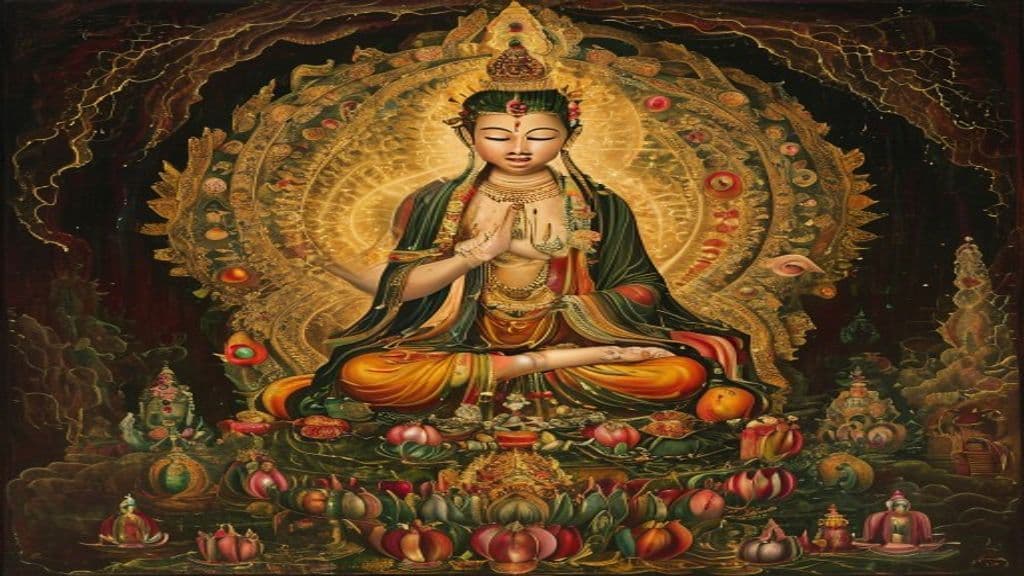
The supplied sources identify Amitābha as one of the principal Buddhas of Mahāyāna Buddhism and equate him with the name Amitāyus. Within the provided material Amitābha is presented doctrinally as a transcendent or celestial Buddha who occupies a central role in devotional systems across East Asia. The excerpts do not supply a sūtric birth-narrative or life-story for Amitābha in full; rather, they locate him as a canonical buddha-figure invoked and visualized in devotional and tantric contexts (including a concise guru-yoga text by Jamyang Khyentse Wangpo in which the master appears in the form of Amitābha).
The supplied materials do not give a detailed iconographic description. What is documented is that Amitābha is instantiated as a Buddha-form used in visualization and devotional practice: practitioners and guru-yoga texts instruct disciples to picture the guru or deity in the form of a buddha, and in the cited Vajrayāna text the teacher is visualized specifically as Amitābha. Beyond this functional statement about visualization, the provided excerpts do not describe specific physical features, attributes, colors, hand-gestures, or attendant iconography.
In the sources Amitābha is described primarily in religious and soteriological terms rather than as an enumerated catalogue of supernatural powers. He is a celestial buddha who serves as an object of veneration across East Asia and as a focus for meditative identification: in guru-yoga practice a disciple visualizes the guru in the form of a buddha (here Amitābha) to unite the practitioner's mind with the wisdom of the teacher and to cultivate familiarity with the purity and equality central to the Vajrayāna vision. The supplied material classifies Amitābha as an exalted, transcendent buddha within Mahāyāna cosmology but does not list specific miraculous acts or magical abilities within the excerpts provided.

Acala
Acala (Sanskrit: अचल, 'The Immovable') is a wrathful protective deity (dharmapala) in Vajrayāna and East Asian esoteric Buddhism, classed among the Wisdom Kings (Vidyārāja). He functions as a ritual focus for visualization and mantra practice intended to remove obstacles and bind or destroy hostile forces.
Akshobhya
Akshobhya is a transcendent buddha of Mahāyāna and Vajrayāna Buddhism, one of the Five Wisdom (Dhyāni) Buddhas. He personifies 'mirror knowledge' (ādarśa-jñāna), is conventionally placed in the East, and is lord of the eastern Pure Land Abhirati; in esoteric texts he is associated with the eastern Vajra division and invoked in mantra/mandala ritual contexts.
Amida Nyorai
Amida Nyorai (Amitābha / Amitāyus) is a principal Mahayana Buddha venerated across East Asia as the embodiment of Infinite Light and Infinite Life who presides over a Western Pure Land and is invoked as the savior who receives the dying into rebirth there.
Amoghasiddhi
Amoghasiddhi is one of the Five Tathāgatas (Five Wisdom Buddhas) in Mahayana and Vajrayana/Esoteric Buddhism, representing the Karma family and the quality of "unfailing accomplishment". He functions as an archetypal, protective, and contemplative buddha-body within tantric mandalas, presiding over the northern quarter and invoked in mantras and ritual iconography.
Anantacāritra
Anantacāritra (Sanskrit: अनन्तचारित्र) is a bodhisattva figure in the Lotus Sūtra, identified as one of the four great perfected bodhisattvas who attend Gautama Buddha. The name is glossed as "Boundless Practice" and, in Tiantai commentary, is read as representing eternity.
Aparajita (Wisdom King)
Aparajita is named in secondary sources as a member of the broad class of East Asian Buddhist 'wisdom kings'—wrathful protective emanations associated with Buddhas and bodhisattvas. The supplied materials do not provide a focused, primary textual profile for an individual Aparajita; most attestations address the wisdom-king category and the protective powers of dharani/mantra (notably the Shurangama Mantra).
Arhat
An arhat (Sanskrit: arhat; Pāli: arahant) is in Buddhist traditions a human practitioner who has gained insight into the true nature of existence, attained nirvāṇa, and been liberated from the cycle of rebirth. The status and valuation of arhatship vary by school: some traditions equate it with full liberation, while others treat it as distinct from or inferior to the bodhisattva/buddha ideal.
Avalokiteśvara
A central Mahāyāna and Vajrayāna bodhisattva who embodies great compassion (mahākaruṇā), Avalokiteśvara hears the cries of sentient beings and manifests in many forms to relieve suffering. Venerated across South, Central, and East Asia, the figure functions devotionally (mantra and sutra recitation) and iconographically in multiple gendered and regional guises.
Bhagavatī
Bhagavatī is an honorific Sanskrit epithet applied to revered female divinities in Hinduism and Mahayana Buddhism rather than a single individualized spirit. The title functions as a respectful form of address for goddesses such as Sarasvati, Lakshmi, Parvati and certain Buddhist female deities (e.g., Cundā) and is the feminine counterpart to Bhagavān.
Bhaisajyaguru
Bhaisajyaguru (Bhaiṣajya‑guru; Medicine Buddha) is a Mahāyāna buddha associated with healing, medicine, and a pure land called Vaiḍūryanirbhāsa (Pure Lapis Lazuli). He functions as a therapeutic savior whose remedies operate through the "medicine of his teachings," vows, devotional practice, and radiance associated with lapis‑lazuli light.
Bhaiṣajyarāja (Medicine King Bodhisattva)
Bhaiṣajyarāja (Sanskrit: Bhaiṣajyarāja; Chinese: 藥王 Yào Wáng) is a Mahāyāna bodhisattva associated with healing, medicine, and supreme self‑offering. He appears in the Lotus Sūtra and in visualization/contemplation sutras and is often connected ritually and iconographically with the Medicine Buddha (Bhaiṣajyaguru) and with the paired bodhisattva Bhaiṣajyasamudgata.
Bhaiṣajyasamudgata
A Mahāyāna bodhisattva associated with the therapeutic activity of the Buddha and invoked in visualization (Guan) sūtras. He is named alongside the Medicine King (Bhaiṣajyarāja) and is the co-subject of a dedicated contemplation sūtra used in meditative-healing practice.
Community Record
- [1]Amitābha - Wikipedia. "Amitābha (Sanskrit pronunciation: [ɐmɪˈtaːbʱɐ], 'Measureless' or 'Limitless' Light) ... is one of the main Buddhas of Mahayana Buddhism and the most widely venerated Buddhist figure in East Asian Buddhism."wiki
- [2]Amitābha Buddha - Wikidata. Wikidata description: "celestial buddha of Mahayana Buddhism."other
- [3]Practices for Buddha Amitabha's Pure Land, 2012-07-02 (archive). Archive listing: a teaching series presenting a complete set of teaching and meditation practices to go to the inner and outer Pure Land of Buddha Amitabha.other
- [4]Fundamentos de la ética y práctica en el budismo Tierra Pura Chino - Charles B. Jones (archive). Archive item referenced in research notes discussing Pure Land doctrine, vows, and accessibility of rebirth in Sukhāvatī.other
- [5]UN GURU YOGA MUY CONCISO BASADO EN AMITABHA (Jamyang Khyentse Wangpo). Archive text (Spanish excerpt): describes guru-yoga practice and notes that in this text the master appears as Amitābha; 'El guru yoga es una práctica a través de la cual el practicante se une a la sabiduría del maestro... En este texto, compuesto por Jamyang Khyentse Wangpo, el maestro aparece como Amitābha.'literary