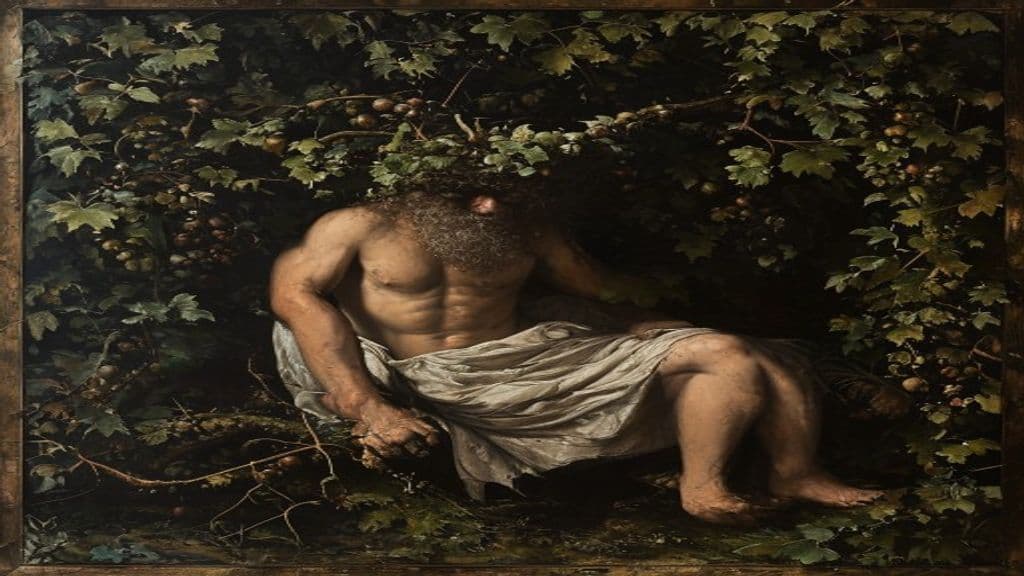
In the version attested in Ovid's Fasti, Ampelus is described as an "unshorn" youth, the son of a nymph and a satyr, beloved of Bacchus (Liber). While rashly plucking showy grapes from a vine that trailed from an elm on the Ismarian hills he tumbled and was killed; Bacchus then bore the lost youth to the stars and the vine is said in the poem to take its name from the boy. This narrative functions etiologically to explain the vine's name and a Bacchic stellar memorial.
Sources give only sparse description. Ovid characterizes him as "unshorn" and records his parentage as son of a nymph and a satyr; no detailed physical description (height, clothing, precise features) is supplied in the cited passages.
No independent supernatural powers are attributed to Ampelus in the provided sources. His role is narrative/etiological: his death and Bacchic favor explain the naming of the vine and his apotheosis among the stars. Modern catalogue entries (e.g., Wikidata) sometimes label him as a hamadryad nymph, but this classification conflicts with Ovid's masculine depiction and is therefore uncertain.

Aergia
Aergia (Ancient Greek: Ἀεργία) is the personification/goddess of sloth, idleness, indolence and laziness in Greco-Roman mythic thought. She appears in literary sources as a named personified quality and as an attendant or guardian in the household of Sleep (Hypnos/Somnus); Roman equivalents include Socordia and Ignavia.
Anaxarete
Anaxarete is a mythic mortal woman in Greco-Roman tradition who, according to Ovid's Metamorphoses, scorned a suitor named Iphis and was transformed by Aphrodite into a stone statue preserved at Salamis. Her story is cited as an exemplum of divine punishment for cruel disregard of love and belongs to the broader corpus of metamorphosis myths.
Athis
Athis is an obscure named figure attested only in modern reference listings as part of the corpus of Greek and Roman mythology. The supplied sources provide the name but no primary narrative, attributes, ritual traditions, or consistent biographical details.
Dies
Dies is the Roman personification of Day, treated in literary and encyclopedic sources as the counterpart of the Greek Hemera and as a divine figure in genealogical accounts of cosmic forces.
Rhipheus
Rhipheus is a named member of the centaur (Kentauroi) class in Greco‑Roman mythic catalogues and in Ovid's Metamorphoses. Surviving references are fragmentary: he appears as an onomastic entry among other centaurs and in a brief poetic line that compares his height to tall trees.
Selene
Selene is the ancient Greek goddess and personification of the Moon, who drives her moon-chariot across the heavens. Daughter of the Titans Hyperion and Theia and sister to Helios and Eos, she embodies both the luminous aspect of the Moon and its function as regulator of the month.
Amos
Amos is a human prophetic figure in the Hebrew Bible, traditionally counted among the Twelve Minor Prophets. Presented as a rural, non‑professional prophet from Tekoa, he delivers visionary oracles condemning social injustice and ritual hypocrisy and is traditionally credited with the book bearing his name.
Amoz
Amoz (Hebrew: אָמוֹץ, ʼAmōṣ/Amotz) is a personal name in the Hebrew Bible identified as the father of the prophet Isaiah. In rabbinic tradition the naming of a prophet's father is sometimes read as implying that the father was also a prophet; later rabbis therefore ascribe prophetic status and royal kinship to Amoz in interpretive accounts.
Ampelos
Ampelos (Ancient Greek: Ἂμπελος, lit. 'Vine') is a mythological figure in Greek and Roman literature who functions both as the beautiful youth beloved of Dionysus/Bacchus and as a personification or origin-figure of the grapevine (and, in one account, a star). Surviving literary summaries record two main versions: in Nonnus a satyr youth is gored to death after provoking Selene and is transformed into the first vine by Dionysus; in Ovid a reckless boy falls while picking grapes and is placed among the stars (Vindemitor/Boötes) by Liber/Dionysus.
Amphalces
Amphalces (Ancient Greek: Ἀμφάλκης) is an Argive prince attested in Greek mythographic and genealogical sources as a son of King Antiphates and Zeuxippe and as brother of Oicles. He appears only in genealogical lists and compendia; no narrative deeds, cult, or iconography are preserved for him in the cited material.
Amphialus (Amphialos)
Amphialus (Ancient Greek: Άμφίαλος, Amphialus/Amphialos, lit. 'of two seas') is a recurring personal name in classical Greek epic, genealogical tradition, and later pastoral/romance literature. The name is applied to several distinct mortal figures — a Phaeacian athlete in the Odyssey, various seafaring companions and suitors in Homeric summaries, a son of Neoptolemus and Andromache in genealogical accounts, and a noble/warrior character in early modern Arcadian romances — rather than to a single supernatural being.
Amphiaraos
Greek hero and seer associated with the Amphiareion of Oropos sanctuary, known for his ability to foresee the future and connection to oracular responses and healing. (Note: 1. Power tier should be Ancient (not Primordial), as Amphiaraos is a hero and seer, but not a cosmological being. 2. Ability description: The ability to foresee the future is accurate, but the transfo)
Community Record
- [1]Ovid, Fasti (Corona Borealis summary in archive packet). Ovid, Fasti (paraphrase/summary as provided in the Corona Borealis archive packet)literary
- [2]Ampelus — Wikipedia. Wikipedia entry 'Ampelus'wiki
- [3]Ampelus — Wikidata. Wikidata item Q12748314 (labels Ampelus; notes hamadryad classification)other
- [4]Nonnos' Dionysiaca (general reference). Nonnos, Dionysiaca (referenced as related Dionysian literature in the archival packet)literary