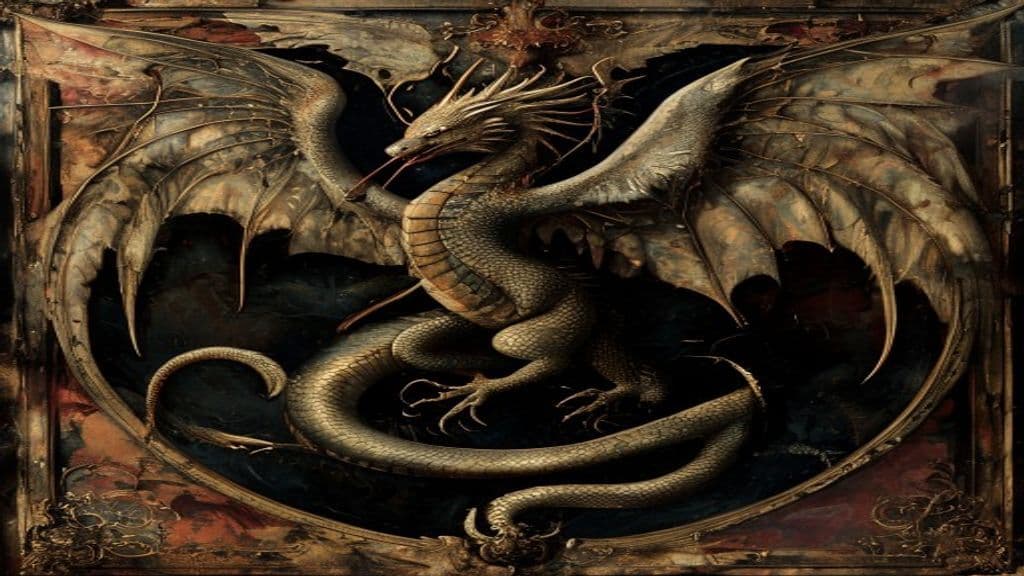
No mythological origin story or narrative cosmology is given in the available sources. The amphiptere is attested only as a classificatory figure within the visual vocabulary of European heraldry; the sources do not provide accounts of its creation, mythic exploits, or cultic history.
Sources provide only the classificatory description 'winged serpent.' Within the limits of the available material, the amphiptere's canonical appearance combines a serpentine body with wings as a heraldic device. No further iconographic details (number or form of wings, limbs, coloration, posture, or stylistic variants) are supplied in the cited source.
The sources do not ascribe supernatural powers, behaviors, or agency to the amphiptere. It is presented as a symbolic, graphical figure used in heraldry rather than as an active supernatural actor; any 'abilities' would be symbolic functions within heraldic representation, but the sources do not elaborate on those symbolic meanings.
Allocamelus
An invented heraldic beast — a pictorial hybrid typically shown with an equine or donkey head and a camel's (usually single‑humped) body — used as a crest or armorial charge by English trading companies such as the Eastland Company.
Boars in Heraldry
The boar (including the wild boar and the boar's head) is a recurring emblematic animal charge within European heraldry and related civic and family identity systems. Treated as a conventional heraldic device rather than a supernatural being, the boar functions as a visual signifier of lineage, allegiance, martial reputation and canting (name-play) across antiquity, the medieval period and into the early modern era.
Lampago
A heraldic beast depicted with the body of a tiger or lion and the head of a man, used as a charge on coats of arms rather than as an agent of narrative folklore. Best known from English heraldry, notably the arms of the Radford family of Plymstock, Devon.
Amphimedon
In Homer's Odyssey, Amphimedon (Ancient Greek: Ἀμφιμέδων) is an Ithacan, son of Melaneus, one of the suitors of Penelope who fights in Odysseus's hall, is killed during the slaughter of the suitors, and (within the Homeric narrative) later appears among the dead in the Underworld to recount the events of that slaughter. The same name is also used in modern biological taxonomy for a genus of sponges; that referent is distinct.
Amphinome
Amphinome is an ancient Greek proper name attested for multiple distinct female figures in myth — chiefly a Nereid (sea-nymph) and several mortal women (including a wife of Aeson and one of the Peliades). The name is also reused in modern taxonomic and creative contexts (annelid genus, butterfly species, and contemporary fantasy), but these are later reuses rather than continuations of a single mythic being.
Amphinomus
Amphinomus (Ἀμφίνομος) is a personal name borne by several human figures in Greek tradition, most notably a princely suitor of Penelope in Homer's Odyssey; other bearers appear in local genealogies, a Catanian civic legend, and a later historical record as a geometer. The sources treat Amphinomus as mortal personages rather than a supernatural being.
Amphion
Amphion is a figure (or set of figures sharing a name) in Greek myth best known as the son of Zeus and Antiope, twin brother of Zethus, husband of Niobe, and famed in some traditions for using music to raise the walls of Thebes. The name also appears for several minor mythic characters (an Argonaut, an Achaean at Troy, a centaur), indicating multiple onomastic uses in the Greek corpus.
Amphion and Zethus
Amphion and Zethus are twin brothers of Greek myth who function as the culture‑founding heroes of Thebes: Amphion the musician and Zethus the hunter/herdsman who together conquer Thebes, build the Cadmea, and rule jointly. Their story links human founders with gods (commonly Zeus as father; Hermes, Apollo and Artemis as intervening deities) and ends in later family tragedy surrounding Niobe and divergent accounts of the brothers' deaths.
Amphirho
Amphirho (Ancient Greek: Amphirho) is attested in the supplied sources as one of the Oceanids — daughters of the Titans Oceanus and Tethys — and is named in a brief mythological taxonomy entry. The name is said in that source to possibly mean "surrounding-river" (from amphi- and rhoos). Modern uses of the form "Amphiro/Amphirho" appear in the provided sources as taxonomic and commercial names (e.g., Wikidata taxon entry, a butterfly species, and a company/product), but those uses are not presented in the supplied materials as folkloric attestations.
Amphisbaena
A legendary two‑headed serpentine or lizard‑like marvel from Greco‑Roman and medieval bestiary traditions, described with a functional head at each end and noted for moving in either direction without turning. It appears in poetry, natural histories, and folk remedies, and its parts are recorded as materia magica in sources such as Pliny and medieval bestiaries.
Amphithea
Amphithea (Ancient Greek Ἀμφιθέα) is a recurring personal name in ancient Greek mythic genealogies, borne by several mortal women who function as wives, mothers, and sisters within Argive, Nemean, Odyssean, and Aeolian family networks. She is not presented in the sources as a supernatural being but as a human figure whose primary narrative role is genealogical linkage among heroic lineages.
Amphithemis
Amphithemis (Ancient Greek: Ἀμφίθεμις) is a name applied in Greek literary tradition to at least two distinct mythic figures: a semi-divine progenitor, son of Apollo and Acacallis connected with Libya and eponymy (also called Garamas), and, in a later poetic treatment by Nonnus, a centaur among Dionysus' retinue. The figure appears in genealogical material (Apollonius/Hyginus tradition) and in Late Antique epic (Nonnus' Dionysiaca).
Community Record
- [1]Amphiptere. Wikipedia, 'Amphiptere' (accessed source excerpt: 'Amphiptere is a type of winged serpent found in European heraldry.')wiki