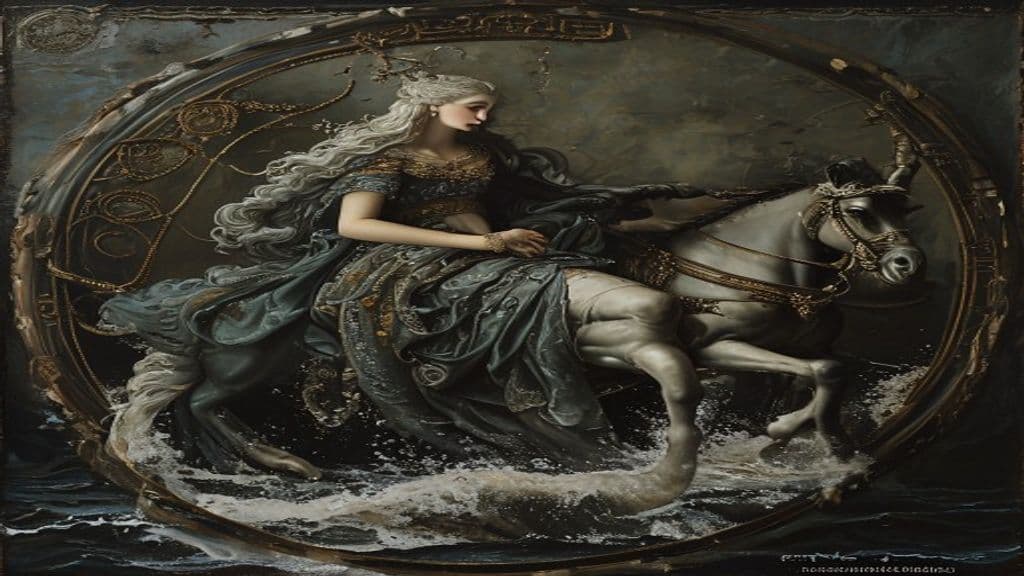
In Hesiod's account Amphitrite is a daughter of the sea-god Nereus and the sea-goddess Doris and is therefore counted among the Nereids; Apollodorus in at least one tradition also lists her among the Oceanids, so sources vary on genealogical classification. Mythic narratives record a courtship by Poseidon: in some versions she fled — to the Atlas Mountains or "the farthest ends of the sea" — to preserve her virginity until a dolphin found and persuaded her to accept Poseidon's suit, whereupon Poseidon rewarded the dolphin by setting it among the stars as the Delphinus constellation. Alternate accounts describe Poseidon seizing her while she danced with the Nereids. She became Poseidon's consort and mothered offspring such as Triton and other sea-figures in various traditions.
In literary and visual traditions Amphitrite is portrayed with queenly attributes: enthroned beside Poseidon or riding with him in a chariot drawn by hippocamps or other sea-creatures and attended by Tritons and Nereids. Iconographic details include queenly robes, nets in her hair, and occasionally the pincers of a crab attached at her temples. Homeric and later poetic epithets describe her as "moaning" or "loud-moaning" Amphitrite and apply the epithet Halosydne ("sea-nourished"), an epithet she shares with Thetis; these are formulaic poetic descriptors rather than anatomical specifics.
Poetic and mythic sources attribute to Amphitrite authority over the sea and its creatures: she is represented as nourishing fishes "in numbers past all counting," breeding sea-monsters, and as a sea-power whose great waves and breakers are central images of peril and abundance in epic. Her agency in narratives is primarily relational and ecological — mothering marine beings (notably Triton) and appearing as ruler or personification of salt water — rather than described as a catalogue of ritualized magical powers in surviving cult manuals.
Weaknesses
- otherNo documented weaknesses; sources emphasize her confined authority to the sea and her infrequent independent civic cult rather than hostile vulnerabilities
Wards
None recorded.

Aconteus
Aconteus (Ancient Greek: Ἀκόντιος, Akóntios, lit. 'javelin') is a personal name borne by several distinct mortal figures in Greek myth: an Ethiopian chief turned to stone by Medusa's head at Cepheus' court, an Arcadian warrior killed in the Seven against Thebes, and Acontius of Ceos who used a trick with an apple to secure marriage to Cydippe. The name functions as a human actor across heroic-age narratives rather than a single supernatural class.
Andromeda
Andromeda is a mortal princess in ancient Greek myth, daughter of Cepheus and Cassiopeia, who is offered as a sacrificial victim to the sea monster Cetus and rescued by the hero Perseus. Her story links human hubris, divine punishment, heroic rescue, and catasterism—she is later placed among the stars as the constellation Andromeda in some accounts.
Ceto
Ceto (Ancient Greek: Κητώ, Kētṓ) is a primordial sea goddess in Greek mythic cosmology, daughter of Pontus and Gaia, primarily notable as the maternal progenitor of various named monstrous beings (e.g., the Graeae and Gorgons) by Phorcys. Her name is etymologically linked to the common Greek term for sea-monster (kētos), and she functions chiefly as a genealogical and cosmological figure rather than an active, individualized actor in surviving narratives.
Cyrene
Cyrene is an eponymous ancient Greek mythological heroine associated with the North African city of Cyrene and remembered chiefly as a mortal lover of the god Apollo and as an aetiological figure whose name is applied to place and artistic types in Greco-Roman culture.
Euphemus
Euphemus is a hero of ancient Greek mythic tradition, often counted among the Argonauts and Calydonian hunters, commonly described as a son of Poseidon and associated with seafaring, a miraculous clod-of-earth episode, and the foundation-ancestry of colonies such as Thera and Cyrene.
Heliades
In Greek myth, the Heliades are the daughters of the sun-god Helios (by the Oceanid Clymene) whose intense mourning for their brother Phaëthon leads to their metamorphosis into poplar trees; their tears are said in the tradition to become amber.
Hyades
A sisterhood of mythic figures in ancient Greek tradition identified with an open star cluster in the constellation Taurus; popularly called 'the rainy ones' because their seasonal risings and settings were associated with rain and the rainy season. They appear in myth as nurses/escorts (notably caring for the infant Dionysus) and in astronomy as the Hyades star cluster.
Lamia
In ancient Greek mythology, Lamia is described as a child-eating monster who, in later tradition, came to be regarded as a type of night-haunting spirit or 'daimon'. The supplied sources do not provide a full physical description or detailed mythic genealogy, and some modern fictional portrayals recast her with serpentine features which are not attested in the provided classical summary.
Piras
Piras (Ancient Greek: Πειρᾶς) is an Argive king in Greek mythic genealogies, known primarily by name and familial connections rather than by individual deeds or cult. He appears in variant forms (Piren, Peiren, Peirasus, Piranthus) and is attested as a son of Argus and Evadne.
Amphithemis
Amphithemis (Ancient Greek: Ἀμφίθεμις) is a name applied in Greek literary tradition to at least two distinct mythic figures: a semi-divine progenitor, son of Apollo and Acacallis connected with Libya and eponymy (also called Garamas), and, in a later poetic treatment by Nonnus, a centaur among Dionysus' retinue. The figure appears in genealogical material (Apollonius/Hyginus tradition) and in Late Antique epic (Nonnus' Dionysiaca).
Amphithoë
Amphithoë is a named Nereid in Greek mythology, listed among the fifty daughters of Nereus and the Oceanid Doris and identified in modern summaries as the Nereid associated with sea currents. She is attested as a member of the collective of sea-nymphs but is not the subject of independent myths in the supplied sources.
Amphitryon
Amphitryon is a mortal nobleman of Greek mythic-historical tradition: son of Alcaeus of Tiryns, husband of Alcmene, and the acknowledged stepfather of Heracles. He appears in heroic-age narratives as a warrior, dynastic actor, and the human whose identity is impersonated by Zeus in literary treatments that explore paternity and identity.
Community Record
- [1]Amphitrite — Wikipedia. Wikipedia: Amphitritewiki
- [2]Wikidata: Amphitrite. Wikidata entry for Amphitriteother
- [3]Votive pinax dedicated to Poseidon and Amphitrite (Penteskouphia). Image file caption and archaeological description (pinax, Penteskouphia near Corinth)other
- [4]Various archival and cultural references to the name Amphitrite. Archive items noting later cultural uses of the name Amphitriteother