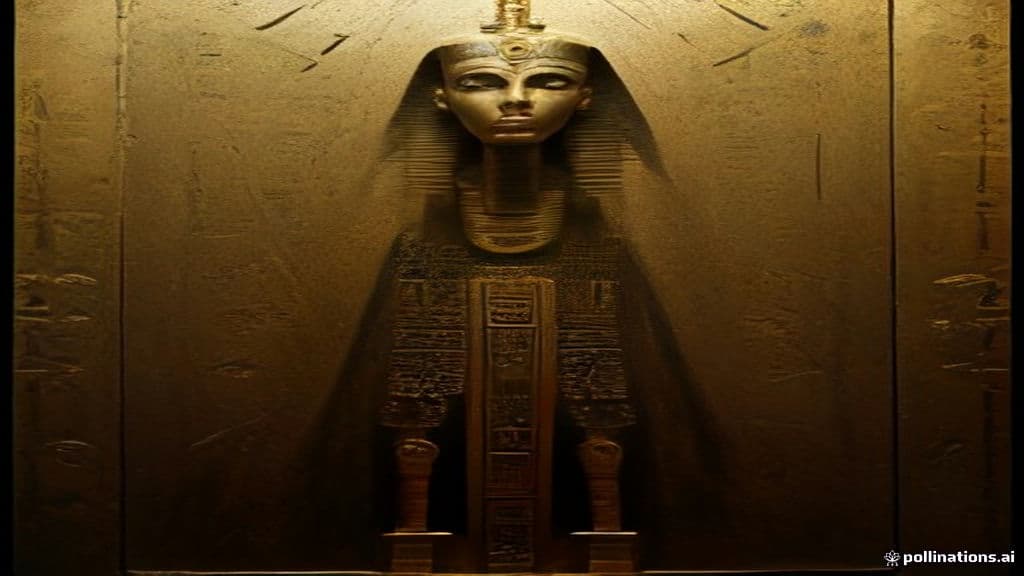
In the sources summarized here, Amun is an early-attested deity (present from the Old Kingdom) who, through historical development and syncretism with the sun-god Re, became venerated as Amun-Re. By the 11th Dynasty Amun rose to patronal prominence at Thebes, replacing earlier local war-gods such as Montu in that civic-religious role. In some theological frameworks preserved in later receptions, Amun is also situated among primordial creative groupings (for example appearing as a member of the Hermopolitan Ogdoad in certain accounts).
The provided excerpts do not record a consistent, detailed iconographic description. Temple inscriptions cited in the material portray Amun-Re as an observing divine presence within ritual and royal scenes (for example, inscriptions showing the king slaughtering captives 'whilst Amun-Re looks on'), but no specific headdress, animal attributes, or full pictorial formula are given in these notes.
Sources emphasize Amun-Re's capacious roles within state religion: legitimizing and empowering the pharaoh, functioning at major temple precincts, and serving as the focus of oracular consultation (the Siwa oracle is singled out as an enduring cultic institution). Temple inscriptions also place Amun-Re as a divine witness to royal acts, reinforcing kingship and military claims. Theological writings in later receptions discuss the deity in broader cosmological and intellectual contexts (e.g., as a locus for discussions about Nous), but ritual or magical abilities beyond state cultic functions are not specified in these excerpts.
Community Record
- [1]Amun. "Amun was a major ancient Egyptian deity who appears as a member of the Hermopolitan Ogdoad. Amun was attested from the Old Kingdom together with his wife Amunet. His oracle in Siwa Oasis, located in Western Egypt near the Libyan Desert, remained the only oracle of Amun throughout. With the 11th Dynasty, Amun rose to the position of patron deity of Thebes by replacing Montu." (Wikipedia: Amun)wiki
- [2]Precinct of Amun-Re. "Inscriptions inside the temple show the king slaughtering captives, whilst Amun-Re looks on." (Precinct of Amun-Re)wiki
- [3]Tracing the Changing Conceptions of Nous (archival essay). Modern reception materials in the collected notes treat the Amen-Ra concept as a locus for discussions about mind/Nous and ancient theological ideas (archival essay).other
- [4]Saturnian Cosmology – Amun-Re (modern theological essay, cited with caution). "Hence, the Pharaoh and Amun-Re enjoyed a symbiotic relationship, with the king deriving power from Amun-Re. In return, the king supported the temples and the worship of Amun. In theory, Amun-Re could even take the form of the king in order to..." (SaturnianCosmology.org text) — presented in the notes as a modern interpretive source and treated as theological rhetoric rather than primary ritual evidence.other