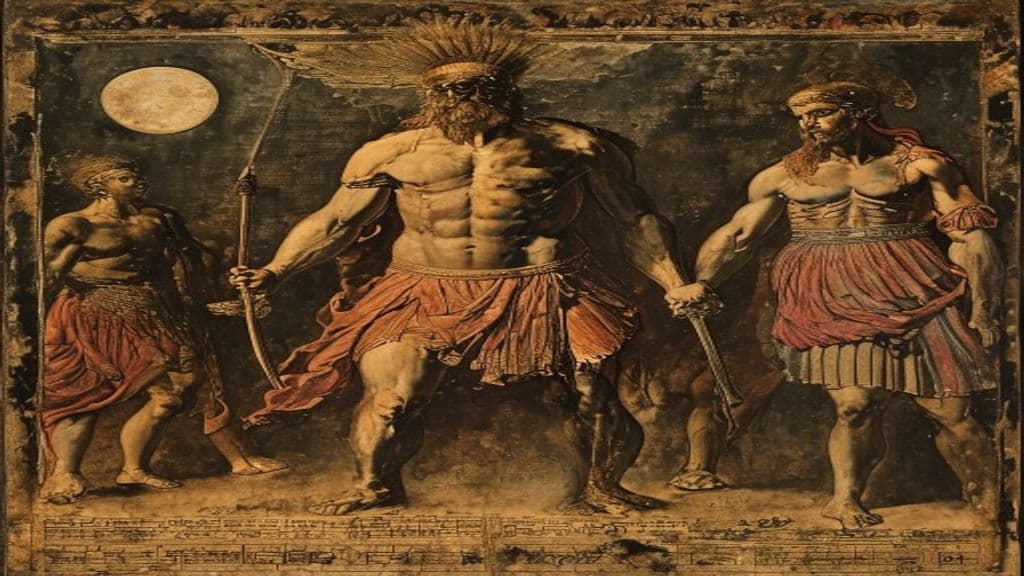
In Hesiod's Theogony (line cited in scholarship, e.g., l. 228), the Androktasiai are listed as offspring of Eris (Strife) among a catalogue of hostile personifications. This Hesiodic genealogical listing names them alongside other abstract daimones produced by Eris — for example Hysminai (Battles), Machai (Wars), Phonoi (Murders), Neikea (Quarrels), and Dysnomia (Lawlessness) — indicating their role as part of a family of evils attendant on discord. This is a list-based, poetic genealogy rather than a narrative birth scene with actions or cultic foundation.
Primary Hesiodic and Hesiodic-Homeric passages do not preserve an independent, detailed visual description or iconography for the Androktasiai. They are typically named within lists of personified evils or as one element among many depicted in ekphrastic set-pieces (for example the Hesiodic Shield of Heracles), and no distinct physical attributes for Androktasiai themselves are described in the cited passages; surviving visual detail in the Shield passage concentrates on other personifications (e.g., Ker/Fate) rather than Androktasia as an individuated figure.
As plural personifications, the Androktasiai represent the phenomenon of manslaughter in battle — the slayings of men that occur in warfare. Sources treat them as named daimones in poetic catalogues rather than as individualized actors with independent myths or discrete feats. In literary contexts (Hesiod; the Shield of Heracles ekphrasis echoed in Homeric material), they function as emblematic components of the scene of war, conceptually linked with other battle-spirits like Hysminai, Machai, and Phonoi. The surviving texts present them allegorically as attendant consequences of Eris (Strife) rather than as agents with documented causal interventions beyond their role as personified abstractions.
Aethon
Aethon (Ancient Greek aithōn) is an epithet meaning 'burning', 'blazing' or 'shining' used across classical Greek literature to describe animals (especially horses), some other animals, and occasionally humans. In the provided sources it functions as a descriptive name applied in poetry and myth rather than as a single, individuated supernatural being; the term is also reused in modern taxonomy and cultural titles.
Chromios
Chromios is an ancient Greek personal name attested for several human figures in classical literary and historical sources (not a single supernatural being). Attestations include Chromios of Aitna, victor in a chariot race celebrated by Pindar (Nemean I, c. 473 BCE); a warrior/captain name found in epic/Homeric indices and scholia; an Argive survivor in the tradition of the Battle of the 300 Champions; and the modern asteroid 32726 Chromios, a Jupiter Trojan named from the Greek onomastic repertoire.
Ctesippus
Ctesippus (Greek Κτήσιππος, Ktēsippos) is an ancient Greek personal name attested for several distinct mortal figures in literary and mythographic sources: one or more sons of Heracles in genealogical lists, a wealthy and disorderly suitor of Penelope in the Odyssey, and a named minor interlocutor or symposium participant in Platonic dialogues. The attestations show recurring onomastic use rather than a single supernatural entity.
Elephantis
Elephantis (Ancient Greek: Ἐλεφαντίς) is a name attested in two distinct registers of the ancient Greek world: (1) a late 1st century BCE Greek poet/physician credited in Roman and Greek authors with erotic manuals, cosmetics and abortive recipes, midwifery, and medical remedies; and (2) a mythographic/mortal figure listed among the wives or consorts of Danaus and named as mother of some Danaïdes in variant genealogical traditions.
Andrew the Apostle
Andrew the Apostle (Greek Ἀνδρέας, Latin Andreas) is one of the Twelve Apostles in the New Testament, a fisherman from Bethsaida, the brother of Simon Peter, described as the “first-called” who introduced others to Jesus. Post-biblical traditions depict him as an early missionary and founder of Christian communities (notably claims of missions to Thrace, Scythia, and founding the see of Byzantium) and as a martyr crucified at Patras.
Androgeos
Androgeos (Greek Ἀνδρόγεως, Latin Androgeus) is a personal name borne by mortal figures in classical Greek and Roman literary tradition, most notably a son of Minos and Pasiphaë whose death in mythic narratives precipitates Athenian tribute to Crete. A separate, less-detailed bearer of the name is listed as a Greek soldier present at the sack of Troy in some sources.
Androgeus
Androgeus is a mythic human name borne by at least two distinct figures in Classical Greek and Roman tradition: a Cretan prince, son of Minos and Pasiphaë, famed for athletic victories and whose death in some accounts is linked to the Marathonian/Cretan bull; and Androgeos, a Greek soldier named by Virgil in the Aeneid who, during the sack of Troy, mistakes Aeneas and his companions for fellow Greeks. Both are mortal figures woven into larger heroic and epic cycles rather than supernatural beings.
Androgynos (Judaism)
In rabbinic Jewish literature, the androgynos (Hebrew: אַנְדְּרוֹגִינוֹס, ʾandərôg̲înôs) is a human juridical category for a person who possesses both male and female sexual characteristics. It is treated as a special halakhic classification that raises questions about which gendered legal obligations, prohibitions, and ritual statuses apply.
Andromache
Andromache (Ancient Greek Ἀνδρομάχη) is a human figure of ancient Greek literary tradition: the wife of Hector of Troy who exemplifies virtuous fidelity, ritual mourning, and the losses suffered by women in war. She appears in Homeric epic and later classical sources as grieving spouse, captive concubine after Troy's fall, and later queen in post-war narratives.
Andromalius
Andromalius is a named spirit from post-medieval grimoire tradition (Ars Goetia–style catalogues) presented as a ranked officer who recovers stolen goods, exposes thieves and dishonest dealings, and punishes wrongdoers. He appears primarily in modern occult reference compilations derived from the Goetia; ritual details and physical description are not attested in the supplied grimoire excerpts.
Andromeda
Andromeda is a mortal princess in ancient Greek myth, daughter of Cepheus and Cassiopeia, who is offered as a sacrificial victim to the sea monster Cetus and rescued by the hero Perseus. Her story links human hubris, divine punishment, heroic rescue, and catasterism—she is later placed among the stars as the constellation Andromeda in some accounts.
Andron
Andron (Ancient Greek: Ἄνδρων) is an ancient Greek personal name attested for multiple historical individuals (writers, a dancer/composer, historians, a sculptor, a physician) in classical biographical and bibliographical sources; it also appears as a modern given name/surname in contemporary records. The provided sources do not present Andron as a supernatural being.
Community Record
- [1]Theogony (Hesiod) — list of Eris' offspring. Hesiod, Theogony (line cited in scholarship for Eris' offspring including Androktasiai)literary
- [2]Shield of Heracles (Hesiodic ekphrasis) — Androktasia on the shield. Hesiodic Shield of Heracles passage describing personifications on the shield, including Androktasia alongside Homados, Phonos, Kydoimos, Kerliterary
- [3]Androktasiai (overview). Modern reference summarizing classical attestations identifying Androktasiai as personified manslaughters descended from Erisother
- [4]Androktasiai — Wikidata entry. Wikidata entry for Androktasiai summarizing literary attestationsother
- [5]Androctasiae (Androktasiai) — Theoi Project. Compilation of classical references and translations noting Androktasiai as Hesiodic personifications of manslaughterother