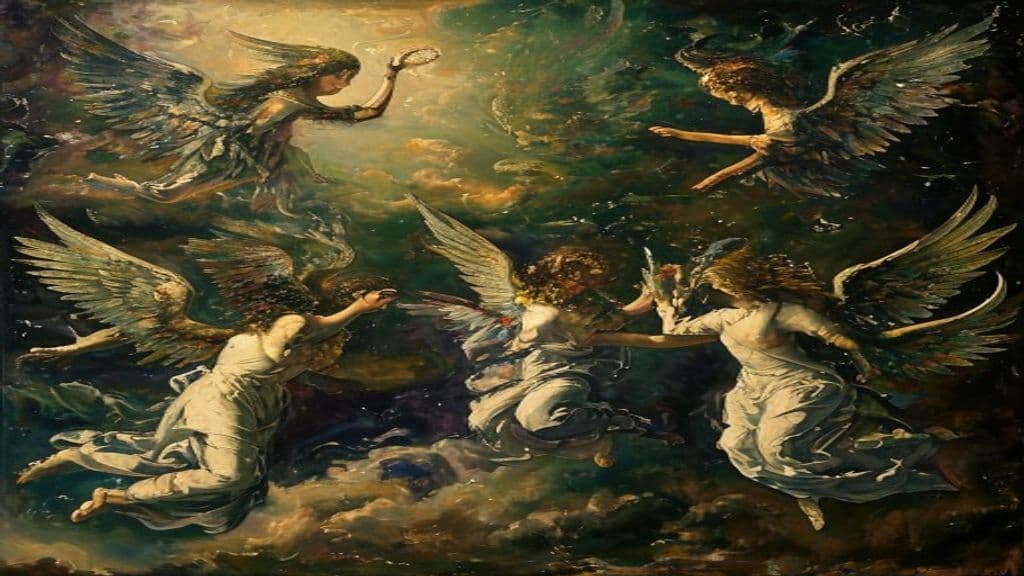
In the doctrinal and textual framework represented by the sources, angels are created by God from a luminous or light-like origin (nūr) and belong to the unseen (ghayb) and the heavenly realm (malakūt). They are formed as part of God's governance of creation and act as heavenly spirits distinct from jinn and devils; their creation from light and placement in the divine order is the principal origin narrative present in the supplied materials.
The supplied sources emphasize angels' origin as beings created from light and classify them as heavenly spirits; they do not provide consistent, detailed anthropomorphic descriptions in the excerpts given. While broader Islamic tradition includes hadith and exegetical material that sometimes describe wings or vast sizes, those specific hadith details are not present in the provided sources and are therefore omitted here.
Across the supplied material angels are described as obedient heavenly agents performing roles assigned by God: mediating revelation, serving on a heavenly council, acting as scribes who record human deeds (cf. Qur'anic references such as Q.50:17–18 as noted in the sources), carrying God's throne, and executing divine commands including participation in divine assistance or judgment. Theological discussions recorded in the sources also treat angels as generally lacking bodily passions and as associated with reason (aql) and light (nūr). Debates among schools of theology concern whether angels are incapable of error (a position attributed to some Mu'tazilite and many Salafi views) or whether they may fail or be dismissed (a view found in some Kalām, Ashʿarite, and Māturīdite discussions).
Abraham (Ibrāhīm) in Islam
Ibrāhīm (Abraham) in Islam is a human prophet and messenger chosen by God, a paradigm of pure monotheism (hanīf), patriarchal ancestor to later peoples and prophets, and traditionally regarded as having helped establish the Kaʿbah with his son Ismāʿīl. He is called Khalīl Allāh ('Friend of God') and is central to rites commemorated in Hajj and Eid al‑Adha.
Asiya bint Muzāḥim (Asiya)
Asiya is the Qur'anic figure presented as the wife of the Pharaoh in the era of Moses who secretly embraced monotheism, adopted and preserved the infant Moses, and is venerated in Islamic tradition as an exemplary righteous woman promised a house in Paradise for her faith and steadfastness.
Jinn
A class of supernatural beings from pre-Islamic Arabian religion later integrated into Islamic theology; jinn are created, morally accountable entities distinct from humans and angels, often unseen but capable of taking visible forms and interacting with people in varied ways.
Angel of Portugal
A Catholic devotional national guardian angel venerated as the heavenly custodian of Portugal. Recognized in popular devotion, private revelation narratives (notably the 1916 visitations connected to Fátima), and in Portuguese liturgical practice through a feast instituted in the early 16th century and restored in the 20th century.
Angel of the Lord
A recurring divine messenger in the Hebrew Bible and New Testament who appears on behalf of the God of Israel, acting as God's representative in speech and deed. The figure—Hebrew מַלְאַךְ יְהוָה (mal’ākh YHWH)—functions as intermediary, guide, protector, judge, and announcer at decisive narrative moments.
Angel of the Presence
A high-ranking heavenly attendant described in Hebrew and Second Temple literature as one who "stands in the presence" of God and acts on God's behalf toward Israel. Sources treat the figure either as an elite created angelic office (one of the attendants who enter before the Lord) or, alternately, as a scriptural idiom referring to God's own saving presence.
Angelia
Angelia (Ancient Greek: Ἀγγελία) is an ancient Greek poetic personification of 'Message', attested in Pindar (5th century BC) as named a daughter of the messenger-god Hermes. She functions in the literary-cosmic vocabulary as the embodiment of a delivered message rather than as a separately attested cultic deity or independent supernatural class.
Angelos (Angelia)
Angelos (Ancient Greek: Ἄγγελος) or Angelia (Ἀγγελία) is a minor divine figure in Greek myth attested only in a scholion on Theocritus' Idyll 2. She is described as a daughter of Zeus and Hera who was entrusted to and raised by nymphs; the preserved account is fragmentary and breaks off abruptly.
Angels of Mons
A World War I legend of a supernatural force that intervened to protect British troops during the Battle of Mons (23 August 1914). Originating in Arthur Machen's short story "The Bowmen" and amplified by wartime press, spiritualist magazines, sermons and memoirs, the phenomenon was variously described as phantom medieval bowmen, a luminous cloud, or angelic warriors associated with Christian figures such as St. George, Joan of Arc, or the archangel Michael.
Angerona
Angerona (also Angeronia; local form Ancharia at Faesulae) is a polyvalent goddess in ancient Roman religion associated with relief from pain and sorrow, protection of Rome (including custody of the city's "sacred name"), and a calendrical role at the year's turning (Angeronalia/Divalia near the winter solstice). She is attested in state cult practice (pontiff-offered sacrifice) and in local altars, and is discussed by modern scholars as a tutelary, healing, and liminal deity.
Anggitay
A Philippine folkloric female equid–human hybrid often described with the upper body of a woman and the lower body of a horse. Frequently compared to the Greek centauride and sometimes presented as a female counterpart to the tikbalang; traditionally associated with an attraction to gemstones and jewelry and with a local homeland in Santo Tomas, Batangas in some accounts.
Angharad Golden-Hand
A literary heroine of medieval Welsh romance, Angharad Golden-Hand (Welsh: Angharad Law Eurawc) appears as a lady of King Arthur's court in the tale of Peredur son of Efrawg. She functions in the narrative as Peredur's beloved whose spoken declaration of love for the Mute Knight permits Peredur to break his vow of silence. The name is later reused in Renaissance and modern literature with different meanings.
Community Record
- [1]Angels in Islam (Wikipedia summary as used). Summary and excerpts drawn from the Wikipedia article 'Angels in Islam' as supplied in the research notes.wiki
- [2]Wikidata: angel in Islam. Wikidata entry for angel in Islam (noted in the research notes).other
- [3]Archive listings and lecture descriptions (selected). Archive collection listing cited in the research notes as a repository of related religious texts and lectures; specific excerpts on angels were not quoted.other
- [4]TIMING IN ISLAM (archive listing). Archive item listed among the sources; included in the research notes' bibliography though no specific ritual material on angels was quoted from it.other
- [5]دروس الفقہ الاحوط - الباب الایلاء (archive listing). Archive lecture listing referenced in the research notes; included among materials that teach core creed points including belief in angels.other