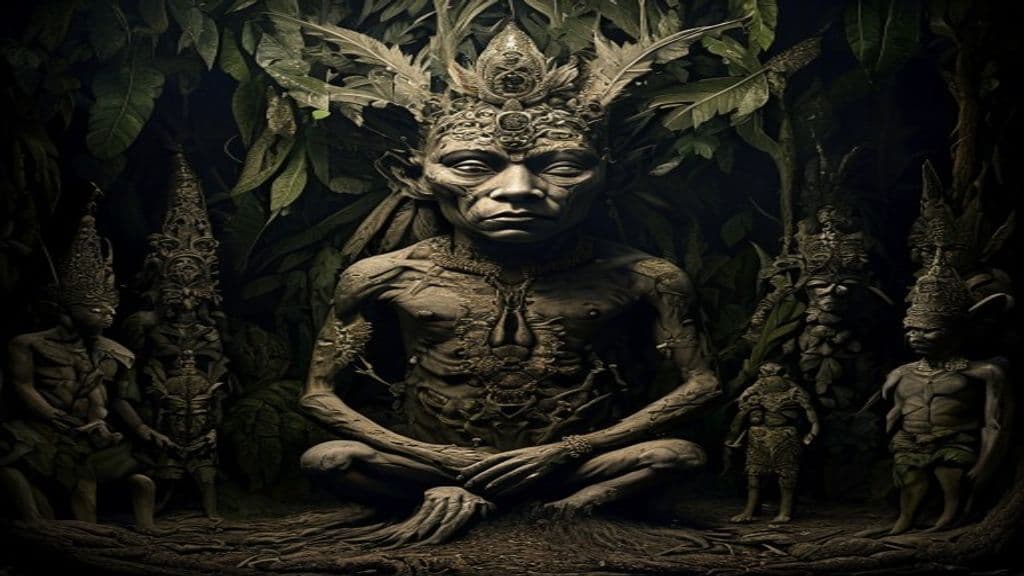
There is no single mythic origin for anito as a class; rather the term is a cultural‑linguistic category with deep Austronesian roots. Linguistically, anito (also anitu) derives from Proto‑Malayo‑Polynesian *qanitu and Proto‑Austronesian *qaNiCu glossed as 'spirit of the dead', with cognates across the region (e.g., Micronesian aniti, Polynesian atua/aitu, Malaysian/Indonesian hantu/antu, and Formosan hanitu/hanidu). This etymological network, together with local cosmologies, grounds anito as a longstanding category for ancestors, place‑owners, and non‑human spirits rather than a single creation myth.
As a class, anito lack a single visual form in the sources. Ancestor anito are socially treated as familial persons and may be represented by carved humanoid figures (taotao) made of wood, stone, or ivory that house or represent the spirit. Many nature or deity anito, by contrast, 'do not normally appear in human form' and are often described as genderless or androgynous; their manifestations are tied to places or forces (fields, forests, seas, winds, lightning) rather than uniform anthropomorphic description.
Abilities and behaviors vary by type. Ancestor anito (ninunò) act as protectors, intercessors, advisors, and can be invoked in pag‑anito rituals for protection or counsel; they may also act as psychopomps guiding souls to spirit realms. Vengeful or displeased ancestor spirits can manifest as harmful apparitions (mantiw) and cause illness or misfortune unless appeased. Nature/deity anito 'own' particular locales or phenomena and receive outdoor offerings; many do not normally intervene in everyday human affairs but can be propitiated for favors or to avert harm. Overall, anito and the living maintain reciprocal obligations—ritual communication, offerings, and taboos—through specialists who mediate requests, diagnoses, and repairs to the social‑spiritual relationship.
Weaknesses
- conditionReciprocal relations and offerings: their goodwill and continued positive influence depend on proper reciprocal relations (offerings, observance of taboos and customary behavior); failure of these relations risks angering them or diminishing their favor.
Wards
- ritualPag‑anito (séance/ritual mediated by specialist)
- ritualPagdiwata (ritual directed to nature spirit/deity)
- conditionMaintenance of offerings, sacrifices, and observance of local taboos/customary behavior toward place spirits and ancestors
Amalanhig
Amalanhig are Visayan undead beings in Philippine folk belief, described as aswang who failed to transfer their monstrosity or power before death and who rise from graves to attack living humans. Accounts portray them as externally human in appearance with enlarged upper canines and as predators that bite, feed with a pointed tongue in some tellings, or — in an alternative variant — tickle victims to death.
Amihan
Amihan is a figure in Tagalog/Philippine tradition presented both as a bird-deity in origin narratives and as the name for the northeast monsoon season (a cool trade wind). In mythic accounts Amihan appears in the Malakas and Maganda creation story as the bird who frees or rescues the first humans from a bamboo; in cultural usage the same term denotes the recurring amihan season across the Philippines.
Bakla
Bakla is a Philippine social and gender category—commonly an assigned‑male‑at‑birth person who adopts a feminine gender expression and is often treated as a third gender. Historically some bakla served as indigenous ritual specialists (babaylan, katalonan), but the term itself denotes a social identity, not a supernatural being.
Laon
Laon is presented in the supplied sources as an ancient supreme creator figure in Visayan mythic cosmology, identified in some accounts with the name Makaako and said to dwell in the uppermost level of a seven-layered universe.
Manaul
Manaul is a birdlike mythic figure in multiple Philippine indigenous traditions, variously portrayed as an omen-bearing bird sent by Bathala or Amihan, a king who guides destinies and instigates cosmic conflict, and a rebellious/cosmogonic agent who creates islands.
Tigmamanukan
A Tagalog augural bird — a class of omen-bearing bird (and by extension other animals) read as messages from the creator deity Bathala. Its flight direction and song were interpreted to authorize or forbid journeys and, in some origin myths, a bird identified as the tigmamanukan acts as an agent opening the primordial bamboo.
Anippe
Anippe (Ancient Greek: Ἀνίππης) is a river-nymph (naiad) in Greek mythology, described in mythographic sources as a daughter of the river-god Nilus and as the mother of the Egyptian king Busiris by the god Poseidon. She is attested primarily as a genealogical figure tying Egyptian place-figures into Greek divine genealogy.
Aniruddha
Aniruddha is a mythological Vrishni prince and warrior in Hindu narrative (notably the Bhagavata Purāṇa), grandson of Kṛṣṇa and Rukmiṇī, son of Pradyumna and Rukmavatī. He is portrayed as a dynastic hero (a mahārathi), participant in the Uṣā–Bāṇāsura episode, father of Vajra, and—in certain Vaiṣṇava theological schemes—counted among the catur-vyūha and associated with the boar (Varāha) theriomorph.
Anit
The string "Anit" appears in the consulted sources as a modern personal name, acronym/technical term, and occasional orthographic variant; the dataset contains no coherent folkloric entity named "Anit." The only mythic figure in the corpus with a vaguely similar spelling is the Egyptian minor goddess Iunit (also spelled Iunet), 'She of Armant,' consort of Montu — an identification with "Anit" is uncertain in the sources.
Anius
Mortal king and priest of Apollo in Greek mythology, with significant spiritual roles. (Note: * Power tier: Lower than Primordial; considering Anius is described as a mortal king and priest, a more accurate power tier would be Greater or at least Ancient, but likely not Primordial. * Abilities)
Anjana
Anjanas are benevolent female fairy beings in Cantabrian popular belief who protect forests, springs, animals and people, aid the poor and lost, leave gifts for the generous, and oppose the hostile Ojáncanu. Oral tradition presents them either as heavenly agents sent by God with a limited earthly term or as spirits of trees who care for the woodland.
Ankalamma (Angala Paramesvari)
Ankalamma (also Angala Paramesvari) is a village mother‑goddess and guardian deity (kaval deivam) of South India, venerated in Andhra Pradesh, Karnataka, and Tamil Nadu. She is associated with territorial protection, sacred groves, and liminal mortuary spaces (graves and cremation), and is often syncretized with Parvati, Kali, or counted among the Matrikas.
Community Record
- [1]Anito (Wikipedia). Wikipedia contributors, 'Anito,' Wikipedia, The Free Encyclopedia.wiki
- [2]Anito (Wikidata). Wikidata entry Q3549810, 'anito'.wiki
- [3]Archive items mentioning 'Anito' (contextual—not used for ethnographic claims). Archive.org listings containing the word 'Anito' but not used for ritual or cultural claims in the present entry.other